
New recommendations have been provided to counter vaccine misinformation, after a flawed analysis gained publicity this year around anti-vaccination.
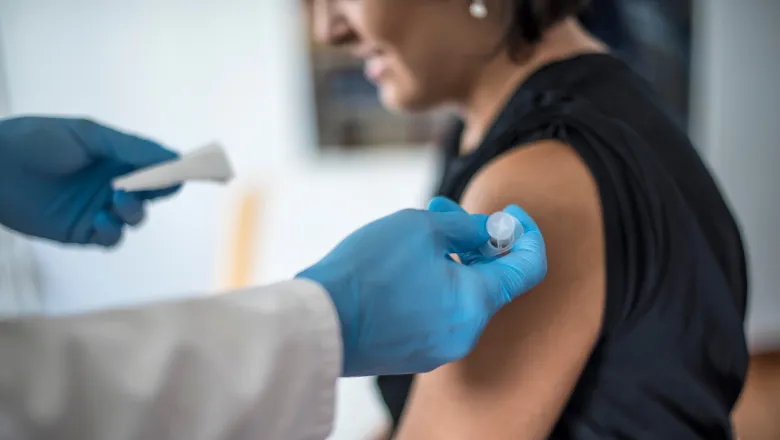
A new Viewpoint led by a King's College London researcher includes guidance around AI, non-peer reviewed research and accessible content, to tackle misinformation around anti-vaccination.
The research is prompted by a non-peer-reviewed analysis that reported a link between vaccination and chronic illness. The analysis was not published in a scientific journal, was never independently reviewed, and appeared on the US Senate Homeland Security and Governmental Affairs website as a hearing submission. It was then picked up through a documentary film An Inconvenient Study and then became widely cited by anti-vaccine influencers on social media. Henry Ford Health, the health system whose records were used, has published a fact-check describing the findings as preliminary, unreviewed and open to misinterpretation.
The new Viewpoint article, written by international experts in vaccinology, paediatrics, infectious diseases, epidemiology and biostatistics, and led by Dr Daniel Munblit, a Reader in Paediatrics at King's College London, unpicks problems and limitations of the analysis. The article, published in Clinical Infectious Diseases, also recommends ways to counteract the widespread misinformation that bolsters anti-vaccination talking points.
The authors conclude that the design of the analysis, which included historic data on 18,468 children born between 2000 and 2016 in a single US health system, cannot support that claim vaccination causes chronic illness.
Dr Daniel Munblit, Reader in Paediatrics at King's College London and lead author, said: "Several problems undermine the analysis. Vaccinated and unvaccinated children differ in ways that also affect their chance of later illness, and unless that confounding is adjusted for it can make vaccines look harmful, or protective, when the real cause lies elsewhere.
"Children seen more often by doctors are also more likely to have conditions detected and recorded: vaccinated children here had around seven recorded healthcare encounters a year compared with around two among unvaccinated children, so they appear 'sicker' in the data even when their underlying health is similar.
"Vaccination status was handled as though it were fixed, even though children move from unvaccinated to partly and then fully vaccinated over time. The report does not show clearly how these changes were handled, leaving scope for periods of follow-up to be assigned to the wrong exposure group. That can distort the risk estimates, but the information provided is insufficient to determine the direction or size of the bias."
Follow-up was also unequal: the median was 970 days for vaccinated children and 461 days for unvaccinated children. Conditions that emerge later in childhood, such as asthma, autoimmune disease and neurodevelopmental disorders, were therefore more likely to be captured in the vaccinated group.
Dr Munblit added: "Many outcomes and subgroups were tested with no adjustment for the number of comparisons made, so some results would look 'statistically significant' by chance alone."
The authors argue the findings should be read not as evidence of vaccine-related harm but as an illustration of how non-peer-reviewed analysis, amplified by social media, can produce convincing-looking associations.
The research also sets out recommendations for tackling misinformation and poor-quality evidence:
- Public institutions, policymakers and media outlets should not present unpublished analyses as established evidence. When non-peer-reviewed claims are discussed in public or policy settings, they should be clearly labelled as preliminary and accompanied by independent expert appraisal of methodological limitations.
- AI-generated and AI-amplified content may further magnify misleading medical narratives where large language models (LLMs) prioritise apparent helpfulness or agreement over accuracy. This was highlighted in one recent experiment, in which a researcher uploaded two deliberately fabricated preprints describing a fictitious medical condition to a preprint server and within weeks major AI chatbots were presenting the invented illness as a legitimate diagnosis to users seeking health information; the fake papers were then also cited in the peer-reviewed literature. Preprint servers and journals should label non-peer-reviewed work clearly, and index corrections and retractions visibly.
- Researchers should preregister analyses, share their analysis code and de-identified data, and avoid speculative interpretation. The issue is not preprints themselves, but the amplification of unreviewed claims as established evidence, without context or independent appraisal.
- Clinicians should frame conversations around vaccine evidence while acknowledging legitimate safety questions. Re-engagement needs to work in both directions: listening to concerns, acknowledging historical mistrust and working with trusted local messengers is more effective than one-way correction.
- Factual correction alone of misinformation is insufficient. Evidence indicates that prebunking, timely fact-checking and trusted communicators reduce the influence of misinformation on social media. Public health agencies should produce accessible, shareable content that conveys scientific accuracy with comparable emotional resonance. The public also needs wider education in data literacy and statistical interpretation.
Asking whether vaccines are safe is a fair question, and it deserves a serious answer. The problem is that this analysis cannot give one. Unreviewed work being shared publicly is not the problem in itself and preprints are a normal part of science. What went wrong here is that a preliminary analysis was presented in a political setting, and then online, as though it were settled evidence, with no independent appraisal attached.
Dr Munblit
Viewpoint has 23 authors from institutions in 14 countries and is linked to the International Severe Acute Respiratory and Emerging Infection Consortium (ISARIC).


