
A joint Australian-British expedition has discovered the true source of the Oxus River in the Wakhan Corridor of Afghanistan in the mountains above Lake Chaqmaqtin, where four great mountain ranges meet – the Pamir, Hindu Kush, Karakoram and Tien Shan.
The expedition was jointly led by Northam-born explorer and adventure cyclist Kate Leeming OAM, a graduate of The University of Western Australia, and Hong Kong-based British explorer and geographer Rupert McCowan, Director of the Royal Geographical Society – Hong Kong, who has been visiting and studying Afghanistan for 40 years.
They were joined on the expedition by Malang Darya, a distinguished Afghan mountaineer who was the first Afghani to climb Mount Noshaq, Afghanistan's highest mountain, after whom the new lake source has been named, and Polish expedition filmmaker Adrian Dmoch.
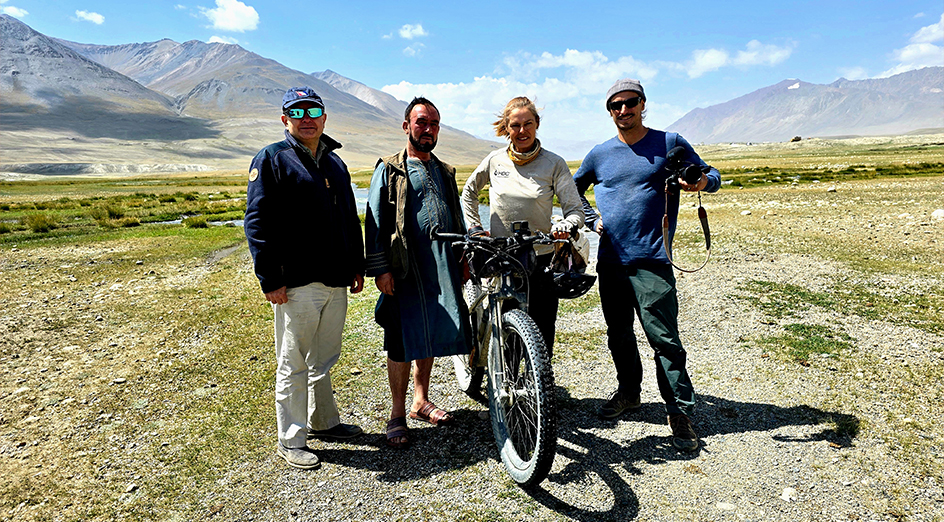 Image: Rupert McCowan, Malang Darya, Kate Leeming and Adrian Dmoch in the Little Pamir.
The discovery, reported in September 2025, follows years of painstaking research of the water systems using maps and satellite imagery and the results have been published in the March 2026 edition of Asian Affairs, the academic journal of the Royal Society of Asian Affairs.
Dr Leeming said interest in finding the true source of the Oxus River/Amu Darya was heightened almost 200 years ago during the 'Great Game' when imperial Britain and Russia competed for control of Central Asia.
The geographical uncertainty highlighted the strategic importance of Central Asia, with control over its vast river systems a key factor in the geopolitical struggle for influence.
"We hope that this discovery brings greater knowledge and understanding about this very special and remote region of the world," she said.
In 2007 an expedition led by British travel writer and explorer Bill Colegrave had identified the Chelab stream as the source of the Oxus, but no one had ever explored the Chelab's own source.
The explorers identified the longest and largest tributary to the Chelab water system. At the top, they found a new and spectacular permanent glacial lake, Lake Malang, at a height of 4,951 metres.
Dr Leeming said Lake Malang was 7.67km from the confluence of the West and East steams, and clearly the source of the West stream, and therefore the Chelab system, and by extension the true source of the Oxus.
"The source of the Oxus is such a special place. The alarming disappearance of this glacier, as with the other glaciers in this region and around the world, is a result of climate change; caused by human activities around the globe, not by local and regional actions.
"Whether it is local actions causing global problems or global actions causing local issues, we are all in it together. And together we must work to solve and manage these issues."
Dr Leeming, Mr McCowan and Mr Colegrave have searched northern Afghanistan for decades for the true source of the mighty Oxus River. Their journeys took them to the towering Pamir Mountains – the so-called 'Roof of the World' – and through the remote Wakhan Corridor in pursuit of Central Asia's most fabled river.
A passionate advocate for human rights and social justice Dr Leeming was recognised with a Medal of the Order of Australia for service to adventure sports in the 2023 Australia Day Honours list.
Since 2013, the passionate adventurer, who grew up on a Northam wheat and sheep farm and won five Australian Open real tennis singles titles, has completed cycling expeditions on every continent on Earth in either polar conditions, across sand or at high altitude.
Dr Leeming, who was also awarded an Honorary Doctorate of Education in 2016, has used her adventures to highlight pressing global issues including extreme poverty, sustainability and education.
Her Breaking the Cycle brand includes an education program that connects students around the world, enabling them to follow her travels, tap into an experiential learning curriculum and learn about the UN's Sustainable Development Goals, as well as study key issues in each region.


