
Calls for a vaccination roll out in South East Queensland
In what's been hailed as a "massive breakthrough", a chlamydia vaccine implant has been administered to a wild koala for the first time.
This is the only koala chlamydia vaccine that uses two doses. Now thanks to the implant it can be applied in one examination.
She might not know it, but the recipient a young koala dubbed Bamse (Norwegian for "teddy bear") is now a trailblazer in the battle against a disease devastating to her species.
The 18-month-old female was captured in Burleigh and taken to Currumbin Wildlife Hospital.
There Senior Veterinarian Dr Michael Pyne, assisted by QUT's Dr Freya Russell, sedated Bamse, injected her with the first vaccine dose, and inserted the implant.
Currumbin Wildlife Sanctuary's koala ecology team returned Bamse to her bushland home on the same day as the procedure (19 May 2026).
That implant was designed to break down after 30 days to deliver the second vaccine dose. Bamse is wearing a GPS collar and will be monitored for at least six months to assess the implant's effectiveness.
Five wild koalas from Burleigh have now received the implant. Bamse and another koala have been recaptured for their one month check-up and both are chlamydia free.
Trialling the implant on wild koalas is a major milestone for the chlamydia vaccine project, led by QUT and Currumbin Wildlife Hospital.
The World Wide Fund for Nature Australia is backing the research – with funding support from furniture brand Koala – to help recover koala populations.
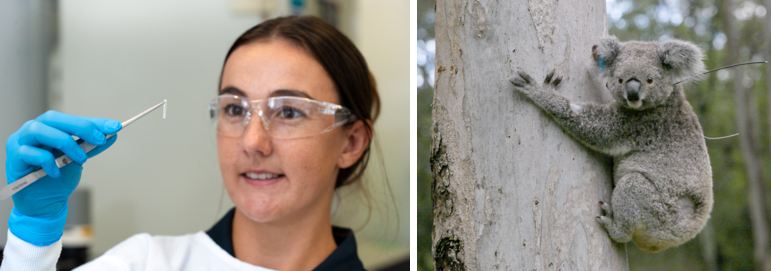
QUT's Dr Freya Russell with the implant and Bamse released on the same day as the operation
Vaccine project success so far
More than 500 koalas have been vaccinated at Currumbin Wildlife Hospital and the Moggill Koala Rehabilitation Centre. This included more than 30 young koalas from Elanora on the Gold Coast, stabilising that population and sparking a baby boom.
In 2020 more than 70% of Elanora koalas presenting to Currumbin Wildlife Hospital were infected with chlamydia.
Now chlamydia admissions from that general area have reduced by 75%, and 41 joeys and 13 grand-joeys have been born in what was previously one of Queensland's most diseased populations.
Importance of the vaccine implant
Success with the Elanora population was achieved through a two-step process. Koalas were captured for an initial vaccine and recaptured four weeks later for a booster shot.
QUT's innovative, biodegradable implant delivers the second dose removing the need to recapture koalas.
The process is much less stressful for the animals, requires fewer staff and resources, and makes large-scale vaccination of wild koalas much more practical.
Tested in captive koalas, the implant proved to be effective giving researchers the confidence to launch the trial in wild koalas, with the hope it will be equally successful.
New study calls for vaccine roll out in South East Queensland
This comes as a new independent report, prepared for the Queensland Government, backed the QUT vaccine, saying it demonstrated "substantial reductions in chlamydial disease and mortality in vaccinated wild koalas" and showed that "vaccination is operationally feasible at scale".
The research, by Dr Lyndal Hulse from The University of Queensland, involved taking swabs from more than 1100 male and female koalas at wildlife hospitals in SEQ.
Dr Hulse has recommended "LGAs including Somerset–South Burnett, Redland City, Logan City, Western SEQ and Moreton Bay should be prioritised for vaccination due to high disease burden".
Logan City was the worst with 58% infected with conjunctival chlamydia and 56% with urogenital tract (UGT) chlamydia. Infection levels were much lower on the Gold Coast and Brisbane which have benefited from the vaccination.
The study, "Maximising effective deployment of the koala Chlamydia vaccine in SEQ", was proudly funded through the Queensland Government.
Dr Michael Pyne OAM, Senior Vet at Currumbin Wildlife Hospital said:
We've been working with vaccines against chlamydial disease in koalas for over five years now and this is a massive breakthrough where we are turning a two-injection vaccine into an injection and an implant that can be all applied in one examination. It's truly a remarkable moment.
Bamse was a great candidate, a young female koala, the poster child for the future of the species. To protect her with the vaccine implant is exactly what we want to be doing. We'll be monitoring her over the next six months. It'll be exciting to see her when she gets her first joey.
We've seen such devastation from chlamydial disease in koalas in South East Queensland and New South Wales. It's absolutely critical the vaccine is rolled out en masse to at-risk populations to protect them.
We've got more work to do. We want to improve the vaccine. But the progress we've made is truly exciting, it gives us hope and allows us to think there is a way to save koalas.
Dr Freya Russell, from QUT's School of Biomedical Science said:
That was an incredibly special moment to be a part of; assisting Dr Pyne with the first implant in a wild koala was like witnessing years of research finally come to life.
It wasn't just a procedure. It felt like a turning point where all of the research setbacks and persistence over the last few years have finally come to the point where we can make a real-world impact. Moments like this make it all worthwhile.
I would love to see the QUT double shot vaccine and implant used in any and all koala populations, particularly the heavily diseased populations that have been identified.
What makes this implant so exciting is its versatility. It can be adapted to a wide range of animal vaccines or medicines that would usually require multiple doses. It opens up possibilities for not just koalas, but for animal health more broadly.
We're in discussions with wildlife and livestock research groups. Many farmers have said this technology would be life changing by reducing the effort it takes to vaccinate cattle.
Tanya Pritchard, Senior Manager of Koala Recovery, World Wide Fund for Nature Australia said:
Bamse is 100% a trailblazer. When we look back on the history of koala conservation, this gorgeous little koala may end up being one of the most important of this century.
Many Aussies are aware of what chlamydia is doing to our national icon, and they want a solution.
WWF is working to protect and restore habitat at scale, but if sick and unhealthy koalas are moving into these areas, it's a problem.
We need to tackle chlamydia and restore and protect their habitats if we're going to bring koalas back from the brink of extinction.
Dr Lyndal Hulse, Postdoctoral Research Fellow, The University of Queensland said:
When we look at the efficacy of the vaccine coming through Currumbin Wildlife Hospital, the reduced burden of chlamydia infection and disease, at a population level, is quite evident.
It's showing that the two-shot vaccine from QUT is actually working. That is the most exciting thing.
It would be quite beneficial if we could actually roll out the vaccine in those regions in South East Queensland with the highest prevalence of infection and disease. So looking at Logan, Scenic Rim, the Somerset region, and Redlands to start tackling the chlamydia disease pandemic.
The flu vaccine changes every year because certain flu strains change. It's the same with Chlamydia pecorum, the most common chlamydia strain among koalas. I'm actually seeing that the genotypes for chlamydia are changing.
So it's one of the things that we need to monitor into the future to make sure the vaccine keeps working.


