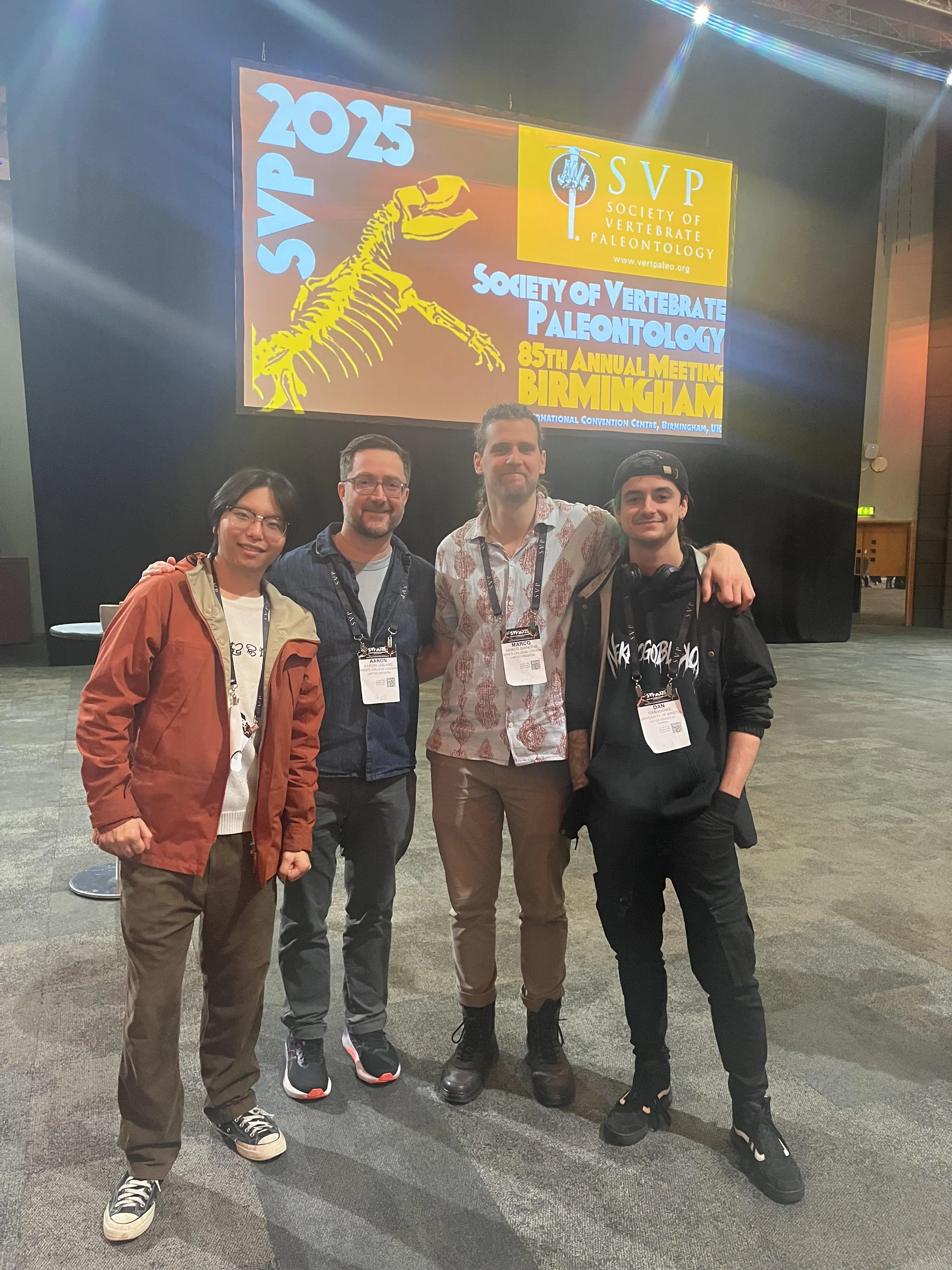
FoDOCS labs made a strong showing at the Society of Vertebrate Paleontology's Annual Meeting in Birmingham (Nov 11-15), with both the LeBlanc and Tucker labs presenting cutting-edge research on teeth, jaws, and ears.

The Society of Vertebrate Paleontology Annual Meeting, held this year in Birmingham, UK, brought together researchers from around the world to share the latest advances in vertebrate evolution and paleobiology. Among the attendees were two FoDOCS labs-LeBlanc's Lab from COCTS and Tucker's Lab from CCRB -whose members delivered a series of well-received oral presentations.
COCTS: LeBlanc Lab's International Debut
For the LeBlanc Lab, this marked their first international conference appearance, and they made it count:
- Dan Marke, who joined the lab only two months ago, presented his Master's research from Bristol, recently published in Nature.
- Marco Bianchin shared results from his first PhD project, focusing on the evolution of lizard enamel.
- Yihui Ke explored tooth replacement in modern alligators, drawing connections to dinosaur dental evolution.
- Lab head Aaron Le Blanc capped the session with a presentation on historic microscope slides from the Royal College of Surgeons, prepared by pioneering dental researchers John and Charles Tomes.
This diverse set of talks highlighted the lab's commitment to bridging historic collections with modern evolutionary questions.
CCRB: Tucker Lab in Force
The Tucker Lab also made a notable impact:
- Abbie Tucker presented on how developmental biology provides new insights into the evolution of the mammalian ear.
- PhD student Maricci Basa discussed her work on the evolution of the snake mandible, offering fresh perspectives on reptilian cranial diversity.
- Fellow PhD student Luke Barlow examined the development and evolution of a mammalian feature crucial for suckling, underscoring the intersection of developmental biology and evolutionary adaptation.
Together, these talks showcased the lab's strength in integrating developmental biology with evolutionary research.
A Strong FoDOCS Presence
The participation of both labs underscored FoDOCS' growing role in international paleontological research. From dinosaur teeth to mammalian ears, their contributions reflected the breadth of vertebrate evolutionary studies and highlighted the next generation of researchers making their mark on the field.
The Birmingham meeting not only provided a platform for these students and faculty to share their work but also marked a milestone in FoDOCS' expanding global presence in vertebrate paleontology.