
Forests and nature play an important role in achieving climate targets. But how much can forest management measures contribute to CO₂ uptake? New factsheets provide key figures to help estimate this contribution. A valuable tool for forest managers, policymakers and advisers working on climate-smart forest and nature management.
More detail and updated insights
Factsheets with key figures for measures in forests and nature areas already existed, but they did not always offer enough detail to accurately estimate CO₂ uptake. "For example, the available figures were only broken down to a limited extent by soil type and tree species," says Erik Roest, researcher at Wageningen University & Research. "Yet these factors can significantly affect climate impact. We have also updated existing measures - such as postponing timber harvest, planting new forest or allowing natural forest regeneration - with new insights from recent research."
Key figures
Key figures for CO₂ storage indicate how much CO₂ is removed from the atmosphere under specific measures and conditions. This CO₂ - or more precisely, the carbon it contains - is stored in forest biomass and soils. By multiplying these figures by the areas where the measures have been implemented, it is possible to estimate how much additional CO₂ is stored or how much CO₂ emissions are prevented.
Which measures deliver the greatest climate impact?
The measure that delivers the most immediate gains is preventing deforestation. Roest explains: "When existing forest is cleared, a large amount of the CO₂ stored in that forest is released in a short period of time. On average, this amounts to nearly 500 tonnes of CO₂ per hectare, equivalent to 2.8 million kilometres driven by an average passenger car."
In the longer term, planting new forest (or allowing natural forest regeneration) can have a major impact. New forest ensures sustained CO₂ uptake over several decades, both in biomass and in forest soils. In the early years, sequestration levels are still relatively low, but they gradually increase as the trees grow more rapidly.
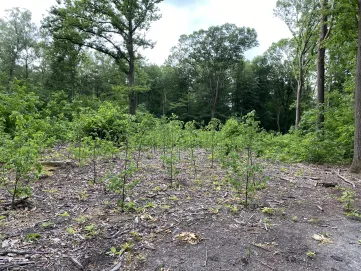
Regeneration group with lime trees in a Northern red oak stand in the Netherlands
More than climate impact alone
"What makes climate measures based on forests, trees and nature so appealing is that they often serve multiple purposes," says Roest. "Making forest and nature areas more resilient not only increases CO₂ uptake, but also strengthens biodiversity and water retention, and enhances the recreational value of the area."
- The factsheets (currently only in Dutch) can be found on the website Gereedschapskist Klimaatslim Bos- en Natuurbeheer
- Read the research report (in Dutch) Aanvullende kengetallen koolstofvastlegging bosaanleg en -revitalisatie


