French police are using overbroad powers to issue on-the-spot fixed penalty criminal fines as a new tool for racial profiling, Human Rights Watch, (RE)CLAIM, and Maison Communautaire pour un Développement Solidaire (MCDS) said in a report released today.
The 60‑page report, "Paying the Price of Police Harassment: Discriminatory Fines Target Black and Arab Youth in France," documents the experiences of the boys and young men from low-income households receiving abusive and discriminatory fines for allegedly committing offenses of noise nuisance, littering, and illegal discharge of unsanitary liquids, when they are simply carrying out ordinary activities such as talking outside their homes or playing sports in a neighborhood park. These fines are issued based on police officers' subjective observations, without judicial scrutiny, while the fined person has no basic fair trial guarantees.
"These abusive fines have intensified discriminatory police harassment that drives children and young people out of public spaces by criminalizing them for their mere presence," said Omer Mas Capitolin of MCDS. "These practices treat them as 'undesirables' rather than full citizens, pushing them toward a social death that jeopardizes their futures, undermines their participation in society, fuels distrust in institutions, and destroys their sense of belonging in society."
The organizations interviewed 42 affected boys and young men, parents, social workers, and several police officers in Paris, its suburbs, the Greater Lyon area, and Grenoble, between February 2025 and April 2026. Researchers also reviewed fine debt records and fine notices, which corroborated accounts.
Young men reported receiving fines for all three public disturbance offenses at once, for offenses at locations and times they could not have committed them, including when they were abroad or in the hospital, and without having had direct contact with police officers. All young men interviewed had received fines as children, including one when he was 13.
The findings support growing evidence, including from France's independent ombudsperson, the Defender of Rights, that police use on-the-spot fixed penalty fines to evict youth perceived as Black, Arab, or North African from public space, while using the nonlegal designation of "undesirables" to classify them in their computerized systems.
In a letter received on June 15 and dated June 3, France's interior minister, Laurent Nuñez, responded to a Human Rights Watch letter sent on May 22 setting out our research findings by stating the designation of "undesirables" in police computer systems has now been removed. The letter disputed our finding that the fines amount to harassment, noting that those subject to fines have a right of appeal and describing fines as an "indispensable tool to restore everyday security."
The government does not collect and publish disaggregated data on these fines that would expose police's discriminatory fining practices. However, official statistics that were gathered on police implementation of COVID-19 fines during the pandemic provided evidence of police's discriminatory implementation in working-class neighborhoods.
The findings demonstrate the intrinsic links between discriminatory and abusive fining practices and discriminatory police identity checks, frisks, and searches that Human Rights Watch documented in 2012 and 2020 and that have been amply scrutinized and condemned at international, regional, and national level.
"Racial profiling in France is pervasive and persistent and yet police were granted new powers allowing them to harass racialized youth without any oversight and accountability," said Bénédicte Jeannerod, France director at Human Rights Watch. "French authorities should immediately take necessary steps to end racial profiling instead of expanding police powers that trap young people in what can be tens of thousands of euros in debt that risks ruining their lives."
Interviews with young people showed that some had fine debt of up to tens of thousands of euros, with automatic penalty increases for unpaid dues and debt collection fees. Among those interviewed, debt ranged from €1,600 to €37,000 and social workers said they knew of cases of up to €50,000.
Djibril, a 24-year-old man from the Essonne department south of Paris, who owes €36,000 in fine debt accumulated since childhood, said that the state garnished much of his modest salary of €500-600 to pay off his accrued debt, leaving him without sufficient means for an adequate standard of living.
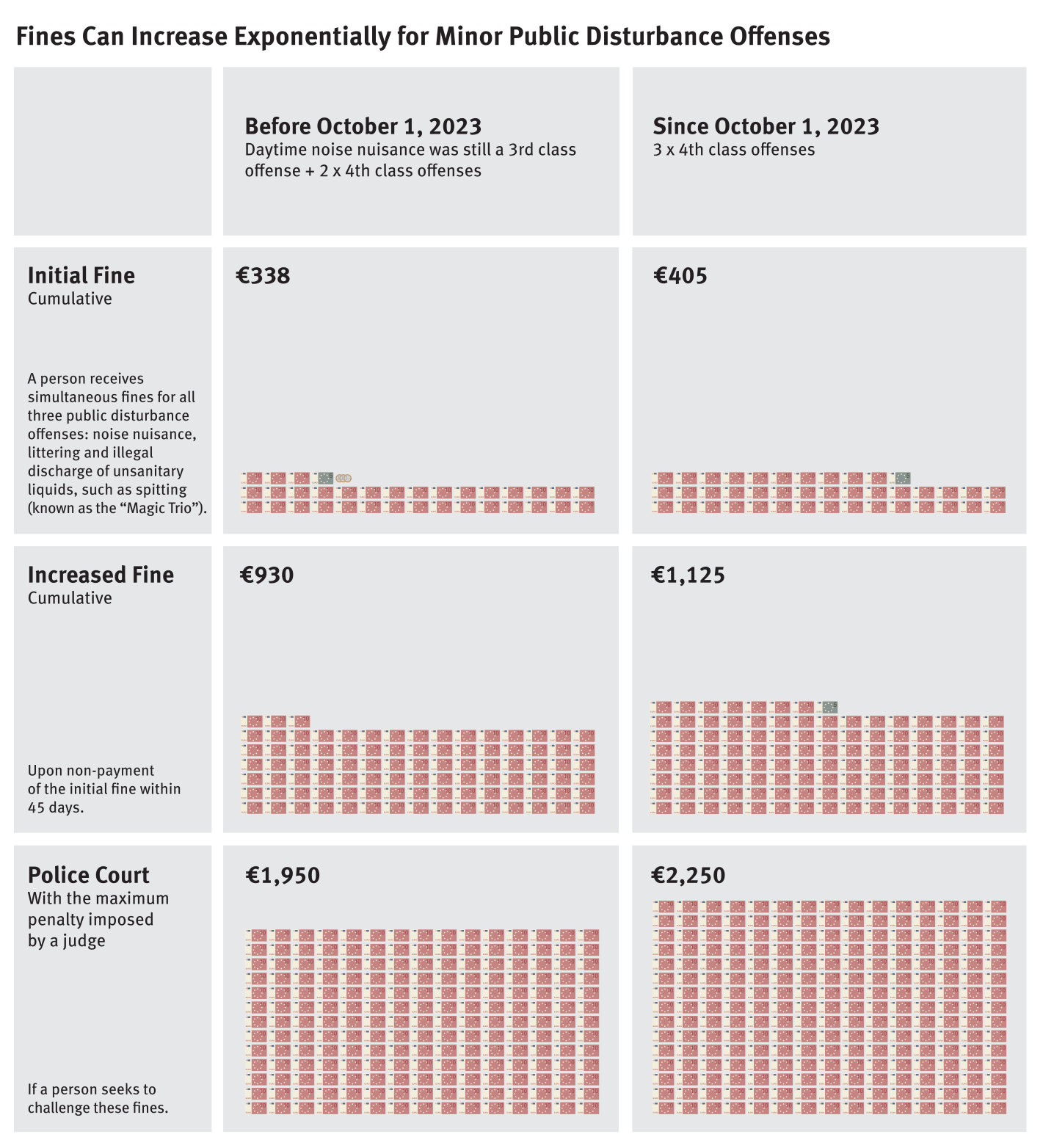
Some said they had to choose between paying fines and paying for food, rent, electricity, and other basic expenses. Debt collection measures also extended to the garnishment of social security benefits.
Some young men reported abandoning formal employment, closing bank accounts, or working informally to escape state debt collection. They also described withdrawing from communal and public life out of fear of receiving more fines. People interviewed said they faced anxiety and social isolation.
Fixed penalty fining procedures make it all but impossible for young people to contest discriminatory and abusive fines. The law deems police officers' incident reports accurate until proven otherwise, and the process to contest fines is fraught with obstacles, with most challenges rejected.
The system rests on assumptions that police officers exercise their fining powers without discrimination, leaving no room for error or abuse, and that fines have only minor or limited impacts. The assumptions are inaccurate, the groups found.
The fines result in serious violations of France's obligations under international and regional human rights law, the groups found. These include the prohibition of racial discrimination, fair trial rights, and the right to an effective remedy; children's rights; and social and economic rights, including the right to an adequate standard of living.
The French authorities should remove the three public disturbance offenses from the French Criminal Code, cancel all outstanding fine debt accrued for these offenses, and put an end to policies designed to exclude young people from public spaces, the groups said.
The authorities should instead adopt and invest in community-centered approaches to address legitimate public disorder concerns. The government should also provide effective independent oversight over fines issued by the police and collect disaggregated data that allows identification of discriminatory practices.
"By transferring judicial powers to police and eliminating all basic procedural safeguards that normally protect individuals against wrongful convictions, the fixed-penalty fining system creates a pernicious tool for harassment that has been weaponized to implement policies to 'evict' people deemed 'undesirable' in public space, with major impacts on people targeted and their families," said Lanna Hollo, delegate of (RE)CLAIM.