
Early detection improves outcomes from almost all cancers. However, there is currently no screening program for most cancers in Australia.

Multi-cancer detection (MCD) tests have the potential to change this, with the ability to identify a wide range of cancers in people who may not have symptoms yet.
Associate Professor Julia Steinberg of the Daffodil Centre is leading new research into whether and how MCD tests could improve cancer outcomes in Australia.
It's an ambitious 5-year project, with over 35 collaborating researchers across the Daffodil Centre, Australia, UK, France and Singapore. It would not be possible without a new $3 million grant from the Australian Government Medical Research Future Fund.
How close are we to seeing MCDs available for everyone?
MCD tests are simple blood tests that aim to pick up biomarkers in the blood for up to 50 different cancer types, ideally as early as possible and before symptoms develop.
There is huge obvious potential from these innovative new tests to improve cancer detection and patient outcomes.
As A/Prof Steinberg says, "Improving early detection of cancers is crucial, as almost half of all cancer deaths in Australia are from cancers where there is no cancer screening or early detection program in place".
But we are still some way away from seeing MCD testing rolled out widely to the public, as the benefits do not yet outweigh the harms.
Right now, even the best MCD technologies miss more than half of early‑stage cancers. As well, there is the risk of false positives, which may lead to unnecessary anxiety and invasive procedures, and false negatives, which may lead to untreated cancers.
How will A/Prof Steinberg's research bring MCD testing into Australia's health system?
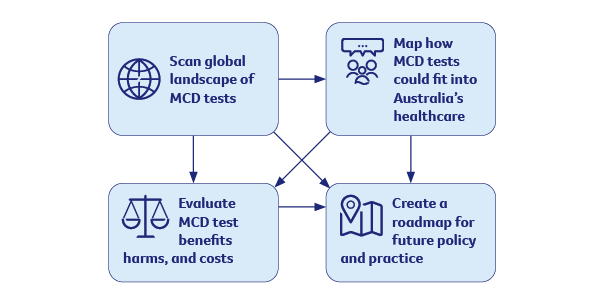
MCD testing technology is rapidly evolving, so A/Prof Steinberg is working on a roadmap that will ensure that Australia's health systems is ready when the technology is ready.
This means A/Prof Steinberg and her collaborators will track existing and incoming MCD testing technology to see how they may improve patient care in Australia.
"Our work will establish an evidence-based Roadmap with recommended next steps in MCD test evaluation and trials, to help maximise the potential of MCD tests for patient-friendly and more effective early detection of cancers." - A/Prof Steinberg
As well, the team will work with health professionals and consumers to understand how MCD tests could be embedded into the Australian healthcare system in an acceptable and feasible way.
In particular, they will investigate what follow-up pathways and diagnostic procedures could look like - that is, what happens after someone had an MCD test? Who do they go to see and for what procedure?
The team will also conduct an analysis of the potential economic benefits or costs of MCD testing.
With further advancements and evidence-based future translation, MCD tests have the potential to transform cancer care in Australia. To keep up to date on this research project, visit our genomics and precision health page.
To learn more about research we conduct and fund, visit our research homepage.


