
A large contingent of girls who study physics at high schools across Victoria travelled to the Australian Synchrotron in May to attend the annual Girls in Physics breakfast.
The event is coordinated by the VicPhysics Teachers' Network with the financial support the Invergowie Foundation. The Foundation provides grants for education and career development for girls and women in Victoria. Chief Executive Officer Kim Bartlett attended the breakfast.
Prime Sci!, Swinburne's Science Education group, also participated.
"This is a great, well established STEM event, that ANSTO is happy to support to grow the science workforce of the future," said Rod Dowler, Leader National Education and Engagement.
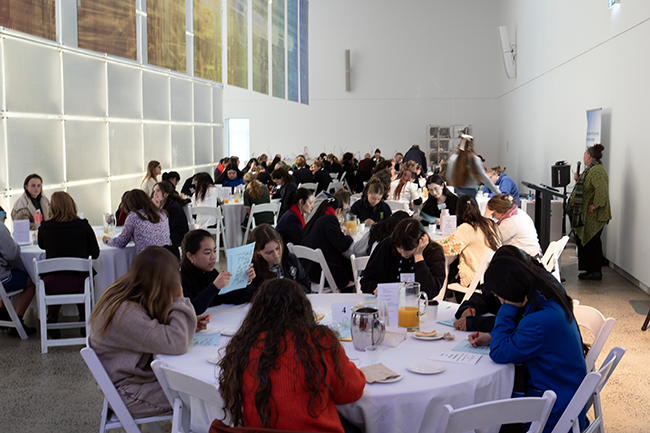
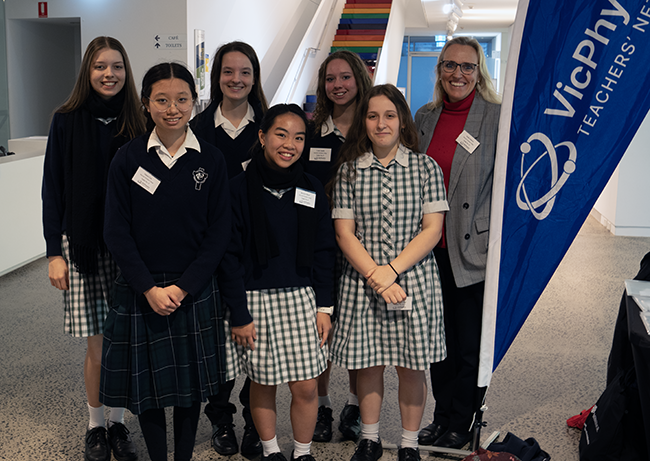
The Year 10 to 12 students attend Mount Waverley Secondary College, Santa Maria College, Bialik College, Donvale Christian College, Western Port Secondary College, Parkdale Secondary College, Sacred Heart Girls College, Ivanhoe Girls' Grammar School and Sacre Coeur.
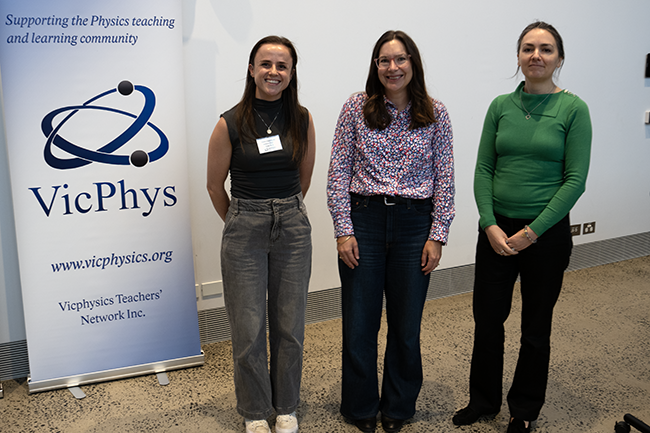
The girls shared a table with women who either had a career in physics or engineering or were at university as an undergraduate or a postgraduate. RMIT, Swinburne, Monash, and the Australian Bureau of Meteorology were represented. The students had the opportunity to ask question and about careers and university experiences.
This breakfast is special in that there is the option of a 60-minute guided tour of the Australian Synchrotron and its beamlines.
The address was delivered by Dr Rachel Williamson, an accomplished scientist who is a Group Manager of the Crystallography Group at ANSTO's Australian Synchrotron and is responsible for the operation, maintenance, development, scientific direction and management of the crystallography beamlines.
Rachel shared some of her professional experience with the audience, including how she landed in a career that began with an interest in finding a cure for cancer.
After completing her PhD in Synthetic Organic Chemistry from Massey University (NZ) in 1999, Rachel worked as a Science Advisor at Medsafe in NZ evaluating both generic and new medicines for safety and efficacy.
She then returned to research and development as an NIH funded Postdoctoral Fellow in the Bioscience Division at Los Alamos National Laboratory (USA) from 2002 to 2006, which was followed by work at the Centre for Disease Control.
Back in Australia Rachel worked at Melbourne University prior to taking a up a role as Beamline Scientist at the Australian Synchrotron since 2007.
"It's incredibly important to encourage girls to follow their passion into a career in science or engineering. We need to build the next generation of scientists now, " she said.


