
Tomorrow's supercomputers are being built today through international partnerships that harness and deploy the power of quantum mechanics at industrial scales. The University of Sydney is working in tandem with University College London (UCL) to make these computers a reality, leveraging each institution's mastery of exotic quantum materials, the mathematics of topology, and even advances in string theory - all while training the next generation of leaders in this rapidly emerging field.
In 2024, the University of Sydney proposed a joint quantum workshop to UCL, building on a relationship with London physicists that helped to secure a $2.45 million (1.2 million pound) grant for research led by UCL and involving Sydney academics, including Professor David Reilly , Professor Alice Motion , and Professor Stephen Bartlett - head of the Sydney Nano Institute and a world-recognised leader in applied and theoretical quantum research.
"Thankfully, they were highly receptive and supportive of the idea," says Professor Bartlett. The workshop took place in London, supported by the University of Sydney's Office of Global and Research Engagement, which helps facilitate and fund international research partnerships.
"At the University of Sydney, we have a fantastic research facility - the Sydney Nanoscience Hub - that is unique in Australia and is a real focal point for quantum research in Sydney and Australia.
"What's unique about this partnership is really the breadth of expertise in quantum across both institutions. We all have areas of strength, but for both Sydney and UCL, there are many different areas that stretch across a broad range of topics.
"You would struggle to find that comprehensiveness at any other institution."
What this means in reality is that there are many points of contact across many quantum research specialties at both institutions, such as quantum computing technologies based on semiconductors, superconductors and atomic quantum systems, theory of quantum computing, fundamental research and translational research - focused on real-world implementation and commercialisation.
"Both Sydney and UCL have it all and can connect at many points."
This breadth of expertise gives the universities an upper hand in the global race among academic institutions, government research agencies and commercial enterprises all seeking to unlock the unparalleled computational power of quantum systems, which will be capable of performing advanced calculations exponentially faster than current supercomputing technologies by exploiting the unique properties of quantum materials.
Quantum computers are built around 'qubits' - the quantum equivalent of standard computer's 'bits' that represent the 1s and 0s of binary code - that rely on delicate states of superposition and quantum entanglement of particles. Creating stable, scalable quantum system is the ultimate goal of this research collaboration, with promising applications in modelling complex systems like atomic interactions and biological processes, drug design, cryptography and cybersecurity, telecommunications and smart sensing systems.
Lab space in hot demand
The Sydney Nanoscience Hub is custom built for bringing together researchers from different disciplines to work on delicate technologies at the tiniest scales. It's built into the sandstone bedrock of the University of Sydney, in a unique environment in which the building is completely shielded from vibrations, radiation, and the heat of Sydney's summers.
"It's one of a kind and a very a busy hub, thanks to strong interest from across the University and our industry partners including IBM, PsiQuantum, and Diraq says Professor Bartlett.
"But visiting the UCL facility - the London Centre for Nanotechnology , based in the heart of central London - we now have a new appreciation for what it means to be constrained for space in the centre of an historic city, surrounded by leaders of education, industry and policy.
"I found it amazing, and eye-opening, to walk into a narrow building between terraces in London's West End to a world-leading research facility, stacked six floors high, and packed to the rafters with research equipment and busy scientists, almost working on top of each other!"

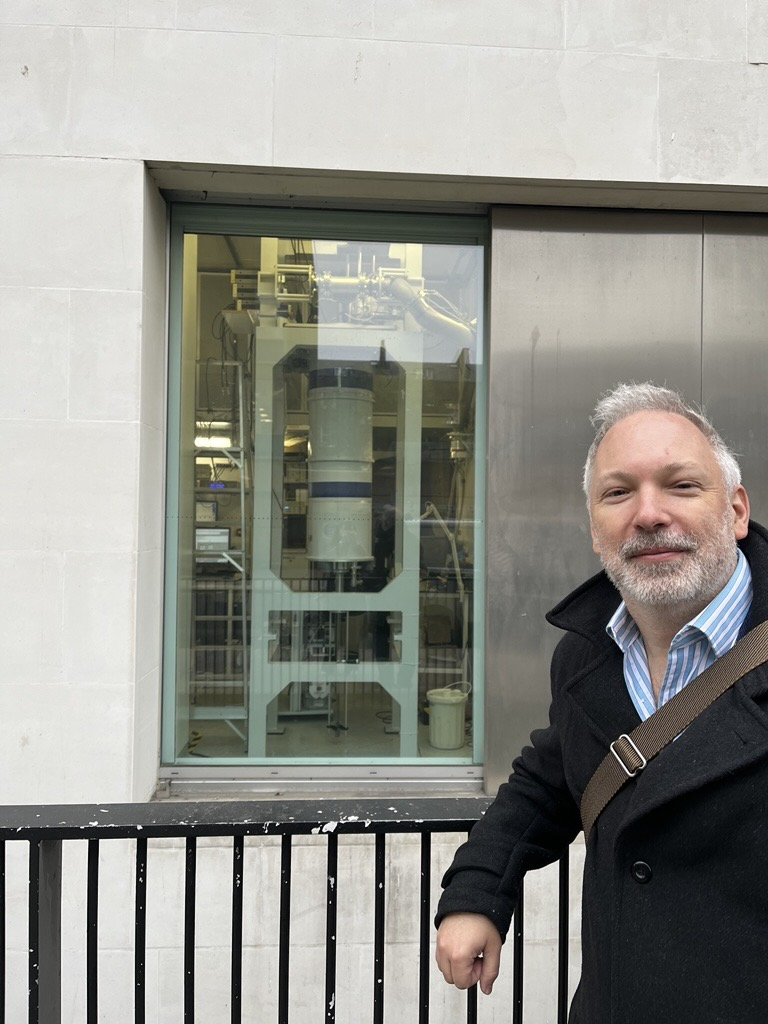
Professor Stephen Bartlett visiting the UCL quantum facility in London
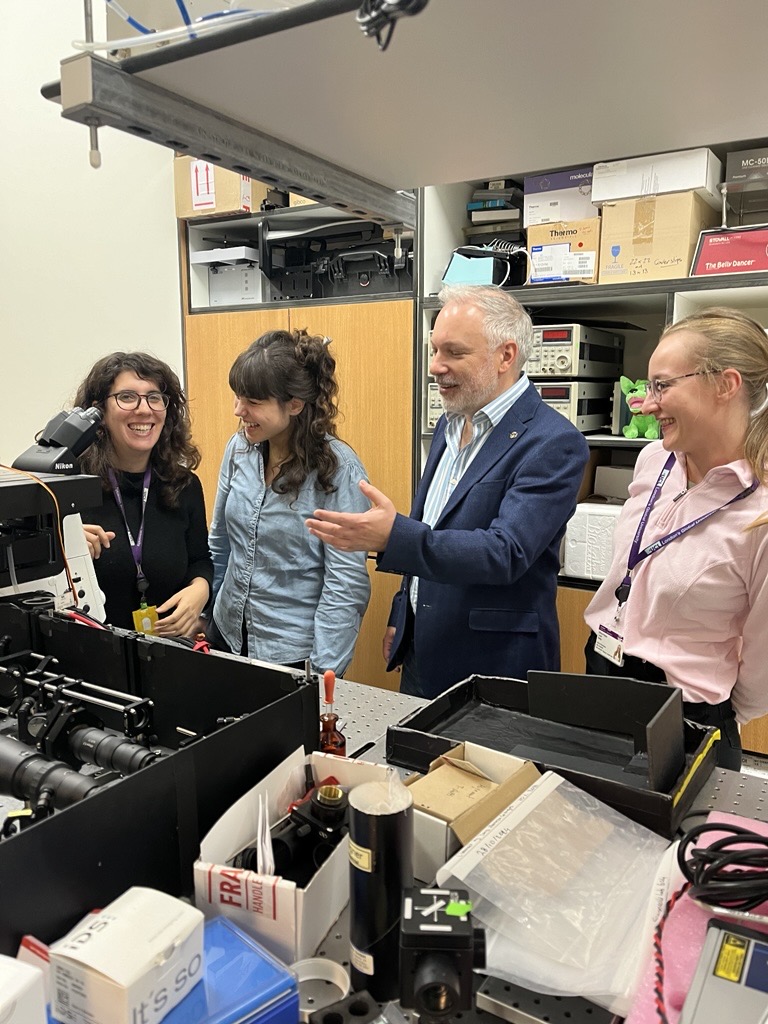
"Learning from different institutions will help me to pick up diverse experimental techniques and problem-solving approaches."
Gargi Tyargi
University of Sydney PhD candidate
Training the next generation of quantum leaders
That close proximity in the lab and global connection with antipodean counterparts has already fostered critical breakthroughs in quantum technologies.
One early success was achieved by UCL PhD student Constance Lainé, during her exchange placement at the University of Sydney, where Constance and her team of collaborators solved a key problem of characterising quantum error-correcting codes in superconducting quantum chips. Error-correction is an important part of any computing system - especially in the delicate yet powerful machinery of a quantum computer.
The results are in the process of being peer-reviewed and published, but herald an important step forward for a full-scale, functioning quantum computer, says Professor Bartlett.
Laine was the first PhD student sent by UCL to study at the University of Sydney over a period of 12 weeks. Sydney is about to reciprocate, with two students travelling to London next month.
Gargi Tyagi is one of the students travelling to London as part of their PhD work to create an adapter that links microwave devices operating at cryogenic temperatures with optical networks that work at room temperature. This will enable scalable quantum network that interconnect processors over long distances.
"I am excited to work with the Quantum Spin Dynamics group to learn advanced techniques in cold microwave experiments and strengthen the expertise that we are also developing in our lab at the University of Sydney," says Tyagi. "Learning from different institutions will help me to pick up diverse experimental techniques and problem-solving approaches."
Ben Field, another student participating in the exchange program, is looking at new ways to store and transport information in the form of light.
"By leveraging long lived states in solid systems we are looking at how to transport light hundreds of kilometres with minimal loss of data," says Field, who will also be working with Quantum Spin Dynamics group.
"Personally, as a late-stage PhD student been able to get a well-integrated experience as to what the research ecosystem is like in the UK and Europe - as well as simply what it is like to live in on the other side of the world - is a very helpful when it comes to exploring options for my next career steps."
Professor Bartlett says that knowledge exchange like this is one of the main benefits of the UCL-Sydney Nano partnership. "So too are the new ideas and perspectives, and the ability for students to be an advocate for their home institution and research group," he says.
"Both Sydney and UCL attract amazing research students, amongst the best in the world. Students come to our institutions because of our history and reputation, but also because we are leading the world in this brand-new research topic of quantum technologies that will have real-world impact on how we live our lives in the 21st century."
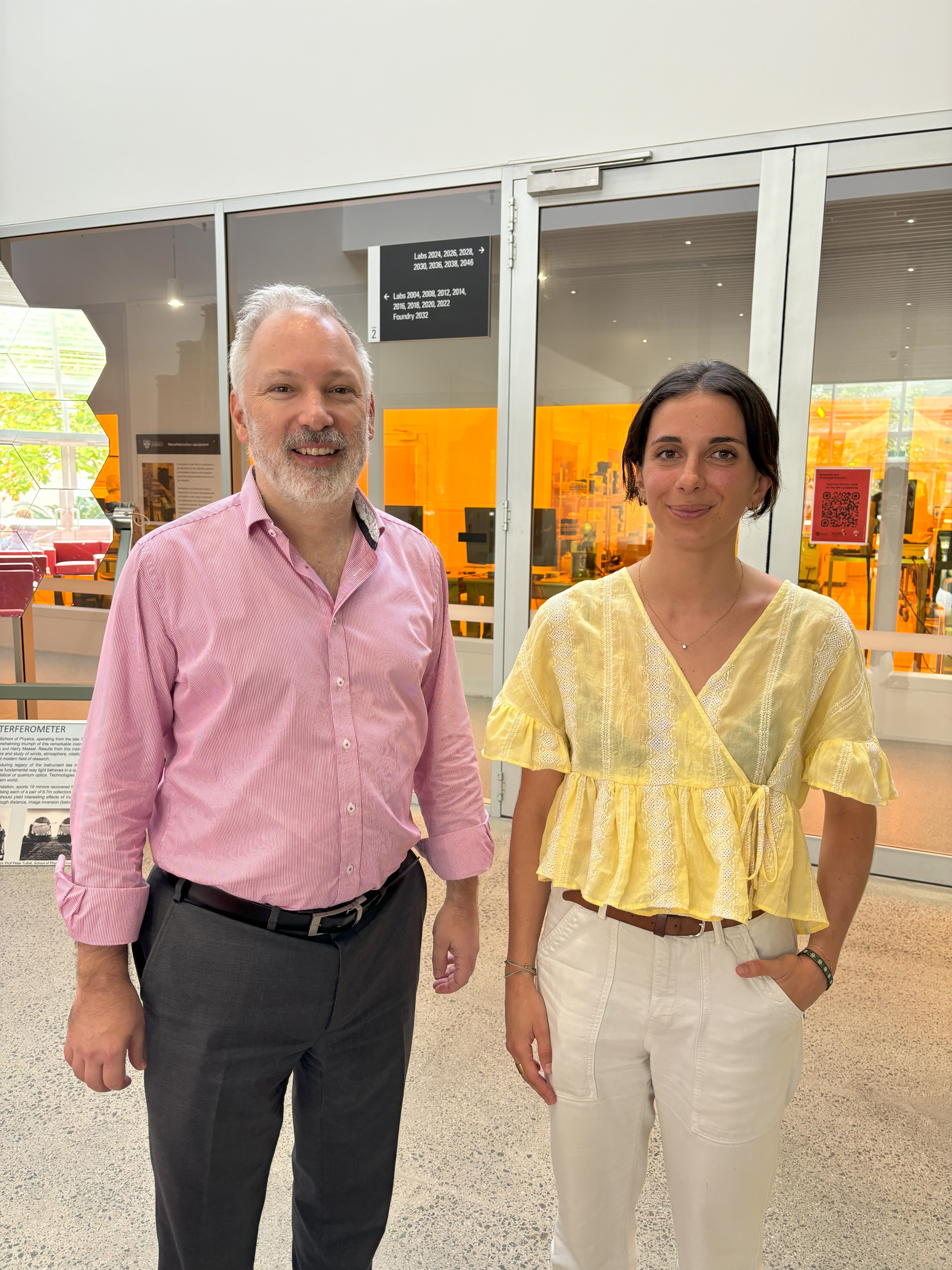
Professor Stephen Bartlett with UCL PhD candidate Constance Lainé at the Sydney Nanoscience Hub.
Making global research work
Aside from the obvious challenges of distance and time zones, Professor Bartlett says the main challenge in establishing and maintaining relationships like the UCL-Sydney Nano one is the busy academic working lives of the senior researchers involved.
"It is difficult to make space for new collaborations and to invest the time needed for them to grow. The PhD students are the key solution to this problem, as they can bring their energy and enthusiasm across research at both institutions to drive progress."
Professor John Morton , Director of the University College London Quantum Science and Technology Institute and an expert in controlling electron and atomic nuclei in quantum technologies, said: "The researcher exchange enabled by this collaboration embodies the spirit of international cooperation which is fundamental to addressing the challenge of developing transformative quantum technologies.
"The knowledge sharing that these placements enable not only help to accelerate research progress today, but they help forge connections between early career researchers that can persist for the rest of their careers."
Now that both institutions have built an understanding of each other and joint capability through the PhD student exchange, the next step is to look at opportunities on the horizon that are best placed to go after in partnership.
"Both Australia and the UK are investing significantly in quantum science and technology, recognising its potential to transform industries and economies, said Professor Bartlett.
"That's why partnerships like ours are so valuable. Together, we can create capabilities that make a real difference globally."


