
UN Secretary-General António Guterres has condemned Israel's decision to resume land registration procedures in a large part of the occupied West Bank, his Spokesman said on Monday.
The development follows an Israeli cabinet decision from May 2025 and applies to Area C of the West Bank, which encompasses some 60 per cent of the territory.
This will mark the first time since the 1967 occupation that Israel will begin registering land as state property following approval announced by the cabinet on Sunday.
Risk of Palestinian dispossession, greater Israeli control
Briefing journalists in New York, UN Spokesman Stéphane Dujarric said the decision could lead to the dispossession of Palestinians of their property. It also risks expanding Israeli control over land in the area.
"Such measures, including Israel's continued presence in the Occupied Palestinian Territory, are not only destabilizing but, as recalled by the International Court of Justice ( ICJ ), unlawful," he added.
He said the Secretary-General calls on the Israeli Government to immediately reverse the measures while again warning that the current trajectory on the ground is eroding the prospect of a two-State solution between Israelis and Palestinians.
Settlement activity illegal
Last week, the Israeli cabinet approved several measures that would increase Israeli civilian authority in Areas A and B of the West Bank, which together constitute roughly 40 per cent of the territory
"The Secretary-General reiterates that all Israeli settlements in the occupied West Bank, including East Jerusalem, and the regime associated with them, have no legal validity and are in flagrant violation of international law and relevant United Nations resolutions," the Spokesman said.
The UN chief called on all parties to preserve the only path to a negotiated two-State solution which is "the only path to lasting peace."
Ongoing Gaza aid restrictions
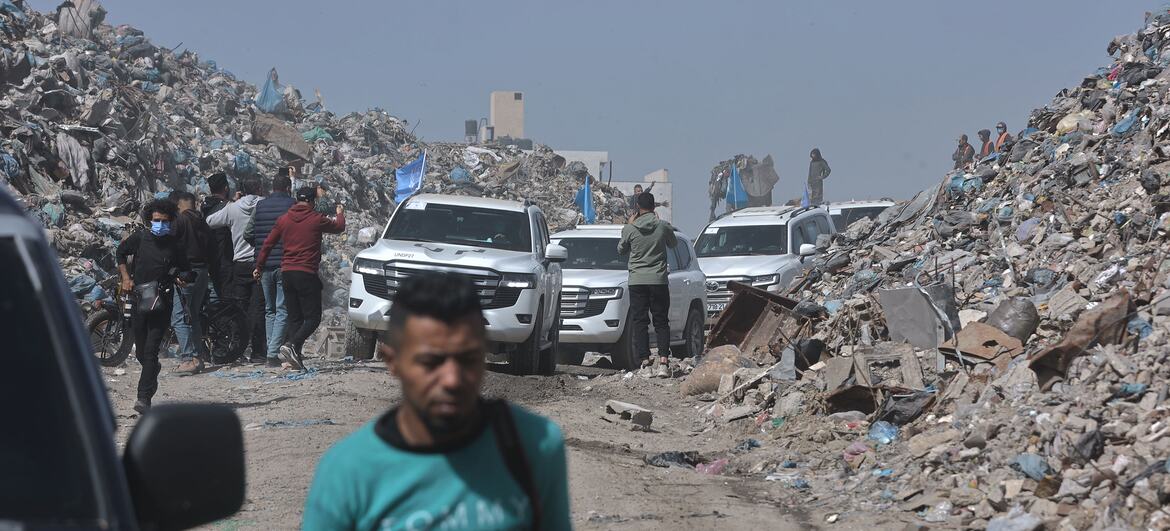
Meanwhile in Gaza, humanitarians working in logistics supported the recent transportation of nearly 1,900 pallets full of food, shelter, health, water and sanitation items from crossing points along the perimeter fence with Israel to destinations inside the Strip.
Despite this, aid operations continue to face significant impediments, the UN Office for the Coordination of Humanitarian Affairs ( OCHA ) said in its latest update .
Shipments from Jordan are restricted to a route that requires multiple offloading and reloading points.
Those from Egypt - which come through the Kerem Shalom/Karem Abu Salem crossing - face a high return rate, with less than 60 per cent offloaded between the period from 4 to 10 February.
Humanitarian missions blocked
Humanitarian movements inside Gaza that require coordination with Israeli authorities also continue to face obstacles.
Out of nearly 50 movements coordinated between 6 and 11 February, just over a half were fully facilitated and five were denied outright.
While 11 movements were approved, they encountered significant delays and other impediments and two were only partially accomplished as a result.
OCHA noted that two more denials were recorded on Monday, and "teams on the ground are engaging with the authorities to clarify the constraints and seek their resolution so that our operations can move forward."


