
Low river discharge reduces the likelihood of young Atlantic salmon reaching the North Sea. Fewer salmon reach the Haringvliet sluices and their passage takes longer, making them more likely to fall prey to predators. Using so-called predation tags, researchers were able to demonstrate for the first time that this predation occurs largely before the Haringvliet sluices and is probably mainly caused by predatory fish. The results provide leads for improving the management of the Haringvliet sluices.
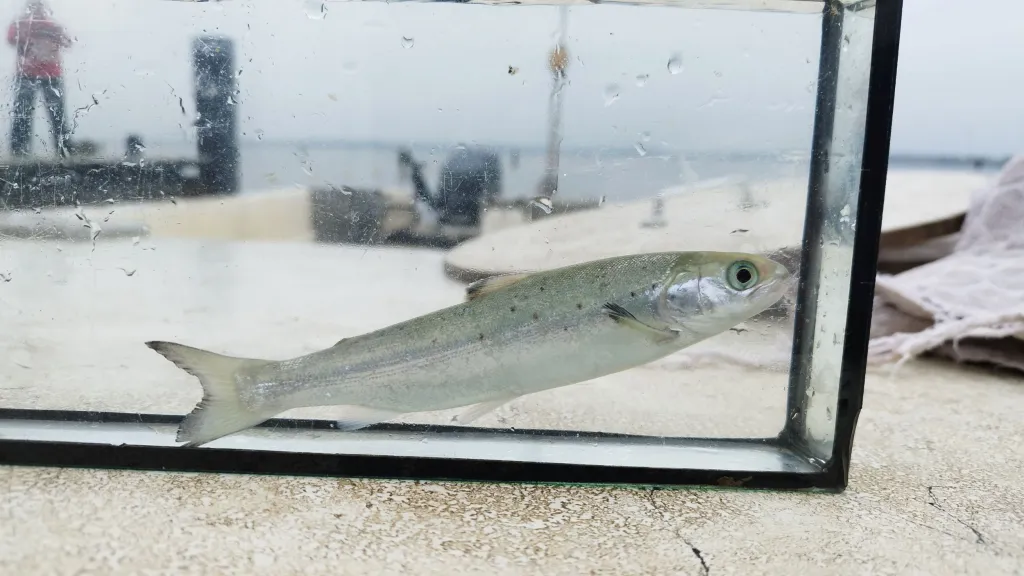
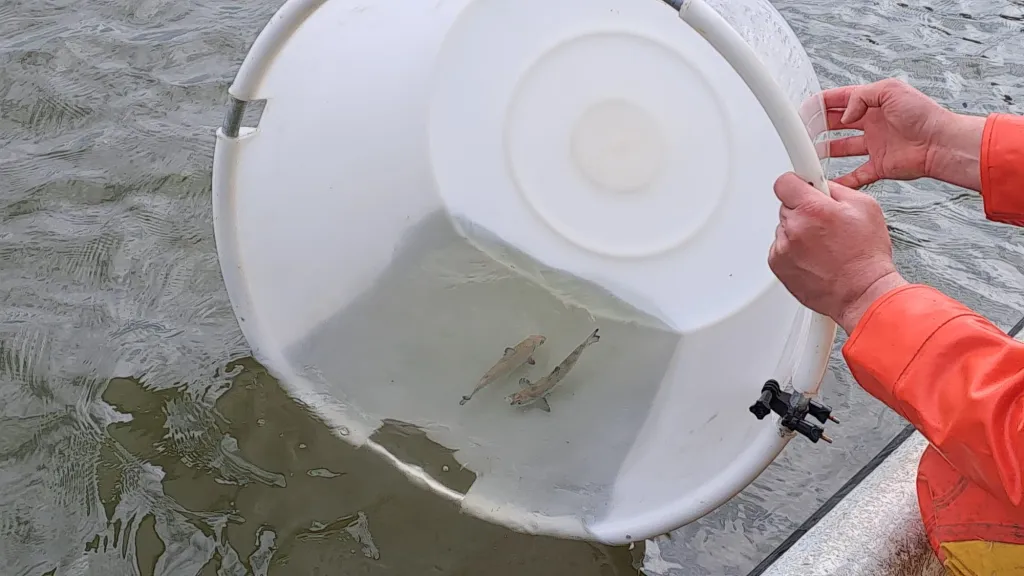
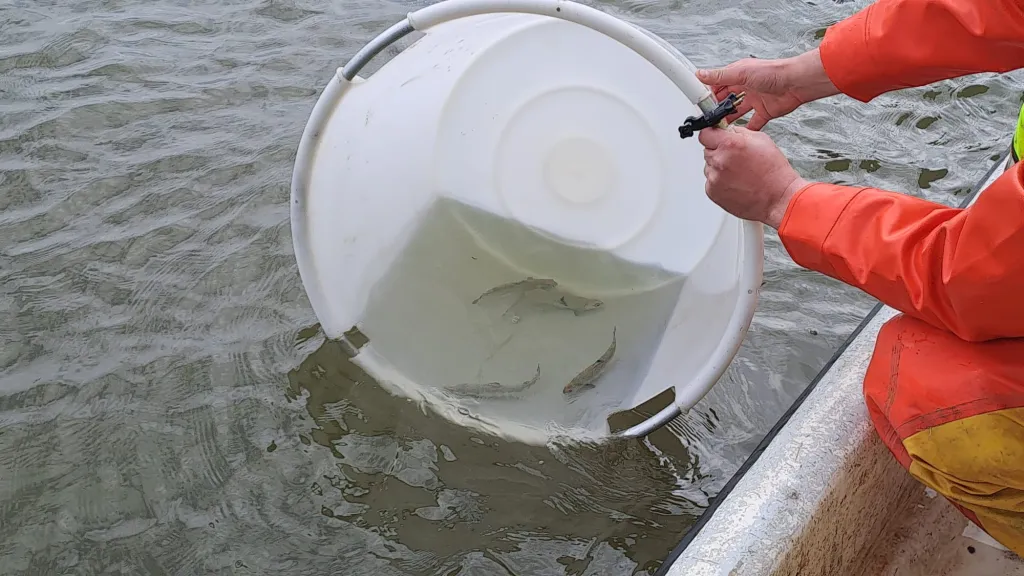
In 2024 and 2025, researchers from Wageningen Marine Research and ATKB tracked a total of 74 young Atlantic salmon during their seaward migration from the Haringvliet to the North Sea. After ATKB had fitted the fish with tags, they were released near Numansdorp, approximately 28 kilometres upstream of the Haringvliet sluices.
The research was commissioned by Rijkswaterstaat and made use of the acoustic telemetry network in the Haringvliet, which Wageningen Marine Research and Sportvisunie established jointly. The network is used, among other things, for PhD research into migratory fish at the Haringvliet sluices.
Low river discharge means greater risk
The differences between the two research years were considerable. In 2024, when river discharge was relatively high, almost half of the tagged young salmon reached the North Sea. In 2025, when the discharge was low, only 6% of the fish succeeded in doing so. At low river discharge, the young salmon also took an average of approximately 27 hours to find a passage through the Haringvliet sluices, compared with 11 hours at high river discharge.
Jacco van Rijssel, an ecologist at Wageningen Marine Research: "I did expect river discharge to play an important role, but not for the effect to be so great. At high discharge, young salmon reach the North Sea much more easily. Their journey takes less time, reducing the likelihood of them being eaten. Moreover, at high discharge, all the Haringvliet sluices can be opened wide, whereas at low discharge sometimes only one of the seventeen sluices is open. The fish then no longer have to search for a passage."
New tags provide insight into predation
For this research, the researchers built on the use of acoustic predation tags that had previously been applied in the PhD research into the upstream passage of migratory fish at the Haringvliet sluices. These tags not only record a fish's location but also emit a different signal when the fish has been eaten. In addition, a built-in sensor measures the temperature inside the predator's stomach. This often enables researchers to distinguish between predation by a fish and predation by a warm-blooded animal, such as a bird or marine mammal.
The tag data show that predation occurred mainly before the young salmon could pass through the Haringvliet sluices, while they were still in the freshwater section of the river. The measurements indicate that this predation was mainly caused by predatory fish, such as pike, pike-perch, perch, asp and catfish.
The researchers also suspect that fish-eating birds take some of the young salmon. However, this is difficult to demonstrate. Fish-eating birds often regurgitate indigestible parts around their breeding colony or resting place, outside the range of the network of acoustic receivers. Predation by these animals is therefore likely to be missed, with researchers simply observing the tags disappearing from the study area.
Management of the Haringvliet sluices can support the seaward migration of young salmon
By linking the data from the tagged salmon to information about river discharge and the operation of the Haringvliet sluices, the researchers were able to reconstruct the conditions under which the fish passed through the sluices. Almost all successful passages occurred when the sluices were discharging river water into the sea.
Jacco van Rijssel sees the results as providing starting points for the management of the Haringvliet sluices: "This knowledge can be used to improve the management of the Haringvliet sluices during the peak of the salmon migration, for example by opening as many sluices as possible during that period. This could contribute to the recovery of Atlantic salmon."
At the same time, he points out that climate change could further complicate the situation: "If periods of low river discharge during the seaward migration of young salmon become more frequent as a result of climate change, it will become even more difficult for young salmon to reach the North Sea. We can only hope that salmon have sufficient genetic variation to adapt to those changing conditions."
Further research should provide answers
Although the research results provide clear starting points, not all questions have yet been answered. Further research into how different ways of managing the sluices affect the passage of young salmon is needed. More insight into predation by birds is also required, so that more targeted measures can be taken to increase the survival chances of young salmon.


