
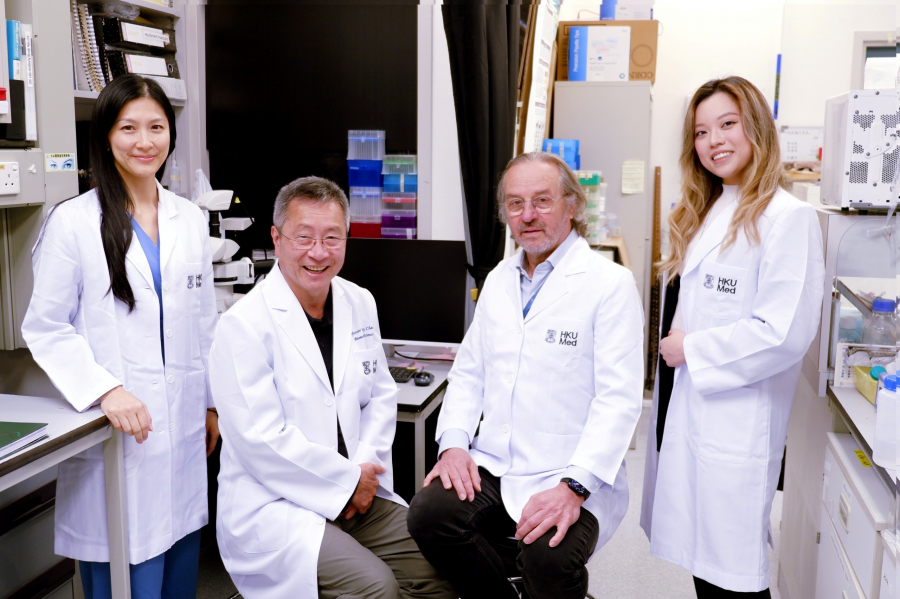
HKUMed demonstrates that 'cloaked' and safe human stem cells work, paving the way for off-the-shelf transplants without immune rejection. The research team includes (from left) Dr Vivian Tam, Professor Danny Chan, Professor Andras Nagy and Nicole Wong.
Researchers from the School of Biomedical Sciences at the LKS Faculty of Medicine, the University of Hong Kong (HKUMed), in collaboration with the Lunenfeld-Tanenbaum Research Institute at Sinai Health in Toronto, Canada, have achieved a major breakthrough in regenerative medicine. The team has genetically engineered human stem cells that can 'cloak' themselves to evade immune rejection, while carrying a built-in kill switch to prevent tumour formation. This innovation opens the door to a safe, off-the-shelf source of cells and tissues, potentially transforming treatment for conditions such as Parkinson's disease, diabetes, heart failure, and spinal cord injuries, without the need for lifelong immune suppression. The findings were published in Stem Cell Reports [link to the publication].
Breaking barriers in stem cell transplants
Professor Danny Chan, Emeritus Professor at the School of Biomedical Sciences, HKUMed, who is the co-lead author of the research, said, 'In collaboration with Professor Andras Nagy, Distinguished Visiting Professor, we have demonstrated three desired properties of the Nagy lab's new class of genome‑edited human embryonic stem cells, known as "FailSafe-AlloAccept". The progeny of these cells can avoid immune rejection, address the shortage of suitable donor cells, and reduce the risk of transplanted cells turning cancerous.'
Inspiration from Tasmanian devils: an immune cloak
When cells from one person are transplanted into another, the recipient's immune system usually attacks them as 'foreign', which is why organ transplant patients need lifelong immunosuppressive drugs. Drawing inspiration from several natural examples, including the transmissible cancer cells of Tasmanian devils that evade immune detection, the human placenta that is not rejected by the mother, and cancer cells that manage to avoid immune attacks, the researchers engineered stem cells with a similar 'cloaking' system. These FailSafe-AlloAccept cells can survive in any recipient, regardless of tissue type, by disguising themselves from immune attack while also suppressing nearby immune cells.
'Efficacy proves a cure works; safety ensures the patient lives to receive it. For universal cell therapies, safety is not just a requirement—it is the very foundation of future advances,' said Professor Liu Pengtao, Professor at the School of Biomedical Sciences, HKUMed, and Managing Director of the InnoHK Centre for Translational Stem Cell Biology.
Humanised mouse experiments validate stem cell safety and efficacy
The FailSafe-AlloAccept human pluripotent embryonic stem cells can become almost any cell type in the body, offering a potentially limitless supply of replacement cells. However, repeated cell divisions can introduce mutations, causing cancerous cells.
In experiments using humanised immune system mouse models, unmodified stem cells were quickly rejected and failed to grow, while the engineered FailSafe-AlloAccept cells successfully formed tissues that survived for up to five months without rejection.
'Crucially, the cells did not compromise normal immune function. Mice remained fully capable of rejecting ordinary foreign cells, ensuring protection against infections and cancer. In addition, the growth of immune evasive cells could be halted by administering a common drug as a built‑in kill switch, further ensuring safety against potential tumour formation,' said Professor Andras Nagy, Senior Scientist, Lunenfeld-Tanenbaum Research Institute, Sinai Health, and Distinguished Visiting Professor at HKUMed.
Towards off‑the‑shelf therapies without lifelong immunosuppression
The results suggest that FailSafe-AlloAccept cells could serve as a universal cell source for diverse therapies, helping to overcome major barriers in transplantation, such as long donor waiting lists and the need for lifelong immunosuppressive drugs, which often have serious side effects and heighten infection risks.
'This is a major step in realising the dream of having a potential universal, off‑the‑shelf product for cell therapy,' said Professor Danny Chan. 'While our findings are still at the preclinical stage, they point to a future in which patients could receive safe, ready‑to‑use cell therapies. This advance could reshape treatment approaches for numerous diseases and lay a strong foundation for future clinical testing.'
'Science transcends borders. HKU's Distinguished Visiting Scholar Scheme catalysed this landmark collaboration between my laboratory in Toronto and Professor Chan's laboratory at HKUMed. By bridging our expertise across continents, we are driving cell therapy innovations that promise to transform human health globally,' said Professor Andras Nagy.
About the research team
The research project was led by Professor Danny Chan, Emeritus Professor, School of Biomedical Sciences, HKUMed, and Professor Andras Nagy, Senior Scientist, Lunenfeld-Tanenbaum Research Institute, Sinai Health, and Distinguished Visiting Professor at HKUMed.


