
Holocaust survivor Marion Blumenthal Lazan, gave a harrowing and heart-rendering account of her childhood under Nazi persecution during Tuesday's Holocaust Memorial event in New York, urging citizens worldwide to push back against 'negativity' by choosing "love, respect and compassion" in how they treat one another.
Speaking in the General Assembly Hall alongside one of her great grandchildren, Mrs Lazan described her family's journey from a 'comfortable' life in Hoya, northwest Germany, to a detention camp in the Netherlands - and in January 1944, internment in Bergen Belsen concentration camp.
Mrs Lazan's indomitable spirit in the face of the most inhumane and extreme conditions, echoed the words of Viktor Frankl, author and Holocaust survivor, who famously said "everything can be taken away from people but one thing: the last of the human freedoms - to choose one's attitude in any given circumstances, to choose one's own way."
Addressing the world today, Mrs. Lazan said "how we treat, behave, and reach out to one another - that is entirely up to us."
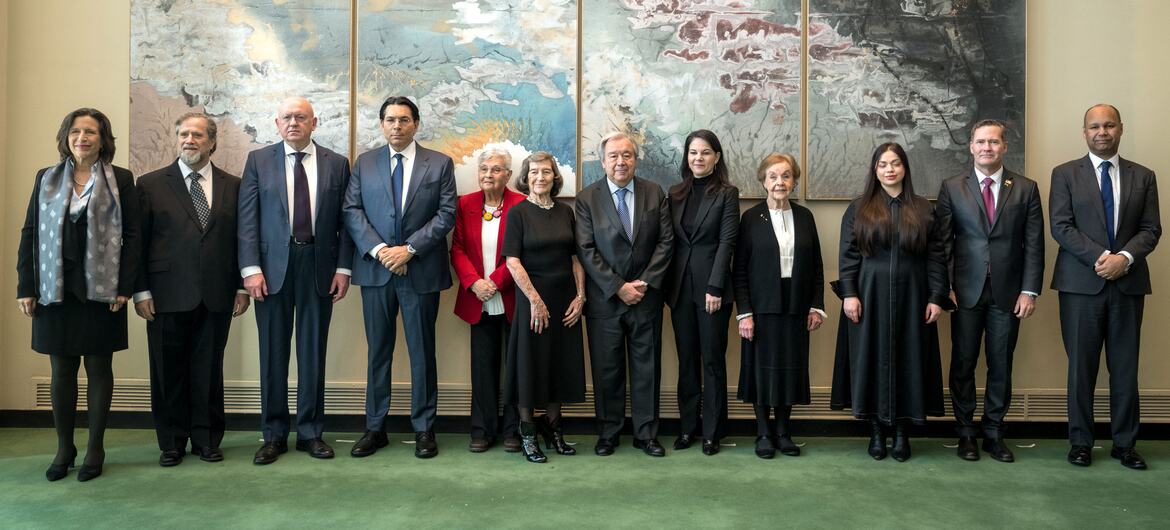
Here's her moving address in full:
In the early 1930's my grandparents, parents, brother and I lived comfortably in Hoya, a small town in northwest Germany.
In 1935, when I was one year old, the Nuremberg laws were formulated, drastically restricting the rights of Jews. Our lives changed dramatically, and my parents decided to leave the country.
On 9 November, 1938, Kristallnacht took place . Our apartment was ransacked, but worst of all, my father was forcibly taken to the concentration camp Buchenwald in Germany. My father was released after three weeks, only because our papers were in order for our emigration to America.
Trapped in the Netherlands
In January of 1939, we left for Holland from where we were to sail to the US. In December, we were deported to the Dutch detention camp of Westerbork to await our departure to America. Under Dutch control, Camp Westerbork was tolerable.
However, in May of 1940, the Germans invaded Holland, and we were trapped.
The Nazi SS took over the command of Westerbork, we were surrounded by the ever-present, terrifying 12 ft-high, barbed wire. Then, in 1942, the dreadful transports to the concentration and extermination camps in eastern Europe began.
Every Monday night, lists of those to be deported were posted, causing incredible anxiety, anguish and fear. Then on Tuesday mornings, every Tuesday morning, men, women and little ones were marched to the nearby railroad platform from where they were transported. This area became known as Boulevard. de misère.
Of the total of 120,000 men, women and children that departed Westerbork, 102,000 were doomed, never to return.
In January of 1944, it was our turn to be shipped out. I remember that it was a bitter cold, pitch black, rainy night when we arrived at our destination, Concentration Camp Bergen-Belsen in Germany.
A lifetime of fear
We were dragged out of the cattle cars and greeted by the German guards, who were shouting at us and threatening us with their weapons and with the most vicious attack dogs by their sides. I was a very frightened nine-year-old, and to this day, I still feel a certain sense of fear whenever I see a German Shepard.
Six hundred of our people were crammed into each of the crude, wooden, heatless barracks, meant for 100 when originally built. There were triple decker bunk-beds with two people sharing each bunk. German winters were bitter cold and very long. We were given only one thin blanket per bunk, and a straw-filled mattress, and this bunk was our only living quarters and that for two people.
I remember seeing a wagon filled with what I thought was firewood, I soon realised that what was in the wagon were dead, naked bodies thrown one on top of the other.
Toilets consisted of long wooden benches with holes cut into them, one next to the other. There was no privacy, there was no toilet paper, there was no soap and hardly any water with which to wash. And in the almost year and a half that we were in Bergen-Belsen, never once were we able to brush our teeth.
Every morning, we were ordered to line up on a huge field, it was called an appellplatz, five in a row as we were counted. We would have to stand there until each and everyone one of us was accounted for, often from early morning to late at night without food, without water.
Urine for warmth
No matter what the weather, without protective clothing. Frostbite was common. We would treat our affected toes and fingers with the warmth of our own urine.
Our diet consisted of a slice of bread a day and some hot watery soup. The bread was later cut back and given to us just once a week and only if our quarters were neat and in order.
Once a month we were marched to an area to shower, and there, under the watchful eyes of the guards, we were ordered to undress. I was so frightened, not knowing what would come out of the faucets - water or gas. Yes, we were always hungry, we were thirsty, and we were in pain, but for me, fear was the worst emotion to deal with.
The dark, crowded quarters often caused us to trip over the dead; bodies could not be taken away fast enough! We as children saw things that no one, no matter what the age, should ever have to see.
Indescribable horror
You have read books, you've seen movies, true documentaries, but the constant foul odour, the filth, continuous horror, and fear, surrounded by death is indescribable. There is no way this can be put accurately into words and pictures.
Our bodies, hair and clothes were infested with lice, we learnt there was a distinct difference between head lice and clothes lice, squashing them between my thumb nails became my primary pastime.
Much of my time was taken up with make-believe games. One game, a game based on superstition, became very important to me: I decided that if I were to find four pebbles of about the same size and shape, that would mean that the four members of my family would all survive. It was a very difficult game to play, but I was sure that I would always find my four pebbles. I made it my business to find those four pebbles.
Maternal strength
My mother was a remarkable, extraordinary lady with tremendous inner strength and fortitude. Mum passed away six weeks short of 105, and when she was still with us, we were five generations of women, and I refer to that as survival and continuity.
I have no doubt that it was because of my mother that I survived. I am fortunate, very fortunate, that i was never separated from my mother during those difficult years.
One day, my mother was able to smuggle some salt and potatoes from the kitchen where she worked, and somehow managed to cook the soup in secret. This was done on our bunk. I was on the bunk with her trying to hide and shield what she was doing. The soup was simmering, just about finished when the German guards entered our barrack for a surprise inspection. In our rush to hide the set-up, the boiling soup spilled on my leg. We had been taught self-discipline and self-control the hard way: for I knew for sure had I cried out, it would have cost us our lives. This happened in the spring of 1945. I was just 10 years old.
Soon thereafter, we were transported to the extermination camps in East Europe. And after 14 days on the train without food, without water, without medical supplies, without sanitary facilities, the Russian army liberated our train near Troibitz, a small village in eastern Germany.
Five hundred of the 2,500 people on board the train died enroute or shortly thereafter. Many inhabitants in Troibitz fled and we took over their homes. Kitchens were stocked with ample food, it was rich and good - actually much too good for our starved bodies. We could not tolerate that unfamiliar nourishment. At that time, at the age of ten and a half, I weighed 16 kilos, the equivalent to 35 pounds. We were all ill with typhus, but my father had to die from it six weeks after our liberation, and this after six and half years of mental torment and physical abuse.
A new life in New Jersey
In 1948, when I was 13 years old, our family of three emigrated to the United States. We arrived in Hoboken, New Jersey April 23rd, 1948, by coincidence exactly three years to the day of our liberation. The Hebrew Immigration Aid Society found a home for us in Peoria, Illinois, where we once again started our lives anew.
Because of my inability to speak English, I, at the age of 13, was placed in a fourth grade with nine-year-olds. Both my brother and I worked long hours after school to help our mum pay bills.

By taking extra courses during the year, attending summer school, and by working very hard in my studies, I graduated from Peoria Central High School five years later, at age 18 ranking eigth in a class of 267 students.
It was two months after high school graduation that I married Nathaniel Lazan. I am grateful that I survived healthy in body, mind and spirit, and that we were able to perpetuate our heritage with a wonderful family.
We have three grown children, all three are happily married, have given us nine beautiful grandchildren and 15 extraordinary great-grandchildren. Survival and continuity for sure!
Pushing back on hatred
This is the very yellow star that I was forced to wear. It was just another way to denigrate us, to isolate us, and to set us apart from the rest of society. Each and every one of us must do everything in our power to prevent such hatred, such destruction and such terror from recurring.
We can begin by having love, respect and compassion towards one another, regardless of their religious belief, colour of skin or national origin. Let us all, each and every one of us, have this compassion and respect. It is such a simple message and yet so difficult to achieve.
There is very little we can do against the negativity in our world, but how we treat, behave, and reach out to one another - that is entirely up to us. And with that, I wish each and every one of you, your children, grandchildren, and all succeeding generations, a healthy, happy, productive future in a world of love and peace.


