In the animal kingdom, only those who adapt to their environment will survive. This adaptation comes in a wide range of forms, from invisible internal shifts in gene expression to dramatic anatomical changes, such as tadpoles growing legs and transitioning to life on land as frogs. Environmental pressures are known as a driving force behind many of the major animal developmental transitions. Yet the mechanisms behind this physical and environmental relationship remain somewhat of a mystery.
Published in Science Advances, a new multi-year study led by researchers in the International Research Laboratory 2028 (IRL EARLY), a joint laboratory between the Okinawa Institute of Science and Technology (OIST) and CNRS, together with Dr. David Lecchini, an ecologist at CRIOBE in Moorea, sheds light on the mechanistic link between environmental variation and developmental adaptability. Using a common reef fish as a model, the researchers explored how environmental differences impacted thyroid hormone signaling, a process essential for development regulation. Through a combination of transcriptomics, metabolomics and other physiological analytical approaches, they revealed how the development of these fish changed across different ecosystems.
"It's surprising to see just how responsive development can be to the immediate environment, not just on evolutionary timescales but within an individual's lifetime," says first author Dr. Marcela Herrera of the Marine-Eco-Evo-Devo Unit at OIST which led this study. "We found that environment and development are far more tightly coupled than we assume, which raises the question of how much flexibility this gives animals when their environments change. This is especially important for animals threatened by climate change or habitat degradation."
One island, many ecosystems
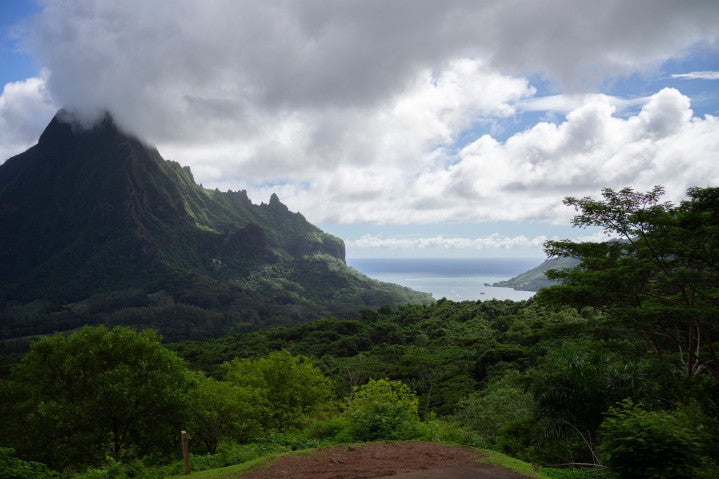
Along the beautiful coastline of Moorea Island, located to the northwest of Tahiti in French Polynesia, an expanse of just a few kilometers brings wildly different local ecosystems.
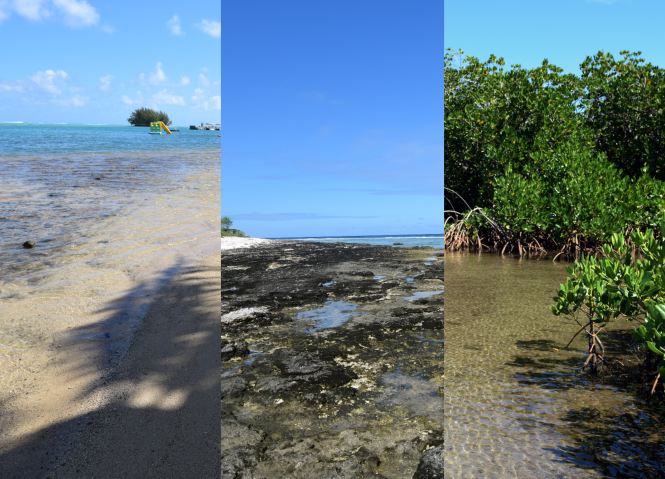
Where rivers meet the sea, dynamic mangrove forests fluctuate in water level and salinity. As water level drops, water temperature often rises. This warm, murky water contains an abundance of sediment and decaying twigs and leaves, resulting in low dissolved oxygen levels. Regardless of challenging conditions, some fish still choose to make these mangroves home. The tangled roots of mangrove trees provide young juveniles with valuable shelter from predators.
Further up the coast, rocky reefs and sandy beaches offer more stable temperature and oxygen conditions. Cracks and crevices in beach rocks give hiding spots for smaller creatures, while sandy beaches suit strong swimmers who can travel further to forage for food.
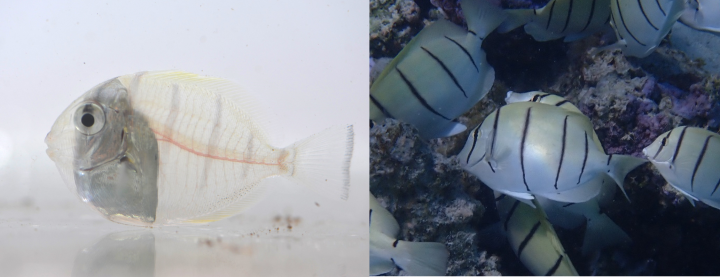
Despite the starkly differing conditions, some creatures, like the convict surgeonfish (Acanthurus triostegus), are found across beaches and mangroves alike. Originally starting off life in the open ocean, convict surgeonfish larvae migrate to these coastal habitats where they undergo dramatic physical changes to become juvenile fish.
"This transition from open ocean to coastal nurseries is a dramatic and stressful shift: during the first day entering the reef, 90% of the juveniles are eaten by predators. Those who survive typically lose 20% of their weight during their first week. It is a real challenge for them," highlights head of the Marine-Eco-Evo-Devo Unit, Professor Vincent Laudet who led this research.
Investigating development: a systems-level approach
To understand the influence of environment, the researchers first profiled fish biology across the transition. Previous observations had already hinted that habitat shapes this transition: fish settling in different environments are known to grow at different rates and develop differently, with mangrove fish, for instance, typically growing more slowly and developing darker pigmentation than fish from other habitats. The team wanted to know whether these visible differences were matched by differences happening at the level of gene expression and hormone signaling.
Studying both wild and lab-reared fish, they took a range of measurements across the first eight days of metamorphosis.
At different timepoints, they found different genes expressed, including genes responsible for thyroid hormone synthesis and genes controlled by thyroid hormones, such as those involved in pigmentation changes. They also noted shifts in gene expression relating to energy metabolism, marking a switch from aerobic to anaerobic energy production.
"You could think of this as a change from endurance cardio to high-intensity intervals. As these fish move from the open ocean to coastal habitats, they shift from a metabolism built for sustained, long-distance swimming to one that can fuel the rapid rebuilding of their body for life on the reef," explains Herrera.
They repeated similar measurements with fish raised in temporary enclosures within a range of mangrove, beach rock and sandy beach environments around the coast of the island. Habitat had a distinct impact on development.
Thyroid hormone levels varied significantly between habitats, as did expression of genes involved in thyroid hormone pathways. Metabolic profiles varied too, with sandy beach fish displaying patterns consistent with higher energy usage compared to the other environments.
"In sandy beaches, resources are generally less abundant, so fish may have to exert more energy to find food or swim away from predators. Beach rock and mangrove ecosystems offer more protection and resources," reasons Herrera.
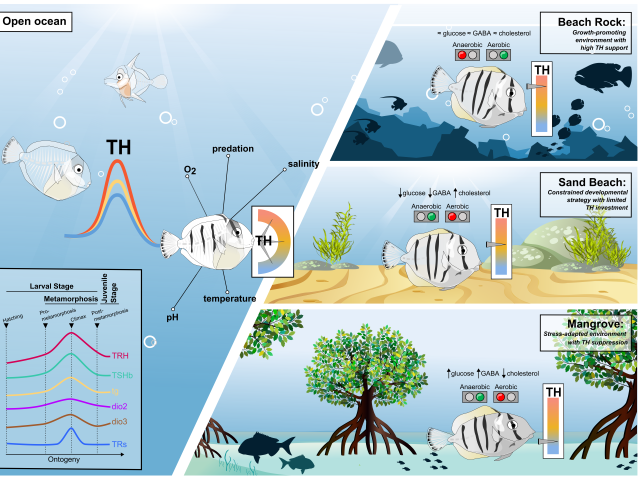
Thyroid hormones are known to control gene expression, particularly for genes involved in key developmental processes and in energy metabolism. Together, the analyses showed that in different ecological contexts, thyroid hormone signaling varied dramatically, producing habitat-specific developmental outcomes.
"Whilst biologists have long accepted that genes and environment both shape development, this study helps to answer a long running question around how the two actually communicate," says Laudet. "Thyroid hormones essentially act as a biological interface between the environment and development. They integrate environmental information to enable developing organisms to adjust their physiology and metabolism to local conditions."
-
This research, led by the OIST Marine Eco-Evo-Devo Unit, headed by Professor Vincent Laudet, was carried out in close conjunction with Dr. David Lecchini at CRIOBE on Moorea Island, French Polynesia, as well as partners within the CNRS IRL 2028 "Eco-Evo-Devo of Coral Reef Fish Life Cycle" (EARLY), supported in fieldwork by Anthony Lagant, Zoé Chamot and Mathieu Reynaud. The work builds upon several years of research into thyroid hormone signaling in coral reef fish, including previous studies on surgeonfish, clownfish and Malabar grouper. This work was funded by a KAKENHI grant from the Japanese Society of the Promotion of Science and MANINI grant from the French National Research Agency.