
The Houthis' latest attacks on commercial vessels in the Red Sea and the Gulf of Aden most likely amount to war crimes in at least three cases, Human Rights Watch said today.
The attacks follow the Houthis' announcement on July 20, 2026, that they would impose a maritime embargo on Saudi Arabia, in response to what they claimed is a Saudi sea and air blockade on Yemen, where the Houthis control the northwestern part of the country. The new attacks targeted at least two Saudi-flagged vessels, a Tanzania-flagged vessel, and a Dominica-flagged vessel. Attacks on civilians or civilian objects committed recklessly or with deliberate intent constitute war crimes.
"The Houthis are once again putting seafarers' lives at deadly risk through their attacks on commercial ships, this time as part of their hostilities with the Saudi-led coalition," said Niku Jafarnia, Yemen and Bahrain researcher at Human Rights Watch. "Whatever the geopolitics, attacks on civilian crews carried out deliberately or recklessly are war crimes."
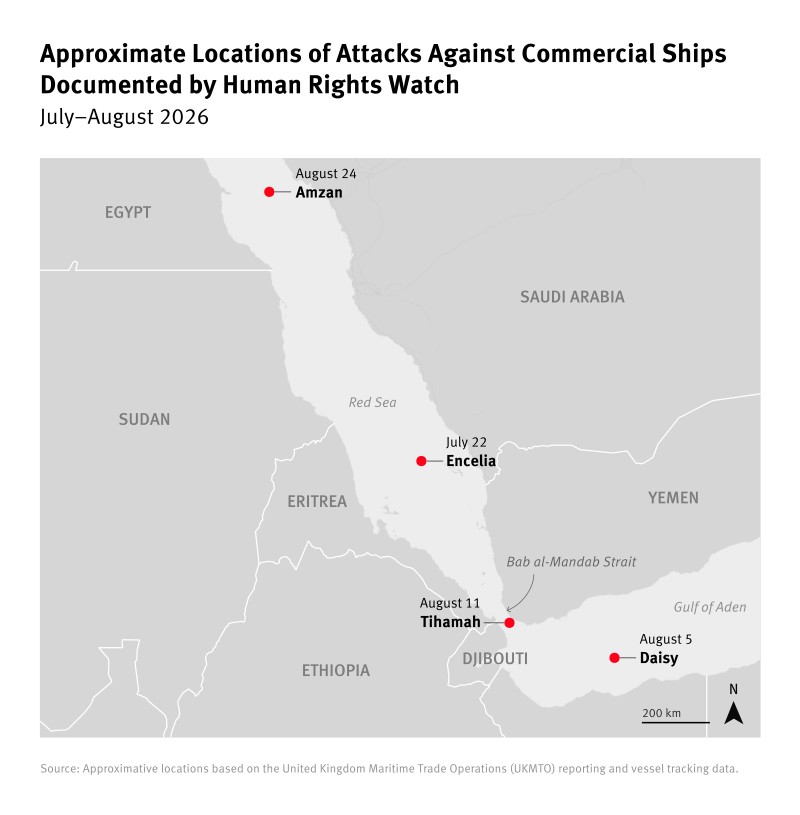
As of August 24, the Houthis claimed that they had targeted at least nine vessels since July 20. Saudi and Yemeni authorities, a shipping company, and a ship's master confirmed four of these attacks: Encelia, Daisy, Tihamah, and Amzan. The Houthis claimed there was a military objective only in the attack on the Tihamah, which they said carried Saudi military equipment.
In addition, on July 24, the Saudi Press Agency, Saudi Arabia's official state news agency, and a vessel's operating company stated that the NCC Masa had been targeted by the Houthis in the Red Sea, an attack that the Houthis did not claim.
Human Rights Watch reviewed data from the United Kingdom Maritime Trade Operations and vessel tracking websites to corroborate the type of vessel attacked and the reported locations and timing. Researchers verified photographs and a video posted online after the attack on the Tihamah.
Human Rights Watch wrote to Bihar International Company, which operates Daisy and Encelia; Bahri, which operates Amzan; and Thubab for Marine services, which owns the Tihamah vessel, regarding the attacks but has not received any responses.
Evidence reviewed by Human Rights Watch, including Houthi statements and publicly available information about the ships, indicates that the Houthis knew or should have known that the Encelia, Daisy, and Amzan were commercial vessels carrying civilians. Human Rights Watch could not confirm their cargos. But the Houthis have not produced any evidence to show that there were military targets on these ships.
On July 23, the Houthis said that they had targeted two Saudi-flagged oil tankers the day before, including the Encelia, using ballistic and cruise missiles and drones. The Saudi Press Agency, citing the Transport General Authority, confirmed that the Encelia had been hit and caught fire at the bow. The authority also confirmed that all crew members were safe and that authorities had secured the vessel and taken measures to protect the marine environment.
On July 25, the Saudi-led coalition carried out military strikes against sites that Turki al-Malki, the coalition spokesperson, said the Houthis had used to threaten commercial vessels in the Red Sea. He said that the coalition "will continue to undertake all necessary operational procedures and measures (…) to protecting our vessels." Human Rights Watch has not investigated the coalition strikes and could not independently confirm the nature of the sites targeted.
On August 5, the Houthis announced that they had targeted the Daisy, a Dominica-flagged oil tanker. At 5:30 p.m. local time on August 5, the Daisy's master reported a loud explosion as it moved west in the Gulf of Aden and said that shockwaves from the explosion had caused minor damage, but that the crew was safe, UK Maritime Trade Operations reported. Marine Traffic, a vessel-tracking website, showing that the tanker later continued to Djibouti.
On August 11, the Houthis announced that they had targeted the Tihamah, a Tanzanian-flagged deck cargo ship, in the Bab el-Mandab Strait. At 5:07 a.m. local time, Wadah Al-Dubaish, spokesperson for Yemeni government-aligned joint forces on Yemen's west coast, posted on X that a civilian ferry used to transport citizens and food supplies had been targeted near Bal el-Mandab. The last signal sent from the Tihamah was received by the vessel-tracking website Marine Traffic at 04:39 a.m. local time.
According to the Yemeni government's Transport Ministry, the vessel was targeted with "three consecutive ballistic missiles." The attack killed at least four crew members, including three Pakistani nationals and one Indonesian national, and killed two rescuers from the Yemeni Coast Guard. The attack also injured at least 10 others.
Though the Houthis later said that the Tihamah was transporting Saudi military equipment, the Yemen Transportation Ministry's statement said that the Tihamah is a commercial civilian vessel that was carrying food supplies. Human Rights Watch was unable to confirm what cargo the vessel was carrying. Three photographs and one video verified by Human Rights Watch and geolocated to Bab el-Mandab Strait show the aftermath of the attack. The video shows smoke billowing from the Tihamah. Human Rights Watch wrote to the Houthis on September 7, asking them to provide evidence of the military targets onboard but has not received any response.
On August 24, the Houthis announced that they targeted the Amzan, a Saudi-flagged oil tanker, with a ballistic missile. One hour later, the tanker's operating company, Bahri, released a statement confirming a security related incident involving this ship and announced that all crew members were safe and accounted for, with no reported injuries.
International humanitarian law protects civilians and civilian objects from attack at all times. Parties to a conflict must do everything feasible to confirm that a target is a military objective before and during attacking it and must take precautions to minimize civilian harm. A person who commits serious violations of the laws of war with criminal intent-that is, intentionally or recklessly-may be prosecuted for war crimes. Individuals may also be held criminally liable for assisting in, facilitating, aiding, or abetting a war crime. Commanders and fighters who knowingly or recklessly attack civilians or civilian objects, or who help others carry out such attacks, may be criminally liable for war crimes.
In the case of the Tihamah, Human Rights Watch could not verify whether there was military equipment aboard the vessel. However, even if there was, any attack on the vessel with a civilian crew is still subject to the requirements of proportionality. Disproportionate attacks include those that may be expected to cause excessive damage to civilians and civilian objects in relation to the concrete and direct military advantage anticipated from the attack.
The Houthis have repeatedly attacked commercial ships in the Red Sea since November 2023, placing civilian mariners at risk. The Houthis also previously detained 25 members of the crew of the Galaxy Leader, a British-owned and Japanese-operated vehicles carrier registered in the Bahamas and seized the ship. They held the crew forover a year, and continue to hold the ship. Human Rights Watch previously found that these attacks are likely war crimes.
"Civilian crew members should not have to put their lives at risk to carry out their jobs," Jafarnia said. "The Houthis should immediately and unconditionally end all unlawful attacks on civilian ships in the Red Sea and Gulf of Aden."


