
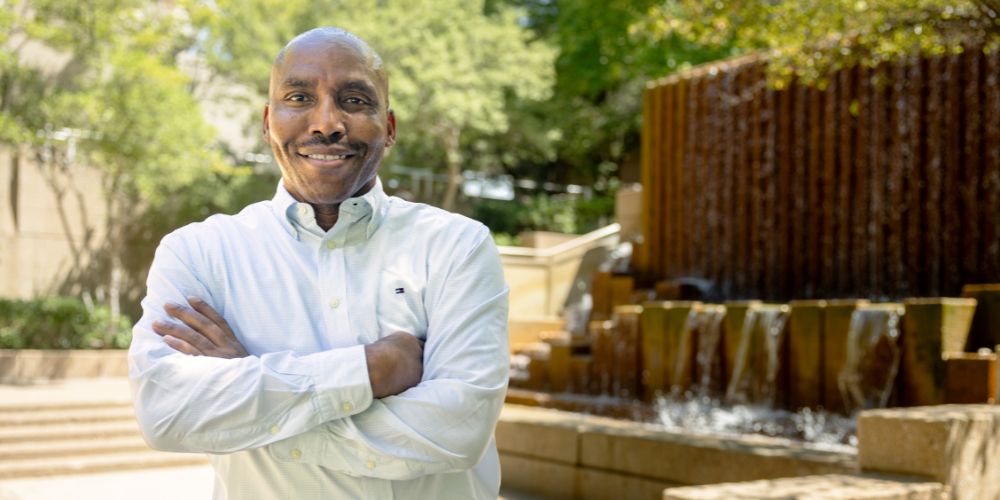
Antwan C. Williams, assistant dean for communications, marketing, recruitment, and graduate admissions for The University of Texas at Arlington's School of Social Work, was working at the Pentagon when it was attacked on the morning of Sept. 11, 2001.
Williams, a retired U.S. Army lieutenant colonel, was an Army captain at the time, working on the personnel staff for Lt. Gen. Timothy J. Maude. Maude, along with 28 of Williams' colleagues, died at the Pentagon on 9/11.
As the nation remembers the 25th anniversary of the attacks, Williams shared his perspective on that day and how the experience shaped his life.
On the 25th anniversary: Well, 25 years ... it's actually gone by pretty fast. It surprised me when someone mentioned that it had been 25 years. You do think about it, especially during this period leading up to 9/11. But at other times, you're busy with your life. I think a lot about how far the nation has come since then and everything that has happened since.
On his role at the time and that specific day: My day-to-day work involved media relations, public affairs, public relations and providing updates and communications not only to my immediate boss, Brig. Gen. William P. Heilman, but also providing information and advice to Lt. Gen. Timothy Maude.
When I went in that morning, my day started normally. Back then, I would usually be at work around 6:30 or 7 a.m., trying to get in before my boss so I could pull together information, news releases and updates on personnel matters that might have appeared in the news that day.
About an hour into that, I received an alert while looking at online news. I think it was the Drudge Report that had the first alert saying a plane had hit one of the Twin Towers in New York City. At the time, I thought it was probably an accident or something like that.
Later, when I checked again, I saw that another plane had hit the second tower. That's when I immediately realized there was more going on than we had first thought. I continued with my work, went to Lt. Gen. Maude's front office to deliver some materials and spoke with his secretary.
Right after that, I thought, "Let me go over to the other side of the Pentagon." I had previously worked in public affairs for the Chairman of the Joint Chiefs of Staff, so I walked over to see if I could get more information about what was happening in New York City.
It took me about four or five minutes to get there. As soon as I walked into my old office, people came running in saying a plane had just hit the building. I didn't hear the impact myself, but others came running into the office saying a plane had hit the Pentagon.
That's when we all took off and ran back to our areas.
Related: From military service to student success at UTA
On his emotions looking back: A lot of those individuals I saw that day didn't make it. The people I was talking to before I left—including Lt. Gen. Maude's secretary Deborah Ramsaur and others—were exactly where the plane came through the building.
I was literally standing there just minutes before the plane struck. If I hadn't left to go to the other side of the building, I would have been in its direct path.
There was some survivor's guilt, but mostly I think about their sacrifices—being there, doing what they were supposed to do, doing their jobs and doing them well.
In a split second, everything changed.
Brig. Gen. Heilman and I both made it out of the Pentagon safely and worked for several weeks after 9/11 in the Pentagon Operations Center supporting the Casualty, Memorial Affairs and Missing Persons project and operations.
Some of my closer colleagues who died that day in the Pentagon were Maj. Ronald Milam, Maj. Clifford Patterson, Lt. Col. (ret.) Gary Smith, Lt. Col. Karen Wagner, and Maj. Dwayne Williams.
On the impact of social workers after the attacks: In the days and weeks after, social workers walked around, passed out pamphlets, talked with us and gave us guidance. They didn't do it just once; they did it for weeks while we were trying to provide closure for families.
We were setting up memorials when remains were identified. We were keeping track of that information. We were also tracking down reports of people believed to have been lost in the Pentagon and verifying whether they had actually been there.
The social workers played a big role in helping us, giving us guidance and advice. Later, I used those services myself and realized I was dealing with things that I needed to talk through with someone.
Related: UTA earns gold for supporting military students
On coming to UTA in 2016: I knew that after the military I wanted to get into higher education. Out of the blue, a position became available at The University of Texas at Arlington School of Social Work in communications and public relations, which was exactly the field I had worked in. I applied, interviewed and was hired by Dr. Scott Ryan, who is still a professor at the School of Social Work and a former dean.
Within a few months, he asked if I would like to teach. He said, "We see you have a law degree and all of this experience in the military. Would you like to teach some of our social work students?" I jumped at the chance and have been doing it ever since as an adjunct assistant professor.
Since 2016, I've been teaching social work students at UTA, focusing on policy matters, social welfare issues, public policy and advocacy.
For me, it has been a way of giving back to the social workers who helped me during that period and helping develop the social work leaders of tomorrow.
On honoring his lost colleagues: My way of honoring them was finding a way to give back, knowing it was only by circumstance that I wasn't there with them, that I had walked to the other side of the building while they remained at their desks doing their work.
I felt an obligation to remember my coworkers by giving back, serving, teaching and helping those who helped me. That's part of what I enjoy doing, and it's also part of what has helped me through this experience.
About The University of Texas at Arlington (UTA)
The University of Texas at Arlington is a growing public research university in the heart of Dallas-Fort Worth. With a student body of over 42,700, UTA is the second-largest institution in the University of Texas System, offering more than 180 undergraduate and graduate degree programs. Recognized as a Carnegie R-1 university, UTA stands among the nation's top 5% of institutions for research activity. UTA and its 300,000 alumni generate an annual economic impact of $28.8 billion for the state. The University has received the Innovation and Economic Prosperity designation from the Association of Public and Land Grant Universities and has earned recognition for its focus on student access and success, considered key drivers to economic growth and social progress for North Texas and beyond.


