
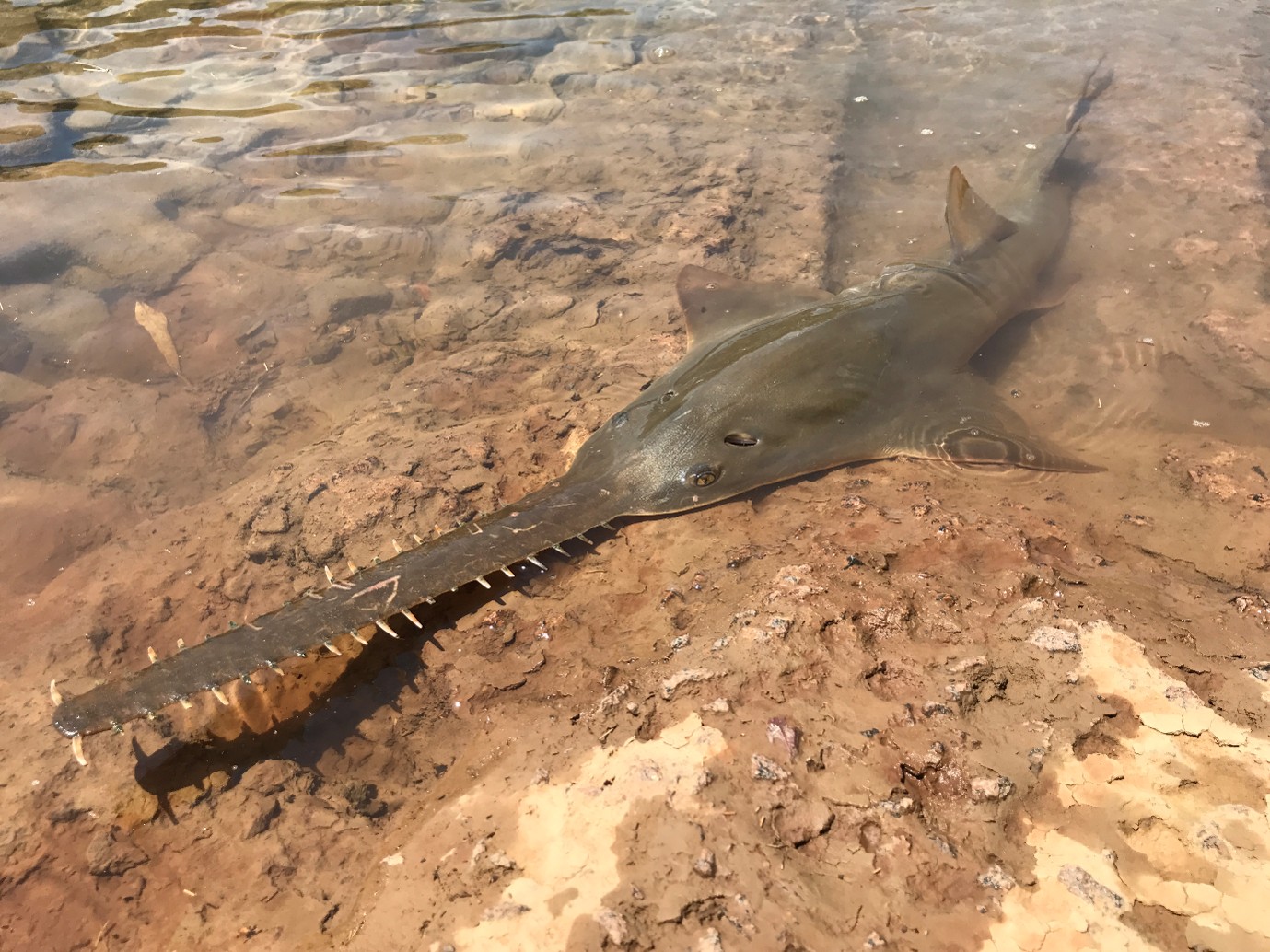
A large freshwater sawfish might look scary in the wild, but its greatest survival assets are tiny microbes that may give its young an invisible forcefield when environmental conditions get tough.
New research led by Flinders University describes how microscopic communities living on the skin of the critically endangered largetooth sawfish (Pristis pristis) could help these animals endure challenging dry-season conditions, offering a new perspective on their conservation.
Growing up to 7.5 metres long, largetooth sawfish use their long tooth-studded snouts, known as rostra, to locate and stun prey. Australia remains the last remaining population stronghold of this species, which uses rivers and floodplains as nursery areas.
Sawfish pups are born at river mouths and migrate upstream, spending their first four to five years in freshwater nursery areas. In northern Australia, young sawfish can become stranded in isolated pools as floodwaters retreat. As these pools shrink and oxygen levels fall, the animals face increasingly stressful conditions.
Published in Environmental Microbiology, the study examined skin microbes from nine young sawfish sampled during a rescue program on the Daly River floodplain in the Northern Territory.
The program relocates stranded sawfish to the permanent river channel to improve their chances of survival.
Researchers found that sawfish carried microbial communities distinct from the surrounding water, with genes associated with dormancy and survival under low-oxygen conditions. Although the microbes differed among animals, they shared similar functional capabilities.
"These sawfish are carrying a distinctive microbial community, even in an environment that puts both the animals and their microbes under considerable stress," says microbiome researcher Dr Michael Doane, from the Flinders Accelerator for Microbiome Exploration (FAME) research group at the College of Science and Engineering.

"The genes we identified suggest these microbes have the tools to persist when oxygen is scarce. That raises an exciting possibility: the microbiome may help maintain a living shield against opportunistic microbes while the sawfish's own metabolism slows."
The research brought together microbiome scientists, sawfish conservation specialists and Malak Malak Rangers, the Indigenous land managers of the Daly Rivers region.
"For a critically endangered species, helping young animals survive these difficult periods is an important part of conservation," says co-author Dr Pete Kyne, a Northern Territory sawfish conservation expert.
"This study adds another dimension to that work. Understanding the relationships between sawfish, their microbes and their environment could help us make better-informed decisions about relocation and the habitats these animals need."
Largetooth sawfish are found is freshwater rivers across northern Australia, from the Fitzroy River in Western Australia, to Cape York Peninsula in Queensland. Individuals can grow larger than 6.5m over a lifespan of up to 35 years and weigh up to 600kg.
Another co-author, Dr Leonardo Guida, shark scientist and conservation lead at the Australian Marine Conservation Society, adds: "Identifying a non-invasive early warning system to detect stress in sawfish before they look sick is also very exciting. For a critically endangered animal, every individual counts and being able to act fast helps ensure the best possible outcome."

Dr Doane says the findings strengthen the case for considering microbiomes alongside animal physiology and habitat protection.
"We increasingly recognise how closely human health is connected to our microbes. Wildlife also lives with these microbial partners, yet their role is often missing from conservation discussions," he says.
"Protecting an endangered animal means understanding the biological relationships that help sustain it. The microbiome is integral to that picture."
Patterns of functional redundancy and anaerobic metabolic potential characterise the skin microbiome of a Critically Endangered Sawfish (2026) by Michael P. Doane, Belinda Martin, Emma Kerr, Elizabeth A. Dinsdale, Malak Malak Rangers, Leonardo Guida and Pete M. Kyne has been published in Environmental Microbiology. DOI: 10.1111/1462-2920.70442.
Acknowledgements: Fieldwork funding was provided by the Charles Darwin University 2021 Institute of Advanced Studies Rainmaker Start Up and the Australian Marine Conservation Society (AMCS). Sample processing and analysis were supported by the Flinders Accelerator for Microbiome Exploration. The activities were performed under Flinders University ethics AEC BIOL9436-2.


