
Two International Labour Organization (ILO) initiatives supported by Japan have helped more than 23,000 informal workers in India, Nepal and Pakistan gain improved access to formal employment, social protection, voice and representation, while parallel efforts have strengthened the institutions, policies and partnerships to prevent child labour in India and Nepal.
A workshop to mark the conclusion of the Promoting Rights and Social Inclusion through Organization and Formalization (PRS Phase 2) Project and the Policies, Partnerships, Learning & Local Empowerment (PPLL) Project took place in New Delhi on14 September 2026.
Funded by the Ministry of Health, Labour and Welfare (MHLW) of Japan, the initiatives saw the ILO work with governments, employers' and workers' organizations, as well as development partners to translate fundamental principles and rights at work into stronger policies, institutions and protections for workers, their families and communities.
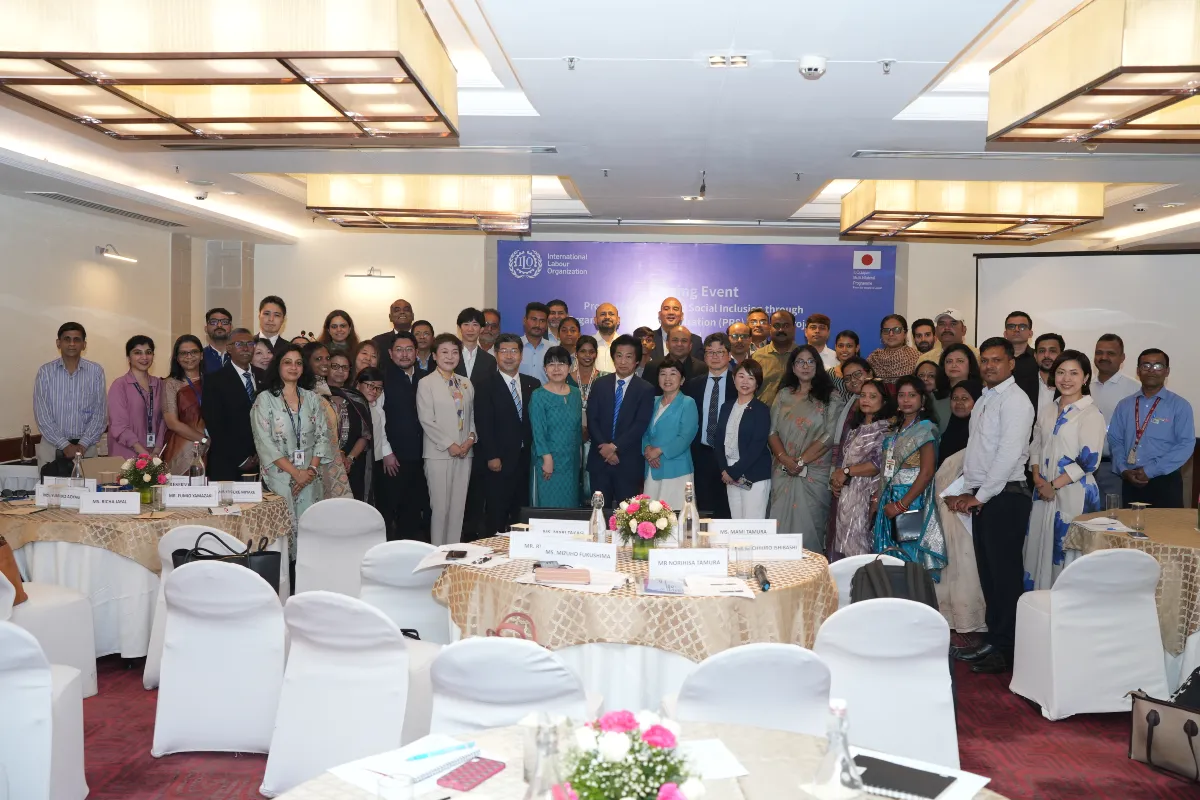
The closing workshop provided an opportunity to reflect on the results and lessons generated by the two projects and their contribution to efforts to eliminate child labour, facilitate the transition from the informal to the formal economy and promote gender equality in the region.
Eliminating child labour in supply chains
Implemented in India and Nepal, the PPLL project has worked to prevent and eliminate child labour, with a particular focus on vulnerable children and families connected to supply chains namely the mica and natural stone sectors in India and the carpet and brick supply chain in Nepal.
The project has combined stronger policies and enforcement with improved coordination, research and community-level action in both countries. In Nepal, it supported child labour legislative reform, the adoption of a hazardous work list for children and the integration of a child labour module into the Labour Force Survey. It also strengthened Child Labour Free Zone approaches, and the development of referral mechanisms linked to child protection system.
In India, it strengthened coordination and enforcement in mining communities, supported improved access to social protection, advanced a state action plan on child labour in Jharkhand, and empowered communities in Rajasthan's sandstone sector to identify and address child labour and its underlying causes.
Advancing integrated formalization through stronger policies, institutions and systems
The PRS Phase 2 project focused on strengthening workers' rights and social inclusion by supporting the transition of workers and enterprises from the informal to the formal economy, with a focus on the domestic work, construction and sanitation sectors in India, Nepal and Pakistan.
It has contributed to the adoption and implementation of 13 policy and legislative measures, including wage reforms for domestic and sanitation workers in Bihar, India, and for domestic workers in Punjab, Pakistan, as well as sectoral policies promoting formal, decent, safe and inclusive workplaces in Nepal's waste management sector.
The project has also enhanced access to formal employment and social protection, as well as greater voice and representation for 23,208 workers in the informal economy across India, Nepal and Pakistan.
Oktavianto Pasaribu, Deputy Director of the ILO Decent Work Team for South Asia and Country Office for India, noted that strong collaboration between the ILO, government and social partners at all levels was a major factor in the success of the initiatives.
"The results of the two projects demonstrate that informality, inequality, child labour, gender inequality and social exclusion are not isolated challenges but are deeply interconnected. Building on this momentum, we must ensure that the knowledge, partnerships and lessons generated through the projects are carried forward and translated into sustained action. Ultimately, the true measure of our impact is the difference we make in people's lives," he said.
The closing event brought together more than 60 participants, including Japanese parliamentarians, officials from central and state governments, representatives of employers' and workers' organizations, community-level partners, workers and children.
Through the ILO-Japan Partnership Programme, the Government of Japan and the ILO have a longstanding partnership supporting decent work priorities across Asia and the Pacific. The experience generated through the PPLL and PRS projects provides lessons for continued efforts to eliminate child labour, strengthen fundamental principles and rights at work, advance formalization and ensure that women and other vulnerable workers are not left behind.


