Mark Hughes Foundation co-founder Kirralee Hughes has been named a recipient of the 2026 Jeannie Ferris Award* for Members of the Community, in recognition of her outstanding contribution to improving outcomes for people with cancer.
Announced by Minister for Health and Ageing Mark Butler with Cancer Australia** at Parliament House, in Canberra, Mrs Hughes was acknowledged as a passionate advocate, community leader, and co-founder of the Mark Hughes Foundation, whose work has transformed brain cancer care, research and support across Australia.
"This award reflects the many amazing people I've had the privilege to work with especially my husband Mark, our amazing MHF team and all the staff at the MHF Centre for Brain Cancer Research at the University of Newcastle," Mrs Hughes said.
"I am in a unique position of being the carer of someone who has brain cancer and nothing motivates you more to make a difference than this very situation. But this position comes with immense responsibility, and I'll never lose sight of the trust that people place in us."
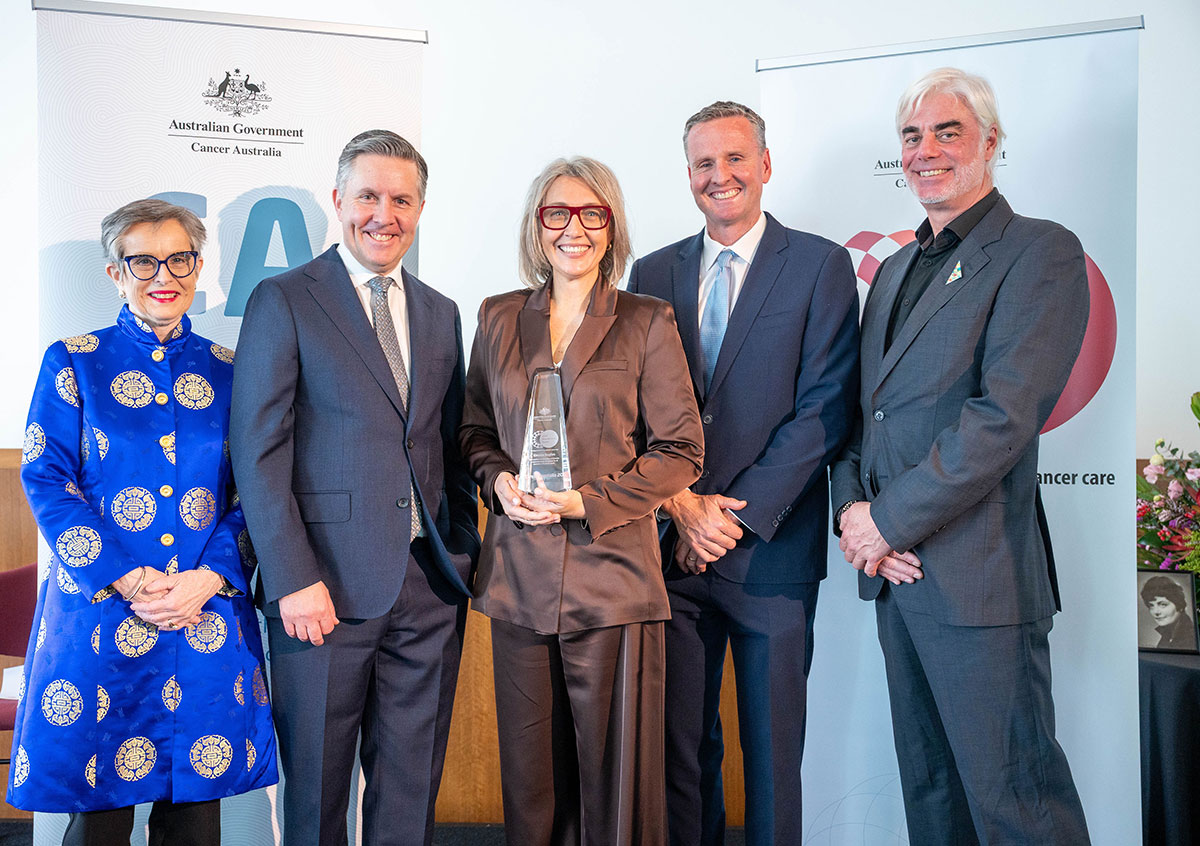 Jeannie Ferris Award recipient Mrs Kirralee Hughes and husband Mark Hughes, OAM, with (l-r), CEO Cancer Australia Professor Dorothy Keefe, Minister for Health and Ageing Mark Butler, and Jeremy Ferris - son of the late Jeannie Ferris, former Senator for South Australia.
Mark Hughes, OAM, a former Newcastle Knights premiership player and NSW State of Origin representative, established the Mark Hughes Foundation with his wife Kirralee, following his diagnosis with brain cancer in 2013. The Foundation's driving mission is to raise awareness, fund research and support patients and families affected by the disease.
As the operational driving force behind MHF, Mrs Hughes has played a pivotal role in growing the organisation into one of Australia's leading brain cancer charities, raising more than $30 million in just over a decade. Her leadership has been instrumental in advancing brain cancer research, support and advocacy nationwide.
Mrs Hughes' leadership was central to the establishment of the Mark Hughes Foundation Centre for Brain Cancer Research at the University of Newcastle in 2022. The MHF Centre has rapidly transformed Newcastle into a powerhouse of collaboration and innovation in tackling the disease.
The Centre now connects more than 100 researchers across 27 institutions and administers an Innovation Grant Scheme that has awarded over $10 million to advance new discoveries. Early research breakthroughs, including the repurposing of an Alzheimer's drug for glioblastoma, show promise in improving survival outcomes and quality of life.
A landmark $18.9 million gift from the Foundation through the University of Newcastle in June this year further strengthened that impact, accelerating efforts to develop new treatments and improve outcomes for patients. The commitment brought MHF's total contribution to the University to $36.6 million, making it one of the largest philanthropic investments in brain cancer research nationally and the largest philanthropic contribution in the University's history.
The latest investment will drive the next phase of research, translating discoveries into clinical practice, with brain cancer still the leading cause of cancer death in children and adults under 40, and survival outcomes largely unchanged for decades.
* The Jeannie Ferris award is named in honour of the late Jeannie Ferris, former Senator for South Australia. Senator Ferris was diagnosed with ovarian cancer in October 2005 and passed away in April 2007. The Award continues Senator Ferris' legacy and recognises and promotes the value and efforts of consumers, health professionals and researchers in improving equitable outcomes for all Australians affected by all cancers.
** Cancer Australia was established by the Australian Government in 2006 to benefit all Australians affected by cancer, and their families and carers. Cancer Australia aims to reduce the impact of cancer, address disparities and improve outcomes for people affected by cancer by leading and coordinating national, evidence-based interventions across the continuum of care.