
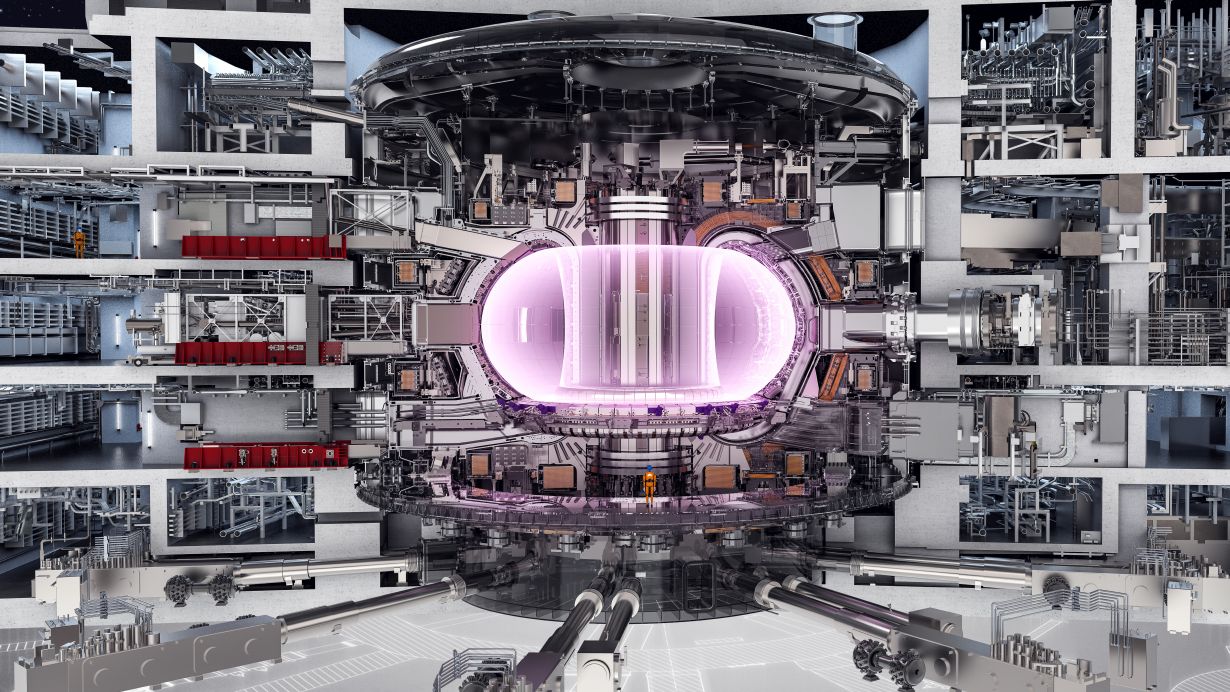
As part of the plans to build a fusion reactor in Germany, the Federal Government is establishing new research hubs. The Karlsruhe Institute of Technology (KIT) will play a significant role in this effort: KIT researchers are developing key technologies for the fuel cycle, high-performance materials, and essential reactor components. By contributing its broad expertise, KIT helps turn fusion technology into a practical reality and plays a leading role in advancing it from fundamental research to real-world application.
The Fusion Action Plan initiative was launched by the Federal Government to advance the construction of the Germany's first fusion reactor. This involves establishing three research hubs. The aim is to pool expertise from science and industry to master the technological challenges associated with fusion energy. A request for proposals for three hubs to receive funding had been launched by the Federal Ministry of Research, Technology and Space (BMFTR). On July 29, 2026, the BMFTR announced its decision: One of the hubs will be set up at KIT. KIT's research will focus on the development of the fuel cycle and new materials, and the technical implementation in the fusion power plant.
Petra Olschowski, Baden-Württemberg's Minister for Science, Research, and the Arts, emphasized that the decision by the BMFTR will strengthen German fusion research and Baden-Württemberg as a center of science and innovation. "How soon fusion can play a role in the energy mix of the future depends mainly on the technological progress made in materials research and in the development of the fuel cycle. This is exactly where the Karlsruhe researchers rank among the world's best: Materials suitable for fusion reactors are a decisive building block when it comes to enabling fusion technology. An equally relevant asset are the key skills KIT can provide for setting up a safe and sustainably working fuel cycle including the production of tritium, the element necessary for a working fusion process. The fact that KIT has been chosen for setting up one of the hubs will strengthen the leading role of Baden-Württemberg in fusion research in the long run. It clearly demonstrates the success of our approach, which focuses on future technologies and the alignment with the High-Tech Agenda Germany."
Karlsruhe as an Ideal Site
"I'm very happy about the decision made by the Federal Ministry," said Professor Jan S. Hesthaven, President of KIT. "We're among the top institutions for fusion technology. Our expertise and our unique infrastructures make KIT an ideal site for this research. The Karlsruhe fusion hub will allow us to advance our research specifically in view of the key requirements for future fusion power plants."
"Fusion energy has the potential to provide enormous amounts of energy. We at KIT are working to make it usable in practice as soon as possible," said Professor Christoph Kirchlechner, speaker of the Fusion Program at KIT. "Together with our partners, we are developing technologies to enable safe, reliable, and economically viable fusion power plants."
Industry will play a key role in this effort. According to Kirchlechner, the aim of the hub is to involve companies in the development of the technologies and to jointly establish the foundations for an efficient supply chain in the fusion industry. As the interface between the different fusion industry branches, the Karlsruhe hub brings together the Proxima Fusion and Gauss Fusion magnetic fusion companies with the Focused Energy and Marvel Fusion laser fusion companies. In total, more than 30 partners are involved in the effort. This includes universities, non-university research institutions, and established industrial companies.
Three Hubs Pave the Way to the Fusion Reactor
While two hubs will focus on magnetic confinement fusion and laser fusion, the third one is dedicated to the fuel cycle, the development of new materials, and the technical implementation in the power plant. KIT had applied for this hub to contribute the institution's long-standing know-how and speed up the transfer of scientific findings to industrial applications.
KIT is renowned as one of the internationally leading institutions in these areas. The research conducted by the KIT researchers includes the development of breeder blankets, which are required for synthesizing tritium as the fuel for fusion reactions, technologies for its safe fuel-cycle management, and materials that permanently resist the extreme temperatures and high neutron fluxes.
In addition, key technologies such as high-frequency systems for plasma heating and components for the continuous operation of future plants are being developed at KIT. "It's crucial to devise and combine these technologies with integration in mind," said Kirchlechner. "This is the only way to arrive at solutions that work reliably in the power plant and can be operated economically."
From Large-scale Research to Industrial Application
Considerable scientific and technical challenges must be overcome until a fusion power plant can actually supply power to the grid. At the same time, nuclear fusion is gaining momentum worldwide as a strategic future technology. Thus, fundamental research, the development of technologies, and educational efforts are closely linked at KIT. This includes areas such as providing highly specialized test facilities and qualifying specialists for handling complex systems such as the fusion fuel tritium. The aim is to establish the preconditions for developing fusion technology as a reliable complement to renewables in the long term


