
From the walls of a childhood home to the layout of a town square, physical environments profoundly shape human identity and comfort. And when they are suddenly destroyed, like during a natural disaster, people feel lost and afraid.
Kopana Terry, the oral history archivist at the University of Kentucky Libraries Louie B. Nunn Center for Oral History, is examining how the rapid loss of buildings during natural disasters affects the psychological well-being of survivors. Her research explores the deep connections between place, identity and loss.
"Our identity is so tied to the buildings that we inhabit," Terry said. "We inhabit that building and the building in many ways begins to inhabit us as well. When you take that away, it's a big adjustment."
Terry's research was sparked by a personal tragedy: the 2012 EF3 tornado that devastated her hometown of West Liberty, Kentucky. The storm destroyed her family home of 70 years. This experience led her to investigate the concept of thigmotaxis - a primitive instinctual need for safety provided by physical structures. In a disaster, the sudden loss of these environments can leave individuals in a state of primal fear because they have nowhere left to hide.
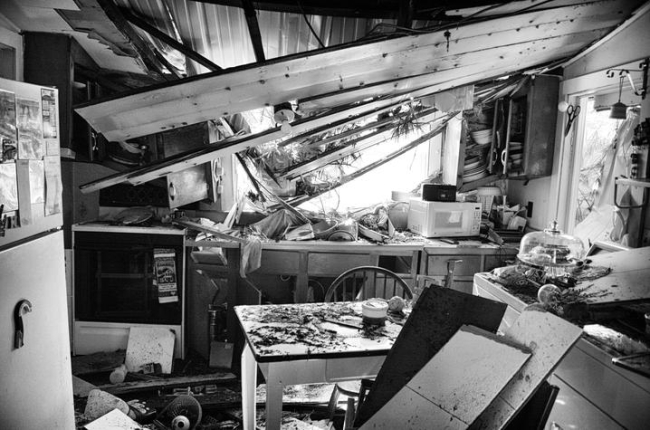
To document this phenomenon, Terry utilized her background in photography and oral history to conduct 30 oral histories with residents of Morgan County and various experts in weather and Appalachian culture. These conversations allowed her to explore how others adjusted to their town looking fundamentally different after the storm.
Terry was able to solidify her research focus thanks to support from Celebrating University Research Across the Enterprise (CURATE), a program funded by the Office of the Vice President for Research, that allowed her to travel to the National Preservation Conference in Washington, D.C.
"I could not have gone to the D.C. conference without that funding," Terry said. "That conference let me know that this work was important. As everybody else is concentrating on the seaboard, somebody needs to look at what's happening in the interior and specifically in Appalachia."
The insights gained from her work have broader implications for how we discuss climate change. Terry found that by using oral history and focusing on personal stories of the weather rather than trigger words, researchers can find common ground with communities often resistant to traditional climate messaging.
"If we can document this stuff and keep talking about it, we can keep younger generations involved and interested," Terry said. "Oral history and photography play an enormous part in helping us know where we've come from and where we're going to go."


