
More than 1,200 microbial strains, 8,000 extracts and 160,000 tests. In a major European research project, Leiden scientists searched the ocean for promising compounds. Their search uncovered new substances that could help combat diseases affecting humans, plants and fish.
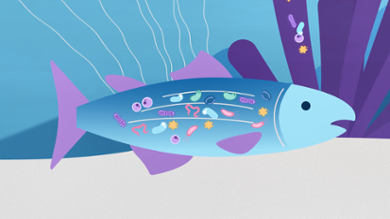
New medicines, crop protection products and treatments for fish diseases could have their origins on the seabed. That is where project coordinator Gilles van Wezel and project manager Mariana Avalos Garcia, both biologists in Leiden, together with their colleagues, searched for micro-organisms that produce useful compounds. Their search took them to sponges, algae, fish and salt-tolerant plants.
'Marine ecosystems are particularly promising,' says Avalos Garcia. 'The organisms there have developed unique ways of surviving intense competition, disease pressure and environmental stress. In doing so, they often produce new compounds to protect themselves, and these can be very different from those found on land.'
Looking for a needle in a haystack
But how do you identify the truly interesting compounds among so many micro-organisms? According to Avalos Garcia, it is like looking for a needle in a haystack. To tackle this challenge, the team developed an analytical tool to identify promising molecules from thousands of samples.
The researchers analysed more than 1,200 microbial strains, produced over 8,000 extracts and subjected them to more than 160,000 biological tests. This led them to several compounds and groups of micro-organisms that can suppress disease-causing organisms.
Five of the most promising compounds have now moved on to the next stage of development. The researchers are investigating whether these substances can be produced sustainably on a larger scale. As part of this work, they are confirming the compounds' chemical structures and activity, while also improving the fermentation process used to produce them. During fermentation, researchers grow micro-organisms under controlled conditions so that they produce the desired compounds.
Discovering without harming the ocean
Sustainability was a key principle of the project from the outset. By growing micro-organisms in the laboratory and producing the desired compounds through fermentation, the researchers hope to avoid repeatedly collecting sponges and other marine organisms from the sea. This makes large-scale research possible without placing additional pressure on vulnerable ecosystems.
'Biodiscovery only makes sense if it doesn't harm or undermine the biodiversity it depends on,' says Avalos Garcia.
Due to the selected cookie settings, we cannot show this video here.
Watch the video on the original website or Accept cookies
Activating hidden genes
Some micro-organisms already contain the genetic instructions needed to produce interesting compounds, but they do not make them under laboratory conditions. The genes involved remain inactive. These genes are often grouped in so-called biosynthetic gene clusters.
The research group led by Van Wezel investigated how we could activate such clusters, enabling micro-organisms to produce compounds that would otherwise remain hidden. To do this, the researchers tested a range of signalling molecules known as elicitors.
'It's like looking for keys to open unread books'
'Micro-organisms often contain a library full of books, but most of those books are locked,' explains Avalos Garcia. 'Finding an elicitor is like finding the key that lets you open those unread books.
Beyond compound discovery
Besides searching for new compounds, the researchers also wanted to better understand how micro-organisms suppress disease-causing organisms. Bioinformaticians led by Marnix Medema investigated the mechanisms behind this process.
Jos Raaijmakers and Victor Carrión focused on salt-tolerant plants. They searched for micro-organisms that could help crops better withstand increasing soil salinity. Their findings may offer new opportunities for agriculture in areas where soils are becoming increasingly salty.
A wealth of knowledge and a new generation of scientists
According to Avalos Garcia, the impact of MARBLES extends beyond the discovery of new compounds. The project also trained dozens of PhD candidates and postdoctoral researchers working at the intersection of microbiology, chemistry, bioinformatics and sustainability.
In doing so, the project has not only uncovered a treasure trove of new opportunities in the ocean, but also helped prepare a new generation of scientists to continue exploring them.
European Commission highlights ocean research
The MARBLES project was recently featured in the Results in Brief series published by CORDIS, the European Commission's research and innovation platform. For this series, the Commission selects completed projects that it considers having significant scientific, societal or innovative value.
The project was led by Professor of Molecular Biotechnology Gilles van Wezel and ran from 2021 to 2026. It received nearly €7.5 million in funding from the European Horizon 2020 programme.


