
Zack Polanski, interviewed by Ellen Sandell
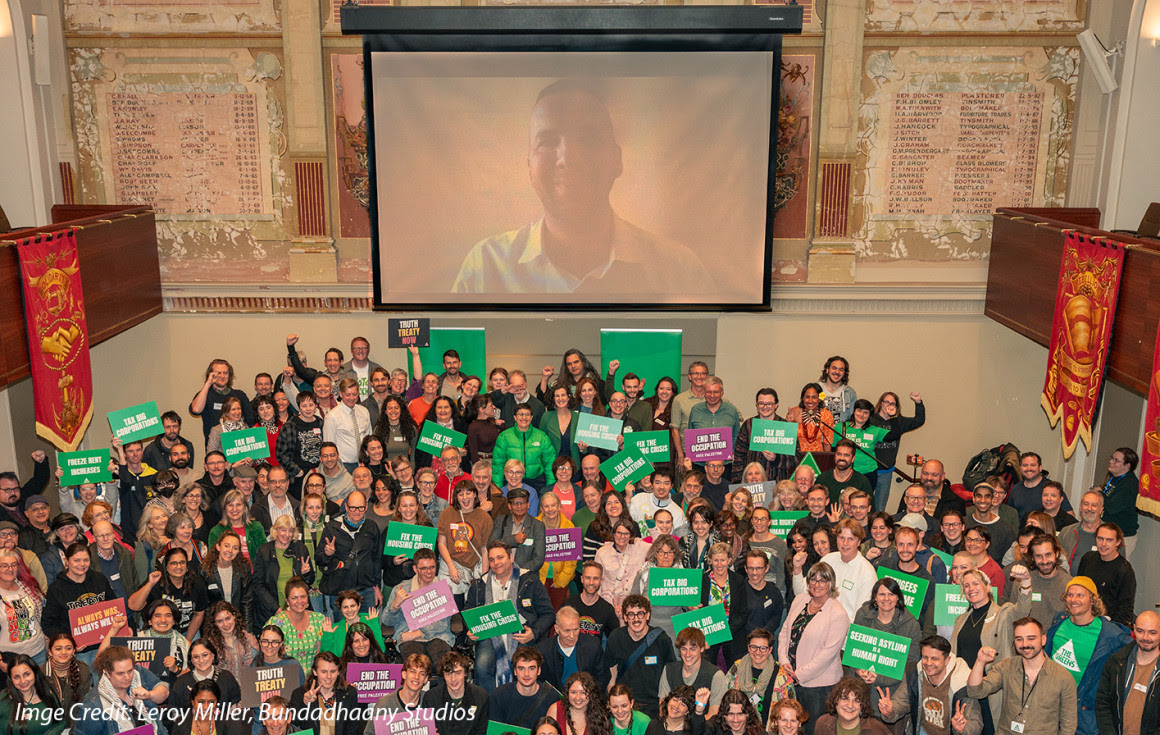
Last month Victorian Greens members, supporters and campaigners gathered in Melbourne's Trades Hall for a weekend of connection, workshops and learnings at the annual Campaign Conference. It was an inspiring weekend full of energising talks and panels including an interview with Zack Polanski, Leader of the Green Party of England & Wales. Here is an excerpt of that interview with Victorian Greens leader Ellen Sandell.
ES: I want to start by saying the UK Greens have obviously been a big inspiration to us here in Australia. And we are seeing a reshaping of politics globally and a break with the two party system around the world. And you have been able to capture that moment in quite an extraordinary way. Tell us what that has been like and what has been the key to that success.
ZP: I think the first thing I'd remark is how quick it's all happened. So superficially, it happened quick. In just kind of seven, eight months, we've quadrupled our poll ratings. Our membership has skyrocketed. And we've won some really key elections. Unsuperficially, though, it's taken a long time of building. We've been standing on the shoulders of giants and people who have been plugging away at that foundational work for a long time.
I think what's shifted, though, is both the global context, which I know obviously is also happening with Victorian Greens too, in terms of people are feeling more and more angry, more and more disillusioned, and more and more ready for change. And I think we really have a responsibility as progressives to not fuel anger, because that's what the right do. They're very, very good at connecting to people's anger, fuelling it, and that makes things happen quicker. I think what we've not necessarily been great at as progressives, though, is connecting with that anger. I think sometimes we rush to hope.
We rush to solutions. So we don't quite connect in the same way. I think connecting with people's anger and then turning it to hope has been what's been so powerful for people. I would say more concretely as well, we've really scaled up our operations. So I think it's both for the moment, it's logistics, and it's also having a powerful story to tell.
ES: From the outside, it does look very quick. It looks like the UK Greens came from nowhere overnight, but we all know that building a movement doesn't happen overnight. Were there any decisions that you took early on or key moments at the start of your leadership or shortly afterwards or shortly before? Any key decisions that you think you took that led you on this path to have this overnight success?
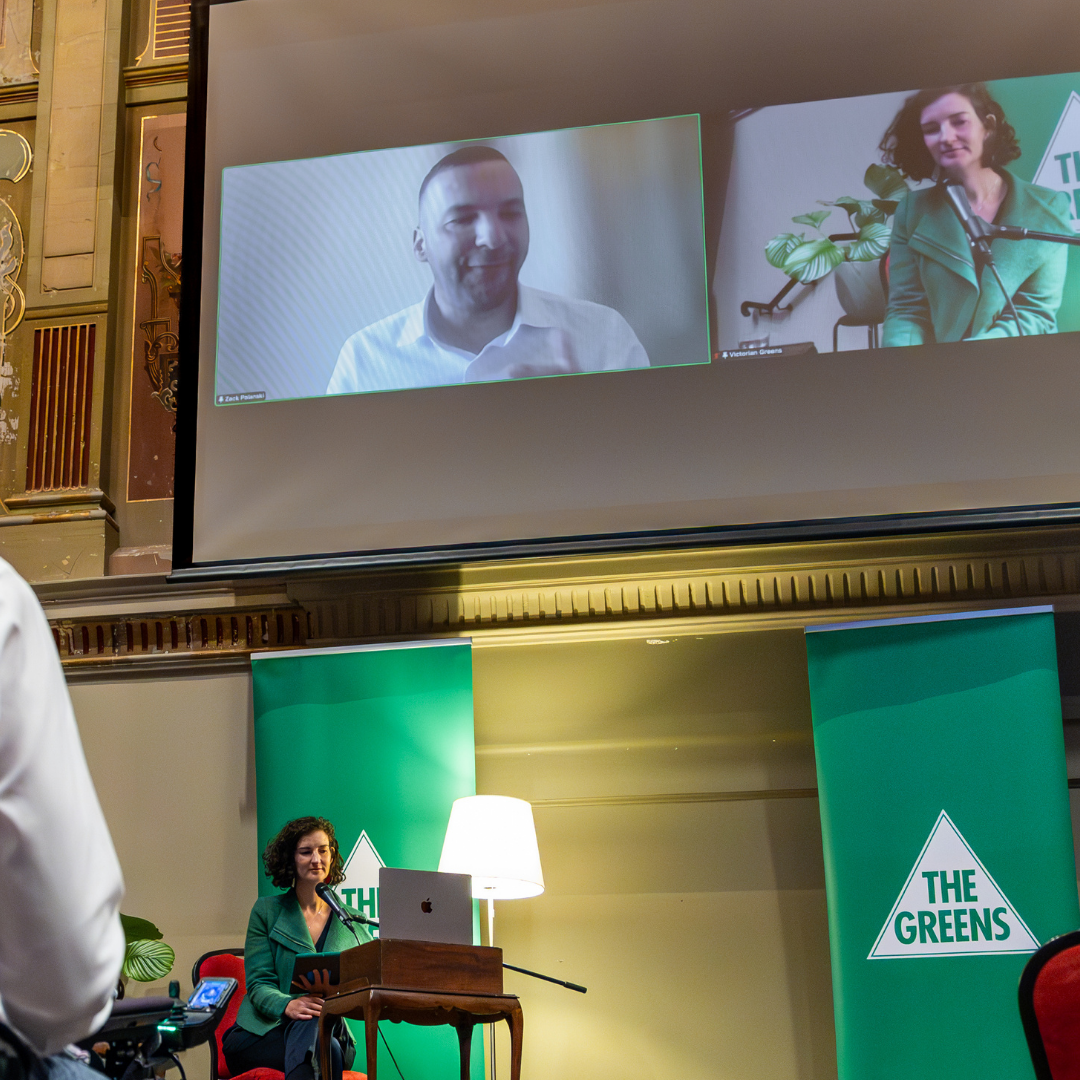
ZP: Yeah, I think there's been a few decisions.. I think one of them, and I would never sit here and say this is the right thing to do or the wrong thing to do, but it's the thing that felt right to me, which is I think in moments of leadership, people can sometimes get into a very kind of command and control structure. And I decided quite early on that if people wanted to start projects, I was going to encourage that. And even if the project wasn't kind of perfectly what I wanted it to be or perfectly what it's always been, I tried to get into the habit of just saying, great, see what you can do.
And kind of really kind of nurturing that snowflake model of lots of different people in different groups doing different things. And some of those projects really lasted and they're still doing brilliant things now. And others kind of crumbled within moments. And all of those things are okay.
And if I give you an example, tomorrow, I'm going to go to a Green Party rave, which is a new thing we're doing in the UK, where there's a group of people who are organising these nightclub nights, which when they first spoke to me about it, I just thought it just sounds like a big distraction from the campaigning. But I just found myself saying, you know what? If you want to go do that, then I'll go support once it's ready.
If you can get a group of volunteers going, then I'll come to the club and I'll come speak and I'll come support that. And now those have become regular things. And literally, I think tomorrow night, the capacity is 4,000 people. So these quite big parties happening around the cities where there's just lots of people really, really excited. It's pretty amazing.
I made a very early decision to always hold my nerve, to put bold politics at the front of everything. So if something is an unpopular position sometimes, that doesn't mean you lead on the front foot with it, but it does mean if I'm asked about it, to be really clear about what my position is and then to as quickly as possible get back to the cost of living and the things that people care about, the food on the table, the heat in the homes. But what it meant was not avoiding those fights or trying to pretend those fights weren't there. It was just really standing on a point of principle, being bold and clear about the things we stand for, presenting the evidence with a story and then getting back to cost of living.
ES: So the difference between the Greens and perhaps other political projects, in particular, more authoritarian or presidential style political parties, is that we are genuinely trying to build a movement here. And a movement is more than one person. And you are the face of a movement in the UK. And people look to you for inspiration, but you then need to distribute that power, right? And it's not just about you, but it's about the volunteers, the candidates. How do you go about distributing that power so that it isn't just a one man show?
ZP: I think it's fundamental to everything, both as a Green movement because of our values, but frankly, as one human being who needs to survive and keep smiling.
We've got to move away from a political system that demands all the time that one person is going to save us or change is going to come from the top down. And so it's very often inherent in my communications that I say to people all the time that I can communicate this to you but we really need everyone to step up to this moment.
And when I say we, I am talking about the global Green movement. We've got to recognise how important the power of the workers is, how important community groups, whether they're faith groups, non-faith groups, and also people who would never come to this Zoom meeting or this conference on a Saturday evening. They care about politics, but they don't think about big party politics.
They think it's not for them. That's not really a thing they do. And I'm not claiming to have cracked this at all because I think it's an ever-growing challenge of how do you make your movement as inclusive and accessible as possible? How do you think about the people who are not in the room and think, how do we get you? And one of the things I've really tried to kind of reinforce is not to expect people to come to us, to our local party meetings or to our branch meetings.
So I go, and in fact, I encourage other people in the local parties all the time to go to people's community meetings, to their trade union meetings. And just yesterday, the reason why I was getting up slightly late was last night, I was giving a speech at a university union in the UK. Just a couple of weeks ago, I was with an education union and next week I'm with the baker's union, so a food alliance union.
So very much going to places where people are organising and speaking to them about the things that they care about and connecting it to a wider green cause.
And then finally, I think we've got to break down the idea of what a politician is, because again, I can't speak for you guys, but I imagine it's true. Most people don't like politicians, sadly, and obviously myself and yourself, present company accepted, but people just generally don't trust politicians. So what we don't want is political candidates who are behaving like politicians.
The good aspects of politicians, professionalism, determination, the ability to care, be compassionate and connect. Of course, we want to maintain those qualities, but we want to speak like human beings.
We want people who've had lives. We want people that when they see them, they go, actually, that's someone I trust to represent me because I know who that person is. And so I'd say if anyone's listening or watching this and they think, you know, I quite fancy that, but I don't see myself represented or I've got this one thing that wouldn't make me great as a politician.
Work on that one thing, ask for some help. And I'd say to the people who lead and organise, what can we all do to make sure that we're giving people the training, the skills, and most importantly, the confidence to be able to go, actually, no one needs a perfect politician. In fact, a perfect politician is probably a turnoff. We want people who have flaws who are human beings, who are working through those flaws whilst connecting with the public and making sure they're holding truth to power.
ES: Absolutely. Zack, you touched on some of the attacks that we've seen from the mainstream media in the past, and the Greens often do have a hard time cutting through with mainstream media and institutions. As you said, challenging the status quo isn't easy. There is always going to be pushback from those who benefit from the status quo. How did you go about building the confidence of your volunteers, supporters, candidates to believe that they could actually win?
ZP: I think the biggest thing is having a really, really clear story as a party. And I say story, I suppose there are stories within the story. And when I think about the word confidence, I think about what gives me confidence, and I say this all the time, and I hope it gives other people confidence, that the other parties take money from oil and gas companies, private healthcare companies, gambling companies, and arms trade companies. So how dare they have the confidence that they have when they turn up at TV or turn up at meetings to pretend that they're there representing people, to pretend that they have best interests, people's best interests at heart, particularly with those four sectors. The opposite is entirely true.
They don't have people's best interests at heart. They're literally trying to destroy our planet. They're funding the military industrial complex, or not funding, taking money from military industrial complex, and then doing their bidding.
So then I think about the Green Party, what are our vested interests? Well, I think we only have two vested interests. We want to protect the communities that we seek to serve, and we want to protect the planet. And when those are your two vested interests, those should give you all the confidence in the world, because actually when you speak, you're not speaking because you want to feel good or because you're on stage or in the spotlight, and it's fine if any of those things are true.
You're speaking for literally millions of people, billions of people around the world who need you to speak right now. You're speaking for people in the Global South, or people who have lived on the land before, people who need people right now to speak out clearly, transparently, and with clarity, need to speak with a moral courage that those people, whether it's in the ancestry or right now, really need you to communicate.
ES: So looking ahead, you have created this incredible groundswell in the UK. You've had some incredible success at elections. You've got more elections coming up, I believe, early next year. And then you'll be leading into your federal election. What is your vision for the future? What do you see as the success of green movements globally from now?
ZP: I mean, I want to see green governments around the world. And I'm not suggesting that's happening in the United Kingdom at the next federal election.
But I am suggesting we're absolutely building up to that and the place that we want to go. And so the reason why I say that first off is I think we've got to be ambitious because if we're not ambitious, what is the point of us all meeting on this Saturday evening? Like we know that we have to change our countries and we have to change the world. And so when you recognise the scale of the challenge, that shouldn't cower us into playing small or being small.
That should energise us into recognising the huge challenge that we have in front of us. But also then what of recognising what are the steps backwards in order for that to happen? So speaking about my own political context, well, then the step is to make sure that we're the big opposition. So on the first day that I became leader, I used a phrase that gets repeated often in our country, which is I'm not here to be concerned or disappointed by the Labour Party.
I'm here to replace the Labour Party. And the media, and this is one time that they were doing their job totally fine. It was a legitimate question to go, that's a bit ambitious, right? You're not getting a bit confident.
And I was like, of course it's ambitious, but I didn't get elected leader and people don't turn up to this movement for us not to be ambitious. And then we've just replaced Labour in hundreds of seats across England and Wales at the council level. And Hannah The Plumber was a place where we took a Labour member of parliament and replaced it with a Green member of parliament.
So now the media don't ask me anymore if it's over ambitious. They can see that we're absolutely in the process of doing that. Now that doesn't mean there's not still a long way to go and there's not a lot of hard work to go.
But what that has done is set a very clear intention that's ambitious but achievable and started to take the steps to go there. So when I think about what my ambition is, I want to see more Green governments all around the world. My interim steps is I want to see more Green members of parliament, more Greens leading the opposition and I want to see more Greens stepping forward.
So when I see what my vision is or what I hope, I hope to see Green parties continuing to place pressure by building movements that shifts the establishment politics in a better direction but doesn't stop there because ultimately we might as well cut out the middle man and make sure that we're replacing them.
ES: You have really gone up and taken it to Reform and we've got a similar far-right party rising here called One Nation with the leader Pauline Hanson backed by the same corporations and billionaires and controlled by them as the old parties. How do you see your place in this fragmented political landscape?
We are often grappling with this situation of we are the antidote to disillusionment with politics and we are the hopeful antidote and we are going up against the hate and fear and division of One Nation but at the same time we don't want to give them any airtime.
We don't want to big them up too much. How do you grapple with that problem?
ZP: For a long time I didn't want to give any airtime to Reform I'd actually just wanted to focus on our hopeful alternative. This reaches a point though and I imagine from the way you describe One Nation you might have reached that point already where they are dominating a news agenda or far too often other political parties are constantly dancing to their tune and so I think it reaches a point where actually you do just need to take them on and you need to take them on directly by being that antidote.
Something the right is also particularly good at doing is mobilizing or energizing people to vote. And I think we could look at that same energy and not at all copy the things they're saying. In fact, we need to be doing the opposite of that. But recognize that even in our opposition, there are things to learn. And this was a big lesson for me in England and Wales was to recognize that the power of the storytelling of the right, the power of the immediacy of the which in which they communicate, the power of them just being everywhere all the time all at once.
They can outspend us but they can't out organize us because actually what we really have is the power of people on the doorsteps in communities. And so really harnessing that energy of the community feels really important too. And then finally, I think I'd never underestimate the power of hope and the power of a positive message. As I said, if you just do that, then I think it feels unrealistic or unpragmatic to people. But if you can recognize the pain people are feeling right now, the struggle people are feeling right now. If you can connect to that, and I'm not talking, I know I'm talking to leadership right now partly, but I'm talking to every single member.
If you're in your neighborhood or community, if you can take that moment to do that deep listening, that deep connection and then be able to offer people solutions, that is so powerful. And it's a little bit like when you have a friend and you're annoyed about something. If someone immediately starts to jump to what you can do about it, sometimes it feels like they haven't really heard you. Whereas if they can give you a moment to be really annoyed about something, to vent about something, to hold that space and then offer solutions together, that's a really powerful experience. And I think it's exactly the same at a macro level in politics. People really need to feel heard. They need to be connected with and then we can talk about solutions. But don't forget about the connection bit. Connection is really important.
ES: My final question is if you were speaking directly to someone in Victoria who was wondering whether they could make a difference (and you literally are speaking to about 300 of them!). What would be your message to Green supporters, members right here in the room today wondering what they can do to make a difference at our state election? What is your message to them?
ZP: To recognise your power because your power is the ultimately only thing that will change the state of politics in Victoria because change is not going to come from the top. It never has when you look throughout history. It comes from the struggle of people everyone who is again in their communities, in their work spaces, in their family spaces, in their neighborhoods. The connection that I was just talking about is the most powerful thing that can possibly happen. And almost once someone enters the political space, it doesn't mean you can't connect, but it does mean once you're a politician, there's a new barrier, which means that you need to get over the fact that people aren't always keen on politicians to then connect.
And that's totally doable and, you know, must be done. But actually when you first start getting involved and you don't have an official role necessarily or it's not a role that's an official representative there is so much power to that because when you have a conversation with people just know I talked about winning elections and the reason why we want to win elections is well for lots of reasons but if I was very kind of broad about it because we want a more compassionate kind of society where people care about each other.
If you're having a conversation with someone and this isn't your paid role or you're not doing this because someone's paid you to do it, then you're really doing it for one reason, which is because you care about that person and you care about that community, even if you disagree. And if you take a step back from that, what are you doing? Well, you're creating the kinder, more compassionate society that we want to win elections to do. So, of course, let's go win the elections to make it happen.
But just by you turning up this evening and just by whatever you go out to do next, whether that's get involved with a more local branch meeting, whether that's speak to people who have been more involved in the party about what your skills and resources could use, whether it's speaking to someone who is an elected representative about what more you could be doing to support them.
All of these things are creating the kind of more compassionate society I was just talking about before you even win the election. So yes, go out there and win the election, but don't wait for that moment. The best moment to have got involved was a few years ago and it's fine. We don't need to rewrite history. This moment exists right now. And actually by getting involved right now rather than kind of screaming at the TV or the radio that you're annoyed about what a right-wing politician saying and by the way still do that. It's really cathartic. I still do that to this day.
And if you don't turn up, what you're depriving this movement of is the unique combination that you can bring that might just be the really key ingredient that helps get Greens over the line, stops One Nation, stops a complacent and entitled Labor Party, and ultimately changes the face of politics forever. So my answer would be: get involved.


