
In 2019, Associate Professor Alison Carter had just arrived in Cambodia to start archaeological fieldwork. She opened her laptop to find an email that would change her career plans for the next several years.
A collector living in Eugene - whose identity remains anonymous for privacy - wanted to donate more than 1,000 artifacts he had purchased decades ago while working in Cambodia and Thailand. Although he purchased them from markets, turns out many of these artifacts were looted from ancient burial sites. He wanted to ensure these items went to a good place, so he turned to the University of Oregon to seek advice from an archeology expert.
For Carter, a College of Arts and Sciences (CAS) anthropology associate professor, it was the start of a yearslong process of returning the artifacts back to their homes - known as repatriating - in Cambodia and Thailand. Repatriating these artifacts has been a way for Carter to give back to people in Southeast Asia, the region she has worked in for decades.
This multi-year repatriation effort was also an opportunity for CAS undergraduate students to gain hands-on experience with archeology including documenting, researching, identifying and interpretation involved with the process. The ethical and cultural experience led to a peer-reviewed article published in an academic journal for one student and a job with a museum for another (see sidebars).
"There was absolutely no way I could have done this work alone," Carter said. "The students were essential."
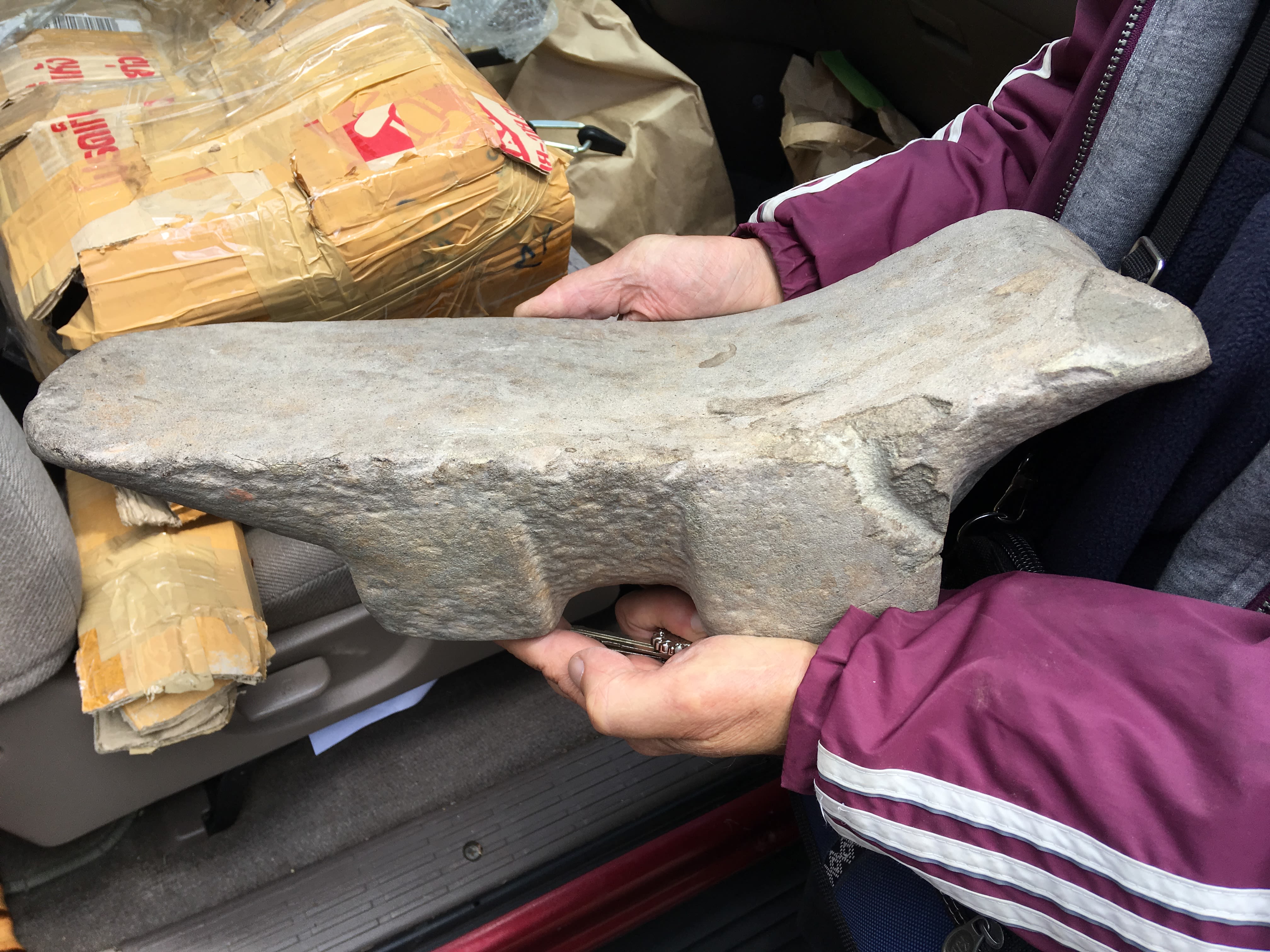
The collector arrived at the University of Oregon Eugene campus with a pickup truck filled with artifacts. He is holding a sandstone grinding stone from Cambodia. Photo by Pam Endzweig, Museum of Natural and Cultural History
Looting artifacts in Cambodia
Since 2018, Carter's research has taken her on an odyssey to a small village in west Cambodia to study the complex societies of Southeast Asia, except for a one year break in 2020 because of the COVID-19 pandemic. Most recently, Carter was principal investigator and co-director of P'teah Cambodia, an National Science Foundation-funded research program studying residential areas of Angkorian society in Cambodia.
The Angkor Empire dominated most of mainland Southeast Asia from the 9-15th centuries Common Era (CE), with its heartland located near modern-day Siem Reap, Cambodia.
Today, Cambodia is still recovering from the occupation of the Communist Party of Kampuchea (CPK), commonly referred to as Khmer Rouge. The occupation included a genocide which took the lives of around 2 million Cambodians from 1975 to 1979, according to the USC Shoah Foundation. The Khmer Rouge carried out systematic attacks that targeted education, cultural traditions, religion and infrastructure as a radical attempt to create an agricultural haven. This had a devastating impact on Cambodia's cultural heritage.
During this time, temples were damaged, archaeological sites were looted and art was destroyed.
In the years after the Khmer Rouge regime, people experiencing mass poverty and political instability in Cambodia often resorted to selling looted cultural artifacts - like the ones that Carter received - in markets across Southeast Asia.
These items aren't what you'd typically find in a museum, according to Carter. The collection she received was filled with everyday objects, many likely looted from burials, such as ceramics and bronze items, and trade-specific tools like spindle whorls and stone adzes. Yet, they are still significant, representing aspects of everyday life of Angkorian society and pre-Angkor.
Cambodian artifacts arrive in Eugene
Returning artifacts takes more than a postage stamp and the wish for a good home. If the collector had taken repatriation in his own hands, the boxes of items would have likely sat in those countries' customs offices without vetted documentation. And the repatriation would have likely raised red flags in customs, as those items would face scrutiny under the laws that now exist to combat illegal artifact sales.
During the 1990s and early 2000s, when the collector was returning to the US with these artifacts, Thailand and Cambodia did not have clear laws in place to criminalize export of antiquities that he was collecting. But more recently the US and Southeast Asian countries have implemented more stringent laws to prohibit exports.
"It was a legal gray area," Carter said about the collector's importing timeline.
When the collector showed up to the UO campus in a pickup truck filled with boxes of artifacts, the work began for Carter and her students.
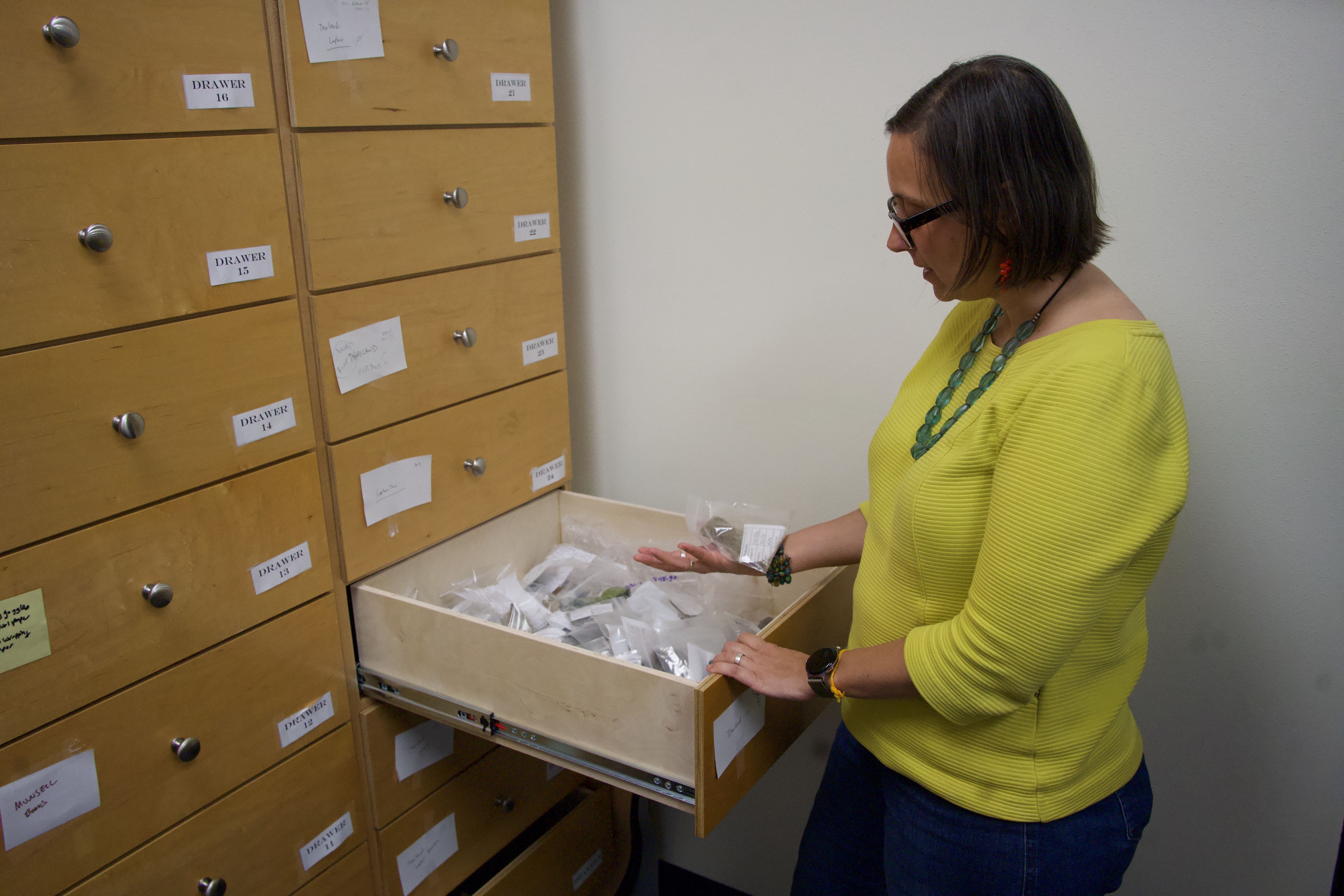
Alison Carter showing a storage drawer of artifacts that she is working on repatriating to Thailand. Photo by Hannah Heckart
The boxes consisted of hundreds of undocumented artifacts, with no records of where they came from. Carter spent a day with the collector as he unpacked everything, trying to piece together the history of each item and where he bought them.
"It unfortunately wasn't much to work from," Carter said. "He had lost most of the paperwork. Sometimes he would say, 'I bought this in a market in Phnom Penh,' but I could tell by looking at it that it was from northwest or southern Cambodia."
Carter knew this would be a lengthy and tricky process. With very little documentation for most of the items in the collection, she knew she would have to collaborate closely with Cambodian archaeologists, along with the Cambodian government. And she had to work closely with the university to ensure that possessing these items didn't put her or the university into any legal risk.
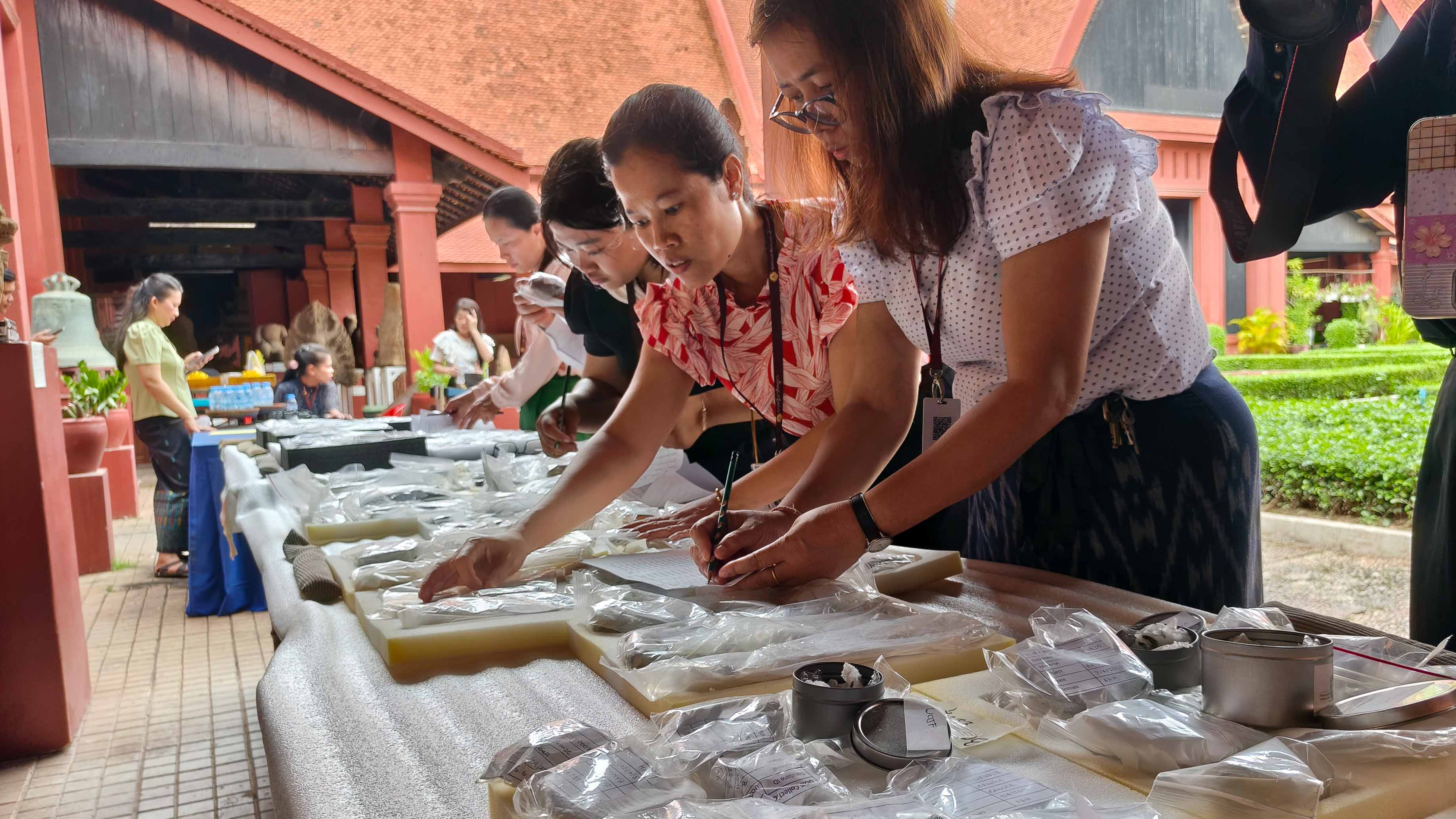
Cambodian artifacts being unpacked at the National Museum of Cambodia in Phnom Penh. Photo by the National Museum of Cambodia
What's next?
Carter has returned more than 700 items to Cambodia. But her artifact repatriation work is still unfinished. Her office is filled with boxes of Thai artifacts, reflecting the work she still has ahead.
"The tricky part about returning the Thai stuff is I don't have the personal relationships with people in the government there that I have in Cambodia," she said. "But with the help of the students, a bunch of the collection's been catalogued already,"
While the Cambodian collection has been sent home, the work continues, offering students a valuable opportunity to get involved with a meaningful and fulfilling project.


