A single enzyme that can generate all four nucleotide triphosphates, the building blocks of ribonucleic acid (RNA), was identified by researchers at the Institute of Science Tokyo. By using polyphosphate as a phosphate donor, the enzyme efficiently converts inexpensive nucleotide precursors into the active forms required for RNA synthesis. Overall, the method dramatically simplifies the process of nucleotide production—offering a low-cost, efficient option for the in vitro synthesis of RNA.
A Universal Enzyme for Low-Cost Production of mRNA Building Blocks
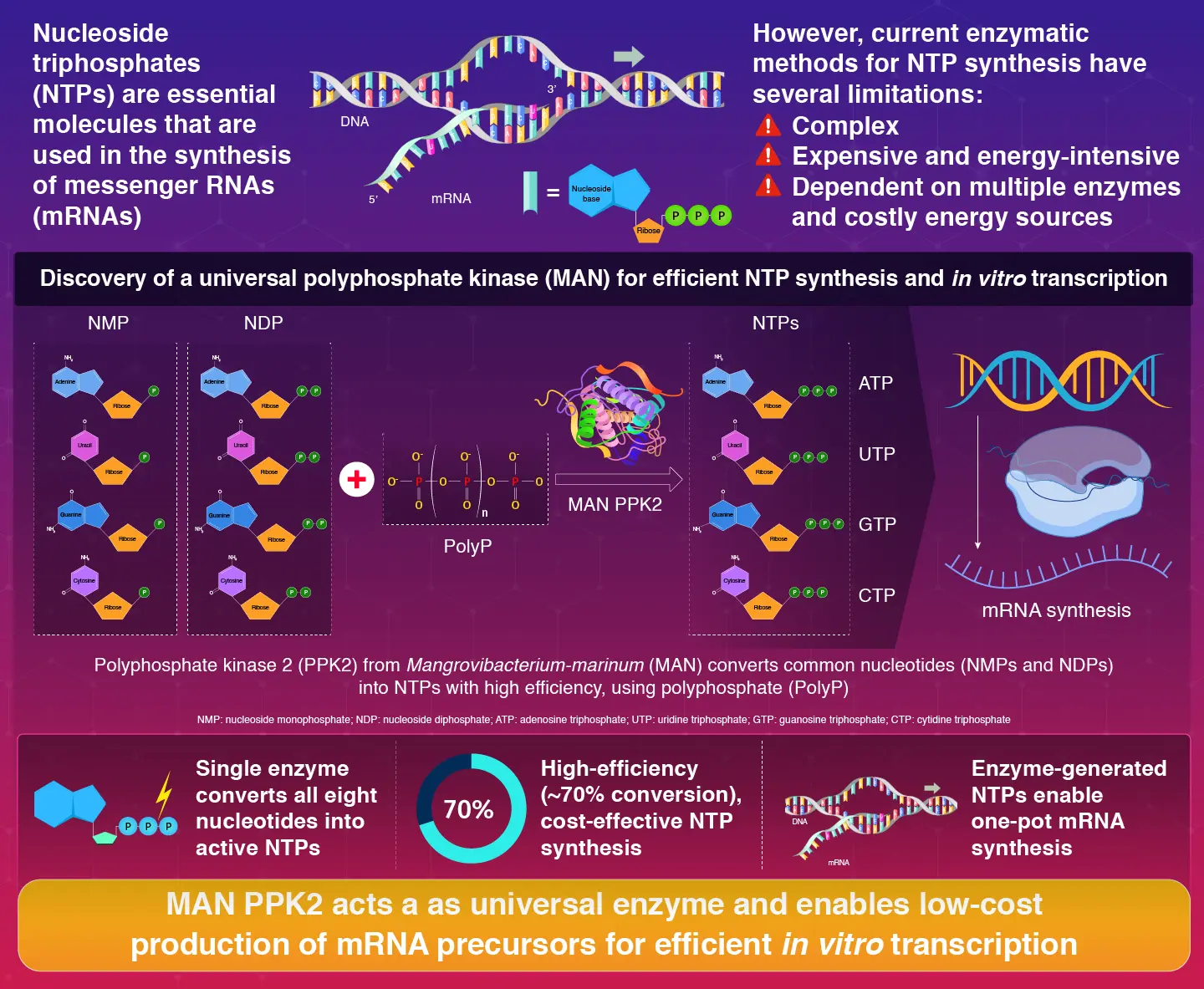
All living systems depend on specific biomolecules that form the basic units of life. One key class of these molecules is nucleic acids, including messenger ribonucleic acid (mRNA), which carries and transfers genetic information within every cell. mRNA is synthesized using nucleoside triphosphates (NTPs), which can act as RNA building blocks or be used to drive other biochemical reactions. The efficient production of NTPs remains a long-standing challenge, as current methods rely on multiple enzymes and incur high energy costs.
To address these limitations, a team of researchers from the Institute of Science Tokyo (Science Tokyo), Japan, led by graduate student Ryusei Matsumoto from the School of Life Science and Technology, Science Tokyo, along with former postdoctoral researcher Takayoshi Watanabe, Associate Professor Liam M. Longo, and Professor Tomoaki Matsuura from the Earth-Life Science Institute, Science Tokyo, came up with a simple and cost-effective solution. The key discovery was a novel enzyme that efficiently converts common nucleotide substrates (both nucleoside monophosphates and diphosphates) into NTPs. The study was published online in the journal Nature Communications on January 8, 2026.
"We focused on a specific polyphosphate (PolyP) kinase 2 enzyme, MAN, derived from Mangrovibacterium marinum, a marine-sourced bacterium," explains Matsuura. "Surprisingly, this enzyme could convert all common RNA nucleotides with remarkable efficiency."
Interestingly, instead of relying on modern, costly phosphate donors, this enzyme uses polyphosphate, which is cheap and commonly available. This change significantly reduces the production costs of NTPs. Furthermore, the enzyme also exhibits broad substrate specificity, an inherent property of ancient enzymes.
"While this kind of broad activity is unusual in modern enzymes, it may reflect how primitive biological systems made do with just a few enzymes," comments Longo.
Using the broad substrate activity of MAN, the researchers developed a simple single-step reaction for the one-pot synthesis of mRNA. In this method, the nucleotide precursors are first converted into NTPs, which are then immediately used to produce mRNA. This technique eliminates the need for complex, multi-step reaction pipelines, simplifying the process of RNA production. Apart from its cost reduction and simplicity, the method also supports sustainable chemistry. Compared to conventional energy donors, polyphosphates are stable and nontoxic, and are easily produced, making the process environmentally safe.
In the future, this research could extend across various fields of biotechnology and medicine where cost-effective production of NTPs is required. For example, it could improve the production of RNA vaccines or RNA-based diagnostics, and support the design of synthetic biological systems. Overall, the study highlights how principles rooted in ancient biology can be harnessed to address modern challenges—overcoming major limitations in RNA-based technologies with a simple enzymatic solution.
Reference
- Authors:
- Ryusei Matsumoto1#, Takayoshi Watanabe2#, Eishin Yamazaki1, Ako Kagawa2, Liam M. Longo 2,3*, and Tomoaki Matsuura 2*
*Corresponding authors
#Co-first authors
- Title:
- A universal polyphosphate kinase powers in vitro transcription
- Journal:
- Nature Communications
- Affiliations:
- 1Department of Life Science and Technology, Institute of Science Tokyo, Japan
2Earth-Life Science Institute, Institute of Science Tokyo, Japan
3Blue Marble Space Institute of Science, USA