
Key points
- The long-range marine heatwave outlook will now be a regular fixture over the Australian summer with forecasts made available publicly leading into and throughout the 2025-26 summer season.
- These forecasts will provide up to four months' advance warning of ocean temperature extremes and the likelihood and location of marine heatwaves.
- Marine heatwave forecasting provides the opportunity to develop rapid responses before events occur.
Just as the 2019-20 summer is remembered for devastating bushfires, the summer of 2024-25 is likely to be remembered for Australia-wide marine biological disruption associated with marine heatwaves.
Marine heatwaves are a well-established cause of coral bleaching.
But the marine heatwaves that characterised Australia's 2024-25 summer contributed to multiple biological disruptions affecting marine species, ecosystems and coastal communities, extending their impact far beyond the reefs.
Along with marine heatwaves, Australia experienced fish kills, out-of-range species, species outbreaks and algal blooms – including the large-scale bloom off South Australia's coast. 
The 2024-25 summer was also the second year in a row that scientists from CSIRO and the Bureau of Meteorology delivered trial seasonal forecasts at national marine climate briefings as part of the Marine Heatwave Prediction Project .
The briefings, which continue this summer, are designed to help prepare researchers and governments for possible marine heatwave (MHW) emergence and impacts, supported by Fisheries Research and Development Corporation and the Department of Climate Change, Energy, the Environment and Water.
Periods of sustained extreme ocean temperatures pose serious risks to fisheries, aquaculture, coral reefs, protected species and marine ecosystems. These events can disrupt industries, communities and cultural activities that depend on healthy oceans.
The long-range marine heatwave outlook will now be a regular fixture over the summer with forecasts made available publicly leading into and throughout the 2025-26 summer season. These forecasts will provide up to four months' advance warning of ocean temperature extremes and the likelihood and location of marine heatwaves. As a complement to the national briefings, the MHW forecasts are now available on the Bureau of Meteorology website .
On the Bureau website, the long-range marine heatwave forecast is updated three times weekly and presented in two new sets of regional maps, showing the probability of a marine heatwave occurring and the category of marine heatwave (none, moderate, strong, severe or extreme). Users can view individual states or the whole of Australia's ocean.
The categories are another useful and intuitive way to communicate extreme ocean temperatures.
The first CSIRO-Bureau of Meteorology National Marine Climate Briefing for 2025 was held recently (October 24), with the next on December 12.
CSIRO Chief Research Scientist Dr Alistair Hobday , who co-presents the briefings and works on the collaborative long range marine heatwave project, stressed that forecasts are only one part of managing risk.
"Information about the future can support decision making," he said.
"Marine heatwave forecasting tells you how you might be loading the dice for a range of ecological impacts."
What marine heatwave forecasting can provide is the opportunity to develop rapid responses before events occur.
"I really hope Australia is able to take advantage of these early warnings," said Dr Hobday. Infographic showing map of Australia with icons around the coast showing the marine events which occurred over the 2024-25 summer. A key on the left explains the icons.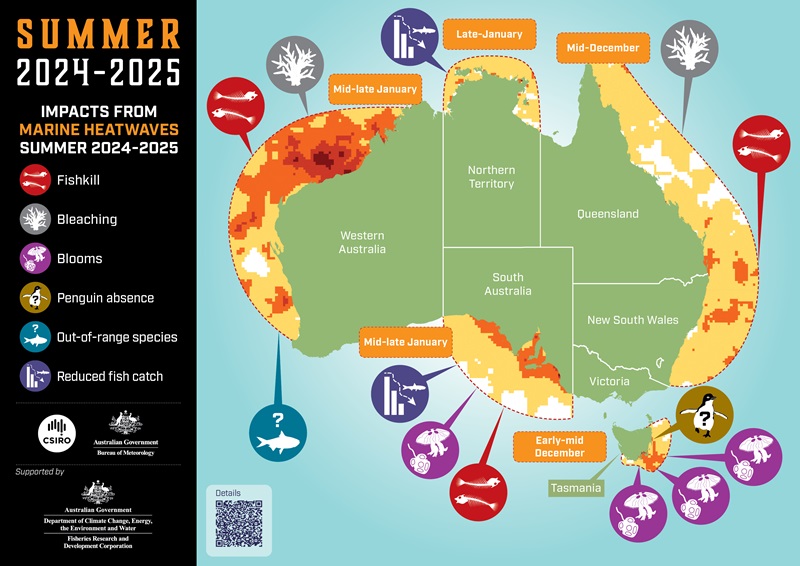
A forecast for summer 2025-26
The 2024–25 summer set a new record for Australian sea surface temperature anomalies at +1.01 °C above the long-term average. Forecasts indicate that ocean temperatures around Australia will stay abnormally warm throughout summer 2025–26.
CSIRO and the Bureau warn that marine heatwaves are likely again this summer, similar to last year when they caused widespread coral bleaching and ecosystem disruptions. Moderate marine heatwaves are forecast for the southeast of Australia, Great Barrier Reef and Coral Sea over the summer months. At their most extreme sea temperatures are expected to increase by ~2 degrees off the northern Australia coastline. However, sea temperatures are not expected to be as high as the 2024-2025 summer.

Deeper ocean observations for better forecasting
There are four types of marine heatwaves:
- Shallow MHW
- Sub-surface MHW
- Subsurface-intensifies MHW
- Deep MHW.
Shallow and sub-surface marine heatwaves can be broken down by strong wind events or by storms that pass over them.
MHWs where heat is extended deep below the surface into the water column are the most concerning as they can retain heat even when winds blow over the surface.
MHW forecasting has relied on satellite-based information to describe extreme heating events or extreme cooling events with surface temperature well resolved from space.
"The suite of satellites from Japan, the European Union and the US provide the basis for much of what we observe in the ocean at the moment," said Dr Hobday. 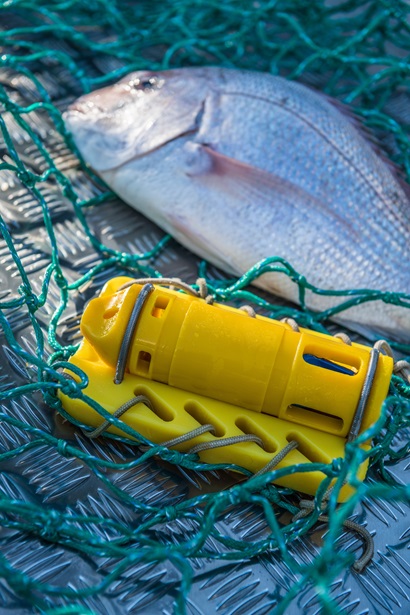
"But we know that's only a very shallow surface picture and it's really important to understand how heat is distributed in the ocean. It's that amount of heat that does things like supercharge cyclones, or slow ocean mixing which can lead to heatwaves lasting for an extended period of time."
Australia is investing in deeper ocean observations:
- Moorings around Australia from the IMOS national reference stations
- Gliders deployed at different locations around Australia through IMOS which can provide information on the structure of marine heatwaves in real time
- Deploying instruments on fishing gear in an IMOS/FRDC program called FishSOOP which is helping provide real time measurements of what's happening in the ocean
- Profiling Argo floats that drop down to about 2000m in depth, drift around for about 7 days and take a profile as they come back up to the surface to transmit that data.
"We're starting to get our hands on a pretty good set of data around Australia for understanding subsurface structure and I hope over the next few years you will see the value of that data collection paying off in terms of what we understand about the heat content that's in it," he said.
"It would be great to have more information about what's happening below the surface because that would help us with prediction and also understanding the impacts."
Understanding compound events and preparing for the impacts
Dr Hobday emphasises that the biological disruptions observed in the marine environment are frequently caused by multiple factors, not just marine heatwaves.
"Compound events where two things are happening at the same time such as a MHW with a cyclone, or with an atmospheric heatwave or coastal flooding.
"That's going to be a problem for the future when we have two of these things going on at once."
However, marine heatwaves are a strong indicator of impact.
The public marine briefings bring together experts, researchers and frontline responders and provide a forum for information sharing.
In the same way Australia responded to the Black Summer bushfires with increased coordination and collaboration across states and territories, the same response will be needed to marine heatwaves and their impacts.
Developing rapid responses
But how can we respond to marine heatwaves?
Responses to MHWs around the globe vary. CSIRO and the Bureau of Meteorology identified seven different interventions:
- Warnings issued
- Coral conservation
- Commercial and recreational fisheries closed
- Government subsidies or fee relief provided
- New/increased commercial and recreational fisheries opportunities
- Increase tourism opportunities for new species in novel areas
- Species and habitats monitored for conservation.
Almost all these interventions are reactive.
Dr Hobday said the off season was the time to consider proactive responses.
"Can you manipulate your system if you had early warning as a conservation manager, as a restoration practitioner, as a commercial fisher, as a recreational fisher, as an aquaculture business. If you get information about the future, what can you do ahead of time to reduce your impact?
"As we approach summer, it's really important to look at baseline data, where your upwelling areas are and are they likely to provide any refuge and look at your vulnerable industries and populations.
"If you are able to use this time to prepare for taking action, you will find yourself less on the receiving end and more on the proactive end.
"Marine heatwaves are a stress test for the future as well because what we see today in a heatwave is what we'll experience every day in 20 years' time."
This article was originally published in August 2025 and was updated to include reference to the 2025-2026 summer forecast and new MHW tool on the Bureau of Meteorology website.


