
They are one of the most recognizable butterflies in North America.
And their beautiful orange and black pattern warns off would-be predators by advertising their toxicity.
Yet many aspects of the monarch butterfly and their migration remain a mystery.
But new technology is now opening the door to a host of information. Tiny solar-powered sensors developed by Cellular Tracking Technologies (CTT) are allowing scientists across the United States to track the annual southern migration of monarch butterflies.
Those scientists include University of Miami assistant professor of biology Neil Rosser and visiting fellow Isla Duporge from Princeton University, who were among the first to learn about the new sensors. They are now part of Project Monarch, a consortium of more than 50 researchers across North America—led by the Cape May Point Arts and Science Center in New Jersey and CTT—working to plot the trajectories of monarch butterflies using the new sensor tags, which send tracking data using Bluetooth technology.
Video: Franco LaTona/University of Miami
"In urban areas, the amount of data you can get from these tags is mind-blowing," said Rosser, an evolutionary biologist who uses butterflies to understand how species evolve and adapt through time. "And once we get all the data, there are going to be some fascinating insights into how exactly monarchs are navigating; how they choose their routes; and how their behavior interacts with the climate. This allows us to ask unprecedented evolutionary questions."
Current knowledge
Most monarchs across North America fly south in the fall to hibernate together in a tiny mountainous area of central Mexico, centered in the Monarch Butterfly Biosphere Reserve, Rosser said. These hearty monarchs are slightly larger and live longer than others, potentially up to eight months, studies indicate. Rosser and Duporge are interested in studying how these monarchs are able to find their way to the same place from all over the United States and Canada, and whether they are able to reorient themselves toward Mexico should they veer off course.
But in South Florida, many monarch butterflies likely do not migrate and instead spend their entire 6- to 8-week lifespan in the same region. Therefore, Rosser, Duporge, and graduate biology student Weston Gray are using the new sensors to learn more about these "resident" South Florida monarchs, too.
"The general view among researchers is that the monarchs in South Florida are nonmigratory and relatively short-lived, but this is not well-tested, so the tags allow us to do this data collection," Rosser said.
The new tags are also opening up a trove of other research avenues too, Rosser said—such as how resident butterflies interact with migratory ones.
"By the time you get to northern Florida, the monarchs you're seeing are migratory, but we don't know where that switch happens between the resident butterfly population and those that migrate, or the genetic changes that are involved in that switch," Rosser added.
Since the tags became available in October, Rosser and Duporge have been able to catch, tag, release, and track about 79 butterflies, including 12 resident butterflies in Miami. They have lost the location of most, which means the butterflies probably passed away, or the tags fell off. Still, Rosser thinks the value of the tags is immense.
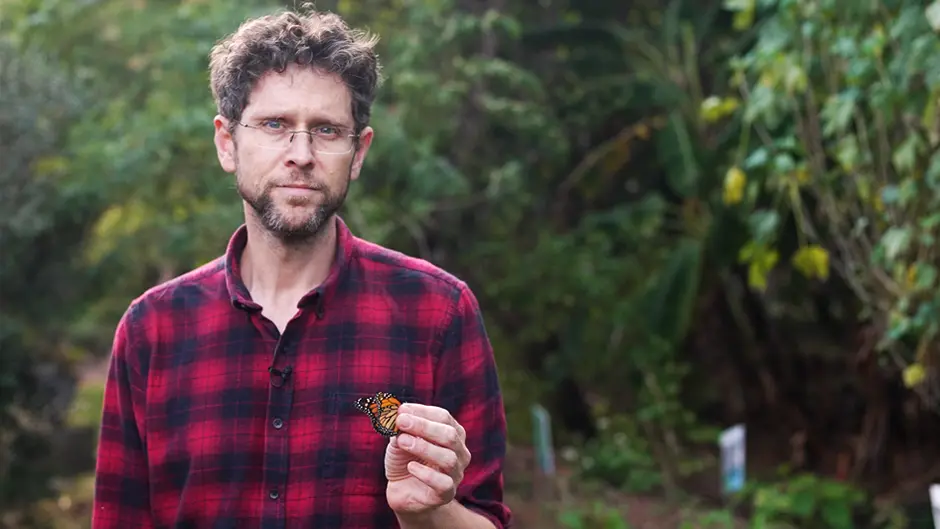
"If you want to conserve the monarchs, knowing the routes they take is critical because they need to stop in places with lots of flowers to refuel and keep going. So these tags can help us to see where they are stopping and focus on conservation efforts in those areas," Rosser said.
Action research
Yet, since the sensors are so new, Rosser and Duporge spent the fall learning how to gingerly place them on the butterflies to ensure they would not hinder the insect's flight. As a postdoctoral research fellow at Princeton, Duporge went to the nearby Cape May Point Arts and Science Center in New Jersey last fall to collect the tags and attend a demonstration. Then, with Rosser, she learned more attachment techniques by visiting Walt Disney World's Conservation Station in Orlando, which is also participating in Project Monarch. There, they learned the tags are best secured with eyelash glue.
Rosser and Duporge are exploring three main research areas during the monarch season in South Florida, which spans fall and winter. First, they want to use these new sensors to understand any differences between migratory monarchs—which head down to Mexico—and the resident monarchs who live in South Florida, including how these hearty flyers may look, act, and be genetically different, beyond simply having a longer lifespan.
But they also want to understand how the migratory monarchs navigate to Mexico and what cues they use to guide them, Duporge said. As a trained zoologist, she has tracked many migratory species' movement behavior using new technology—including that of elephants, wildebeests, and even whales—and is now excited to focus her efforts on the monarchs.
"The only way people knew that the monarchs in Mexico came all the way from Canada before is because scientists put stickers on them, so having live tracking of these butterflies' individual routes is a big step forward," she said. "Now we can correlate these paths with wind, topography, and their flight path, and none of those things could be done with a sticker, so it's quite amazing."
Both Duporge and Rosser are hoping to expand their research next fall and winter by tagging hundreds of butterflies. For now, they are scrutinizing the data visualization maps to see what can be gathered about the monarchs' migration this year, and plan to share their research with others in Project Monarch for future publications.
"Among the local monarchs, we can see that females tend to have a larger home range and spread out more, whereas males stay closer to home," she said. "But this year was just a trial run, so we are looking forward to a much bigger study next year."
Still, they are excited by the possibilities and hope they can one day use the tags to learn more about other butterfly species.
"The fact that you can see them flying in real time gives this work a tangible quality that we haven't had before on many animals," Rosser said.


