
An international team has published research in Nature today that identified the oldest known mummified remains of an exceptionally well-preserved terrestrial vertebrate, a 289-million-year-old reptile Captorhinus.
Dr Joseph Bevitt, Manager of an Instrument Group at the Australian Centre for Neutron Scattering, undertook neutron imaging at ANSTO which provided detailed information about the animal's skin, bone and cartilage.
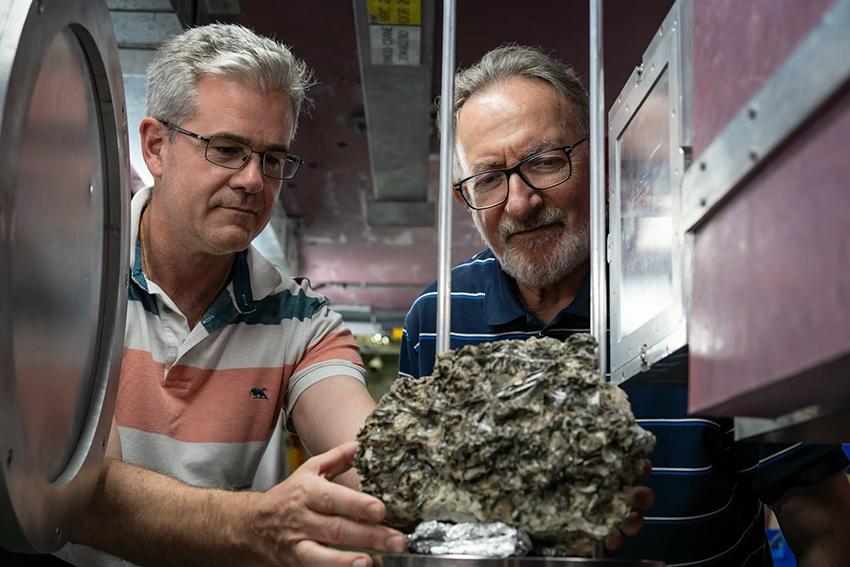
"These remains are an incredibly rare find. The investigation led by a University of Toronto research team revealed important information about the evolution of the breathing system in the reptile. Only neutron imaging has the unique ability to visualise these extremely delicate internal organs preserved within the limestone rock," said Dr Bevitt, who has collaborated with the research team on other occasions and is highly valued by international teams for the quality of his imaging expertise.
Preserved in a death position, the parts of the animal that were recovered were complete with a covering of skin, native protein remnants, and cartilage that form the complete skeleton of the respiratory system.
The investigators suggested that the extraordinary preservation of soft tissues was the likely result of encasement in fine clay and saturation with oil-seep hydrocarbons but protected within a cave system. Particularly striking was the preservation of endogenous protein remnants that predates previous such evidence by nearly 100 million years.
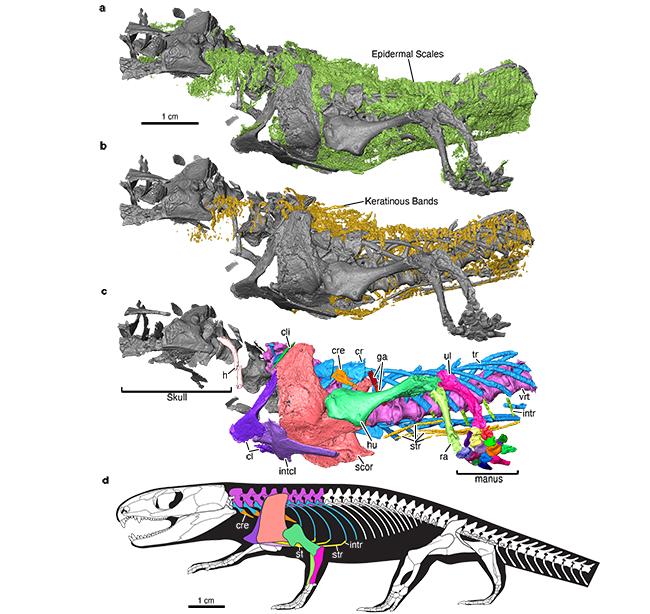
Because of the delicate nature of the remains, particularly the preserved soft tissues, the research team did not use traditional mechanical or chemical preparation that could have caused damage. According to lead author Prof Robet Reisz, these unprecedented discoveries allowed the reconstruction of important aspects of the biology of this early reptile, and they have great evolutionary significance.
The preservation of the cartilaginous components of the amniote respiratory system showcases the oldest known complete rib cage for muscle powered inhalation and exhalation.
Also discovered was evidence of pectoral girdle mobility the ability to move the shoulders relative to the ribs during locomotion, which we, crocodiles and other animals, take for granted today.
Vertebrates, or back-boned animals, first walked on land sometime in the Late Devonian, between 390-365 million years ago, with the appearance of the semiaquatic 'fishapods', such asTiktaalik (375 million years ago) and the first terrestrial tetrapods, such as Acanthostega (365 million years ago). Much has been revealed about the evolution of fish fins into the legs and feet of early amphibians and reptiles, but little evidence has been found to explain how the anatomy of animals evolved to support muscle-supported breathing of air on land.
"We propose that the system found in Captorhinus represents the ancestral condition for the kind of rib assisted respiration present in living reptiles, birds, and mammals. This efficient respiratory apparatus is important for their more active, energetic, and competitive lifestyles compared to their amphibian counterparts," said Prof Reisz.
Other collaborating intuitions included Harvard University (US), National Synchrotron Radiation Research Center (Taiwan) and Jilin University (China.
A fossil Captorhinus is on display for all visitors to ANSTO to see during an onsite tour.
This content was adapted from media information provided by the University of Toronto.


