
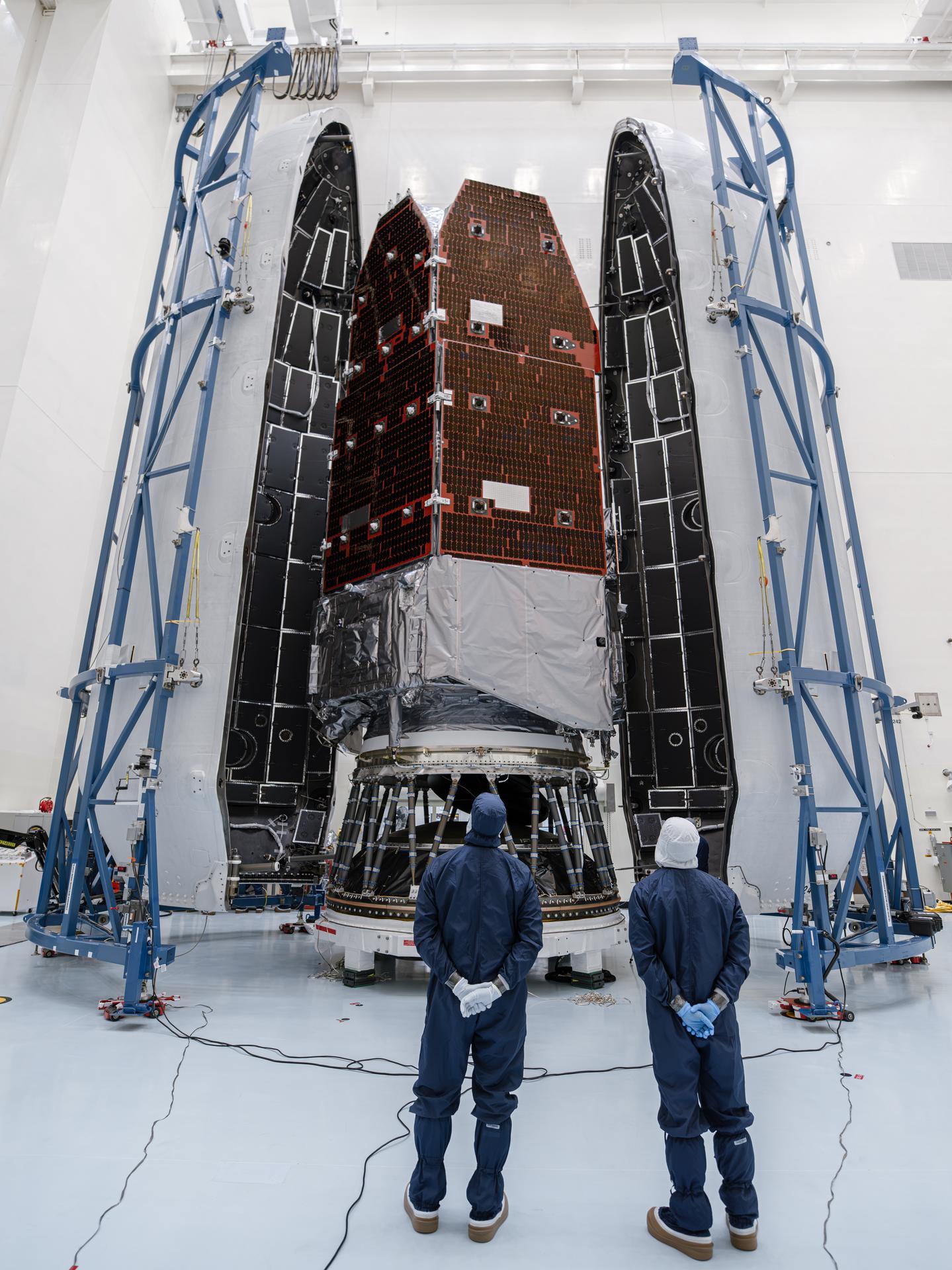
Coverage plans are ready for NASA's Nancy Grace Roman Space Telescope prelaunch and launch activities. Roman is NASA's next-generation observatory designed to explore some of the universe's biggest mysteries, including dark energy.
NASA and SpaceX are targeting Roman's liftoff for no earlier than 7:26 a.m. EDT Sunday, Aug. 30, aboard a SpaceX Falcon Heavy rocket from Launch Complex 39A at the agency's Kennedy Space Center in Florida. Launch coverage begins at 6:20 a.m.
Live coverage of these events will stream through a variety of platforms. Learn where to watch online:
Named for NASA's first chief astronomer, the Nancy Grace Roman Space Telescope will pair sharp infrared vision with a field of view at least 100 times larger than the agency's Hubble Space Telescope. Its crisp, sweeping surveys will help scientists investigate dark energy and dark matter, discover and characterize exoplanets, map billions of galaxies, study black holes, and explore objects from our own solar system to the edge of the observable universe.
After launch and separation from the rocket, Roman will travel to the second Sun-Earth Lagrange point, or L2, about one million miles from Earth. The mission has a five-year primary lifetime with a goal of operating for 10 years, and Roman's science data will be publicly available after processing.
NASA's mission coverage is as follows (all times are Eastern and subject to change based on real-time operations):
Saturday, Aug. 29
9 a.m.: NASA's Roman Space Telescope Mission Science Briefing: The briefing will take place in the NASA Kennedy Press Site auditorium with the following participants:
- Shawn Domagal-Goldman, director, Astrophysics Division, NASA Headquarters
- Julie McEnery, Roman telescope senior project scientist, NASA Goddard Space Flight Center
- Vanessa Bailey, Roman Coronagraph Instrument scientist, NASA Jet Propulsion Laboratory
- Kristen McQuinn, Roman Science Operations Center lead, Space Telescope Science Institute
- Lee Armus, Roman Science Support Center lead, Caltech/IPAC


