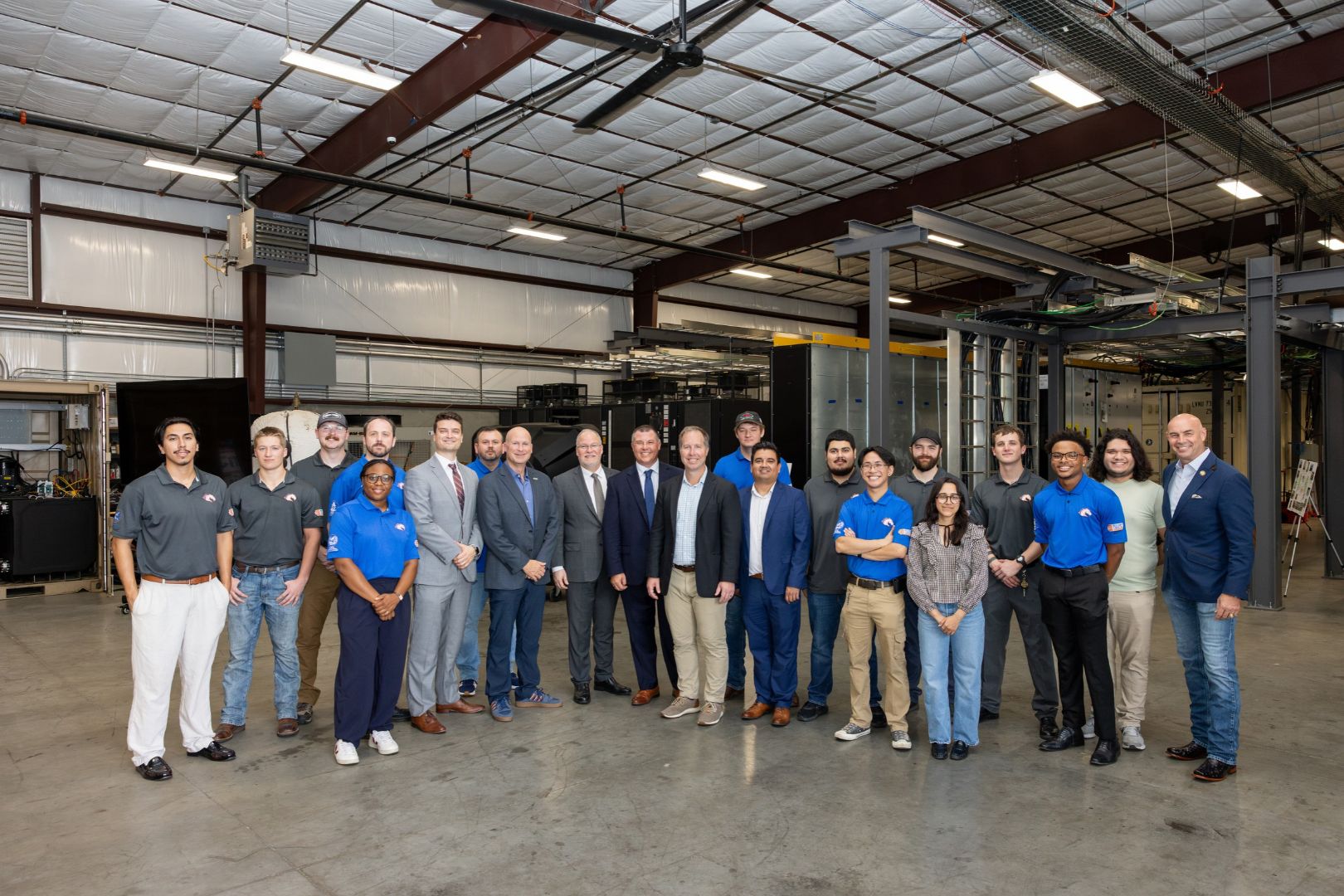
Six months after securing an $86 million Navy contract, The University of Texas at Arlington welcomed senior Navy officials, a member of Congress and industry leaders to its South Arlington research facility for a firsthand look at the university's growing role in developing power systems for the Navy's next generation of ships.
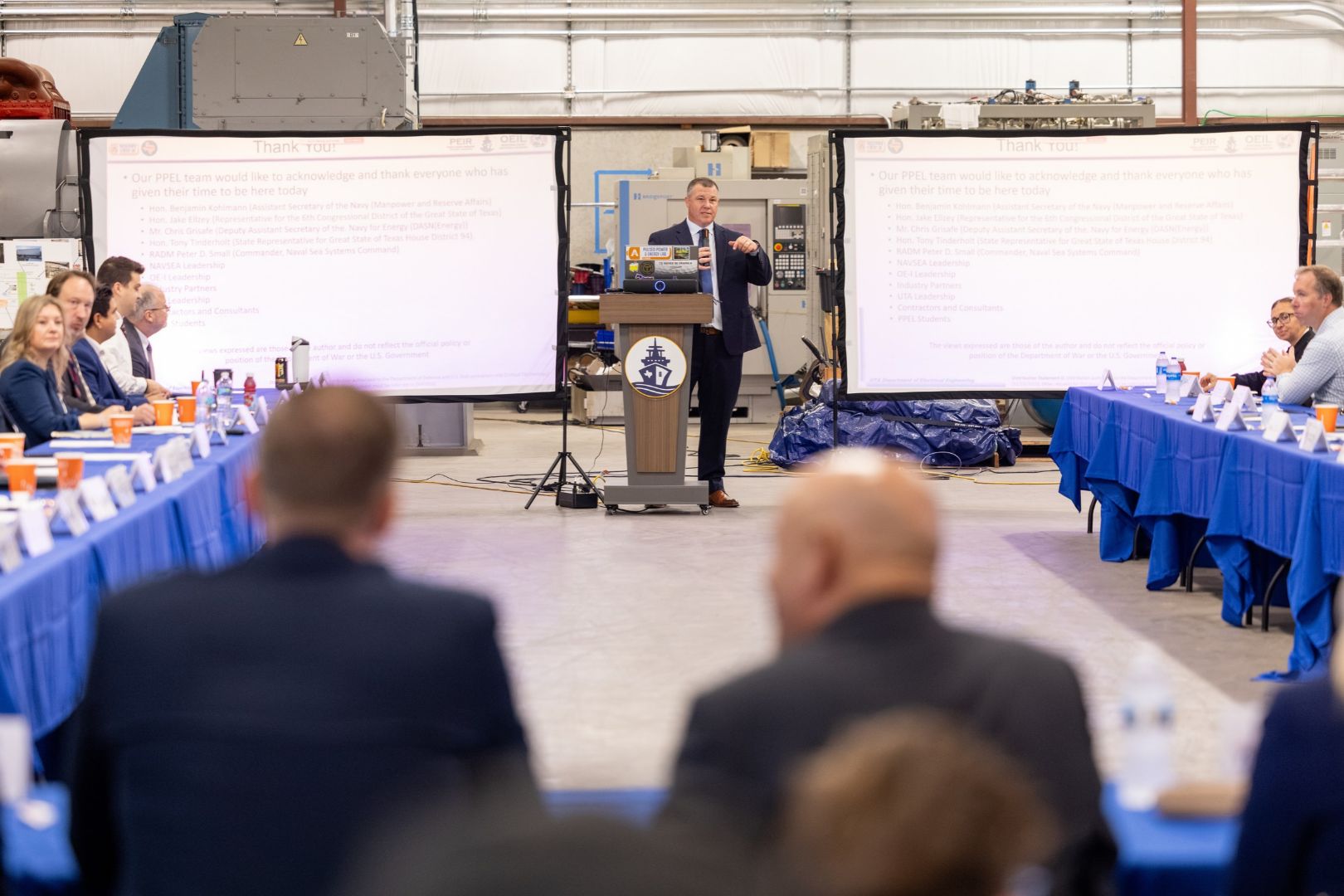
The Honorable Benjamin C. Kohlmann, Assistant Secretary of the Navy for Manpower and Reserve Affairs (ASN M&RA) was joined by Deputy Assistant Secretary of the Navy Chris Grisafe, other senior Navy officials, U.S. Rep. Jake Ellzey and defense industry representatives for the Oct. 13 visit, which included a laboratory tour and roundtable discussion on defense industry partnerships, technology commercialization and workforce development.
David Wetz, professor of electrical engineering and director of UTA's Pulsed Power and Energy Laboratory, led the visitors on a tour of the new Power and Energy Innovative Research (PEIR) Lab, where researchers are developing and testing advanced electrical power systems for military applications.
"We are proud to partner with Navy and industry leaders to address some of the most complex power and energy challenges facing the future fleet," Wetz said. "This visit highlights UTA's role as a trusted hub for collaboration, bringing together the expertise, facilities and talent needed to advance innovation and prepare the workforce that will support the nation's future maritime missions."
Related: UTA secures $86 million Navy contract
The PEIR Lab helps the Navy test power systems on land for its next generation of ships. Engineers there test how future ships will generate, store, distribute and cool their electrical power before the technology goes to sea. The lab is also testing large-scale power systems for unmanned ships that need to operate independently for extended periods.
"The more energy capacity we have, the more options we have," Kohlmann said on UTA's research. "Thank you to all the folks who are here doing incredible work."
UTA's pulsed power research has received nearly $125 million in Department of Defense funding. Expansion projects underway include a new large testing annex.
"Our sailors need to know the systems aboard their ships will work when it matters most," said Congressman Jake Ellzey. "The work happening at UT Arlington helps give them that confidence by testing these technologies before they ever go to sea. As a former Navy pilot, I understand what it means to depend on your equipment and the people behind it. I'm proud to see Texas researchers, students, and industry partners helping build a stronger Navy."
The roundtable brought together Navy officials, industry representatives and UTA researchers to explore opportunities for collaboration on emerging defense technologies. The lab's testing capabilities can reduce risk for the Navy when purchasing new systems and can attract defense industry investment to Texas.
Founded in 2010, the Pulsed Power and Energy Laboratory, which houses the PEIR Lab, conducts research on how batteries, capacitors and other energy storage devices perform, heat up and wear out at power levels far beyond those of consumer electronics.
About The University of Texas at Arlington (UTA)
The University of Texas at Arlington is a growing public research university in the heart of Dallas-Fort Worth. With a student body of over 42,700, UTA is the second-largest institution in the University of Texas System, offering more than 190 undergraduate and graduate degree programs. Recognized as a Carnegie R-1 university, UTA stands among the nation's top 5% of institutions for research activity. UTA and its 300,000 alumni generate an annual economic impact of $28.8 billion for the state. The University has received the Innovation and Economic Prosperity designation from the Association of Public and Land Grant Universities and has earned recognition for its focus on student access and success, considered key drivers to economic growth and social progress for North Texas and beyond.