
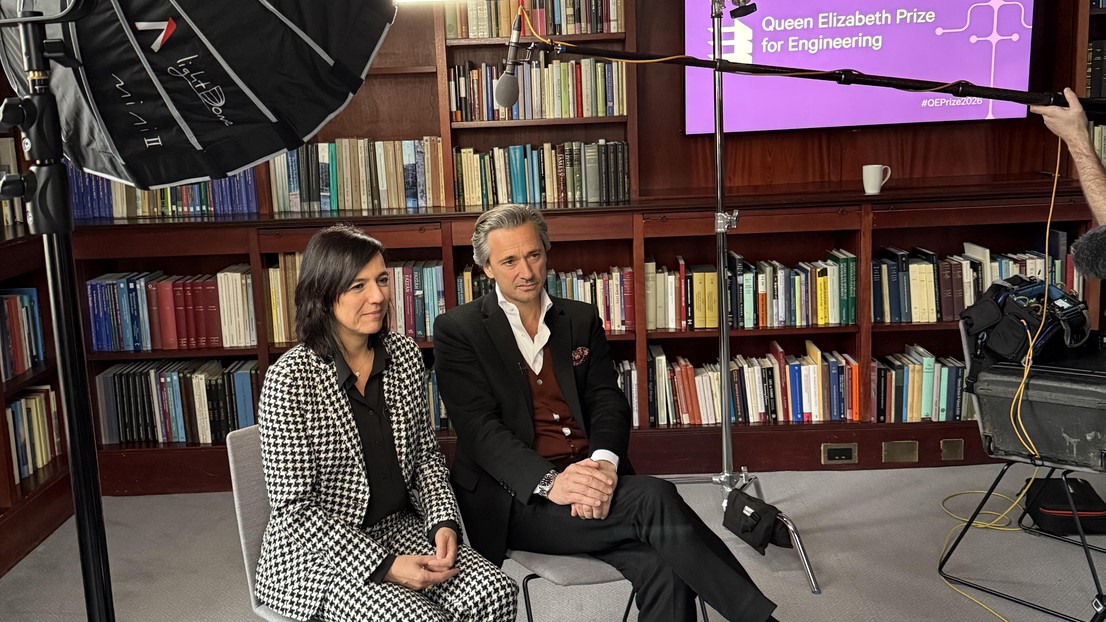
Jocelyne Bloch and Grégoire Courtine. © Anoush Abrar
Neural interfaces are the winners of the 2026 Queen Elisabeth Prize for Engineering. Nine scientists are honoured, including Jocelyne Bloch and Gregoire Courtine, from EPFL and UNIL/CHUV, recognised for their development of electronic spinal stimulation technology, which reactivates neural circuits controlling locomotion.
The 2026 Queen Elizabeth Prize for Engineering honours nine engineers whose pioneering work on modern neural interfaces has restored lost human function and had a lasting impact for people around the world. Among them, UNIL/CHUV and EPFL researchers Jocelyne Bloch and Grégoire Courtine, whose work over the last two decades allowed several impaired patients to regain voluntary movement or to stop suffering from hypo- or hypertension consecutive to spinal cord injuries. "Professors Jocelyne Bloch and Grégoire Courtine are recognised for their development of electronic spinal stimulation technology, which reactivates neural circuits controlling locomotion. By combining targeted electrical stimulation with advanced rehabilitation approaches, their work has enabled individuals with spinal cord injuries to regain voluntary movement", says the committee of the Prize.
They receive the prestigious award along with seven fellow researchers, all active in the field of neural interfaces: Graeme Clark, Erwin Hochmair, Ingeborg Hochmair, Blake Wilson, John Donoghue, Alim Louis Benabid and Pierre Pollak.
"Our collective effort to build a world in which paralysis is no longer a life sentence has been neither swift nor easy. This prize does not mark the end of the journey, but the responsibility - and the encouragement-to continue the fight against paralysis. Onward!," declares Grégoire Courtine. "Neurosurgery teaches humility. Innovation demands audacity. This journey has required both-and this prize recognises that this unlikely combination was essential to advance treatments for people with paralysis," says Jocelyne Bloch.
EPFL President Anna Fontcuberta i Morral is delighted with the announcement: "This prestigious award highlights the excellence, long history and remarkable achievements of the .NeuroRestore team, while giving it international visibility. Big dreams for a better world are based on ambitious vision, courage and interdisciplinary collaboration - in this case between neurosurgery and engineering - which is the strength of teamwork in the service of a common mission. I warmly thank Grégoire and Jocelyne for their exceptional commitment and congratulate them on this global recognition. Above all, this award is a powerful message of hope and encouragement for the future."
One field, many approaches
This year's Laureates have delivered pioneering achievements in neuroengineering, demonstrating the extraordinary power of engineering to overcome physical limitations. Their work enables technology to interact directly with the brain and nervous system to restore abilities such as hearing, movement, and communication for people affected by sensory loss, paralysis, and neurological disease.
Together, these advances mark a new frontier in neuroprosthetics, where engineering and medicine converge to restore capabilities once thought lost forever. Spanning several decades of research and clinical translation, the Laureates' contributions have transformed complex neuroscience into practical technologies that have restored independence and improved quality of life for growing numbers of people worldwide.
Modern neural interfaces encompass a range of technologies that connect engineered systems with the nervous system to restore function. Among the most established of these are cochlear implants, which convert sound into electrical signals that directly stimulate the auditory nerve, enabling people who are profoundly deaf to regain functional hearing.
Read the full press release on the Queen Elisabeth Prize for Engineering homepage.


