
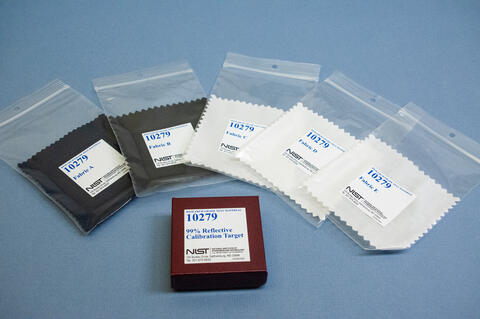
A new NIST research-grade test material is part of an effort to help the textile industry better identify and sort textiles and fabrics.
NIST
Though more than half of all clothing and other textiles are suitable for recycling, most of them aren't repurposed. The high volume of donated clothing and the slow, labor-intensive process of manually sorting fabrics means they aren't always reintroduced into the domestic supply chain to make new products.
To increase the speed and efficiency of the sorting process, the textile industry is turning to artificial intelligence (AI) tools. But the industry needs standards to better identify the fibers in clothing and textiles so they can be accurately sorted.
Researchers at the National Institute of Standards and Technology (NIST) have developed a set of textile materials that the research community can use to improve methods for identifying the fibers in textiles. These materials will help ensure that textiles are efficiently sorted, increasing recycling and repurposing while reducing waste and disposal costs.
"This textile material will help validate sorting methods and make textile sorters' measurements comparable from one center to another," said NIST materials research engineer Amanda Forster. "This lays the foundation for expanding supply chains and increasing the recovery of the economic value from textiles and clothing in the U.S."
Shedding Light on Textiles
At most recycling centers, workers use handheld scanners to shine light on a piece of clothing. Using a method called near-infrared (NIR) spectroscopy, these devices measure how much light passes through or scatters from the fabric to obtain a unique fingerprint that identifies the fiber in the clothing. The workers will then sort the clothing by hand into separate bins.
NIR is also used in automated sorting, where clothes are fed onto a conveyor belt with cameras and sensors, and algorithms identify and sort the fabrics. Once textiles and clothing are properly sorted, they're sent to recycling manufacturers for processing and made into new products.
But NIR isn't the only sorting technology. There's also computer vision sorting, which sorts fabrics by color and appearance, as well as hyperspectral imaging, which uses a combination of NIR and camera sensors.
Recycling centers use their own versions of either or both technologies. How can they be sure their methods are accurately identifying different types of fiber in clothing? That's where NIST's textile material comes in.
The Textile Test Material
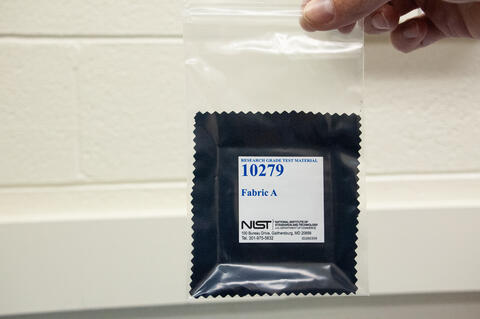
Known as Research Grade Test Material (RGTM) 10279, Textiles for Feedstock Identification, it consists of a set of five fabric squares, 4 inches (10.2 centimeters) on a side, made from different fibers, dyed and undyed. Produced on a short time frame compared with NIST's standard reference materials, RGTMs are a relatively new category of material. NIST produces RGTMs and distributes them to laboratories that agree to measure them and share their results to help determine whether the material is suitable for its intended purpose.
A. Boss/NIST
The recycling and sorting community will use this RGTM to explore whether it is suitable for assessing the accuracy of sorting methods and to help validate the algorithms that identify the fibers in textiles and clothing.
Textile sorting facilities can explore how the RGTM can be useful for production quality control, especially as many new types of textiles are blends of different fibers that are hard to identify. "This material also provides a way to detect things that aren't reported on the label, which is important for recycling," said Forster.
Labs can also use the physical standard as a benchmark to compare their methods against or to develop new sorting technologies.
Additionally, much of the current research in this field has focused on used or heavily worn clothing, but this RGTM could also be useful before a piece of clothing is designed.
"For example, if a brand is buying a fabric that is 100% cotton, but it ends up being a cotton-polyester blend, then they would like to know that difference," said NIST guest researcher Katarina Goodge. The RGTM could help verify the composition of these fabrics, ensuring that brands are receiving the exact materials they paid for.
It can even potentially be used to check whether luxury goods are fake, a process known as fashion authentication. However, this isn't something NIST researchers are currently working on.
In addition, AI technology offers the promise of quickly identifying fibers in textiles, but its accuracy has not been exhaustively tested. "We've identified an industrywide measurement challenge," said NIST researcher Michelle Seitz. "Standards like this RGTM help improve textile identification and sorting, which supports advances in AI-enabled sorting of textiles and U.S manufacturing and industry."
Join the Study
For NIST scientists, the next steps include determining if the RGTM can be used by industry in real-world settings. To accomplish that, the RGTM, whose fiber composition is undisclosed, is part of a study in which labs, manufacturers and other organizations will use their own fiber identification methods to see if they can accurately analyze the fibers in the material.
Researchers will then use the feedback, which will remain anonymous, and incorporate those results into developing a more well-analyzed reference material that meets industry's needs.
The RGTM is available free at the NIST Store


