
The latest generation of football helmets do a better job of protecting players from impacts that can cause concussions, according to new lab tests conducted at the University of Cincinnati.
Despite the improved helmet performance, players are still most susceptible to blows to the back of the head, testing found. And the position-specific helmets underperformed others, researchers found.
UC College of Engineering and Applied Science doctoral student Sean Bucherl and his co-authors examined three helmets each from four popular models made by two manufacturers in Professor Eric Nauman's lab in the UC Bioscience Center.
Each helmet was fitted onto a head and neck dummy similar to the kind used in automotive crash testing. The dummy contains sensors called accelerometers that measure accelerations when struck with a modal impulse hammer that likewise measures applied force.
In Nauman's Human Injury Research and Regenerative Technologies Lab, researchers examined 14 impact types to the bare dummy and the dummy wearing each of the 12 helmets, including two new position-specific helmets for quarterbacks and linemen. Blows were delivered at both 90-degree and 45-degree angles.
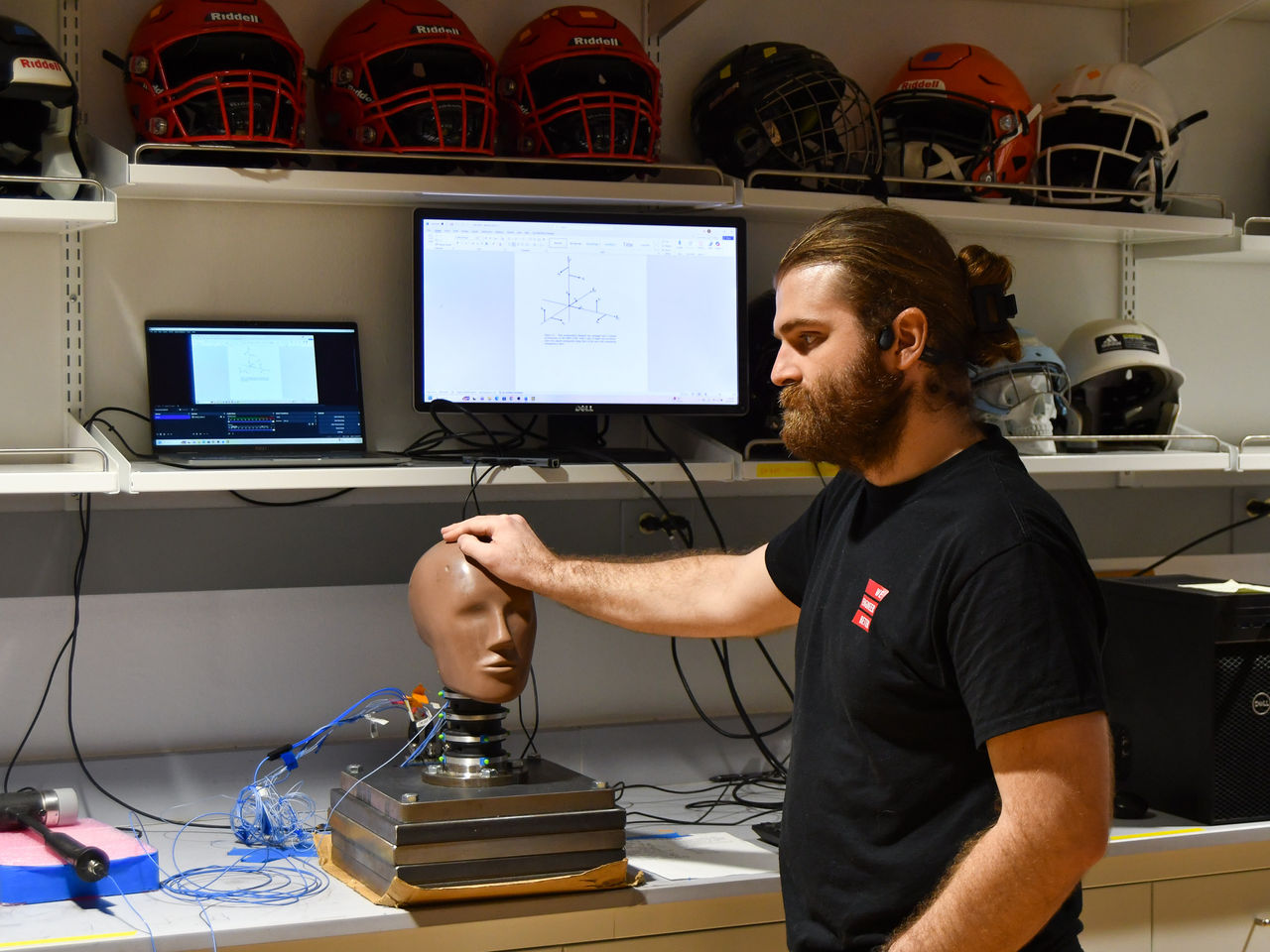
UC graduate student Sean Bucherl works with a dummy head mounted with sensors to test impacts that can lead to concussions in Professor Eric Nauman's biomedical engineering lab. Photo/Michael Miller
They studied the helmets' mitigation of both translational accelerations, or change in velocity, along with rotational accelerations, or the rate of spin when struck at an angle. Virtually every head impact results in both acceleration types, which is why it's important to measure each, Nauman said.
Previous tests in Nauman's lab demonstrated that the Riddell SpeedFlex and Vicis Zero 1 were the best-performing helmet models in attenuating both of these types of hits. For the latest tests, UC researchers examined the 2022 version of the Riddell SpeedFlex, the Vicis Zero 2, the Vicis Zero 2 Trench designed for linemen and the Vicis Zero 2 QB for quarterbacks.
They found that helmets mitigated between 64% and 87% of translational accelerations and 44% to 88% of the rotational accelerations, depending on the model and impact type. Typically, helmets are designed to resist translational accelerations, but rotational accelerations are believed to cause the worst injuries, Nauman said.
The backs of the helmets fared worst in testing across models.
"There's a dip in performance in the back of the helmet in every helmet we've tested," Bucherl said.
"This kind of impact is most common when you get tackled and hit your head on the turf," Nauman said. "It affects receivers the most because they go up to make a catch and can come down and hit the back of their head."
The tests also showed that the Vicis position-specific helmets fared worse than the Vicis Zero 2, which protected the dummy better than all helmets tested.
Nauman said that's likely because the addition of padding to protect the front of the lineman's head and the back of the quarterback's interfered with the helmet's ability to flex or deform to slow an impact.
The study was published in the Journal of Visualized Experiments. The study was supported by a grant from the Ohio Bureau of Workers' Compensation.
Bucherl noted that some helmets that protect players on the first hit might not provide the same protection on subsequent hits because of the way some sections are designed to deform to slow the energy to the player's head.
"So how many hits is too many hits? It's difficult to quantify," Bucherl said.

Sean Bucherl uses a modal impulse hammer to strike a helmet on a dummy head mounted with sensors in Professor Eric Nauman's biomedical engineering lab as Nauman looks on. Photo/Andrew Higley/UC
UC researchers said every improvement to helmets makes it less likely that a child will end up in the emergency room. Children playing youth sports sustain 400,000 concussions each year, according to the Centers for Disease Control and Prevention. As many as one in six players in middle and high school report at least one concussion per year, with the highest rates in football, lacrosse and soccer.
"In the past couple decades, younger and younger children are playing contact football," Bucherl said. "So every incremental improvement will help players."
While concussions get a lot of attention in professional and college sports, Nauman said he is more concerned about preventing concussions in youth sports.
"You have to do whatever you can to protect children," Nauman said.
Featured image at top: UC biomedical engineering researchers found that the latest versions of some popular brands of football helmets did a better job of protecting players from concussions. Photo/Michael Miller

UC College of Engineering and Applied Science Professor Eric Nauman is studying how to improve player safety through better technology in his biomedical engineering lab. Photo/Andrew Higley/UC


