
Abstract
As demand for electric vehicles (EVs) and energy storage systems (ESS) continues to grow, batteries in various configurations are entering the market to achieve desired voltage and capacity characteristics. However, current battery health assessment tools often require collecting new data and retraining models for each specific configuration, leading to significant inefficiencies.
To address this, Professors Donghyuk Kim and Yunseok Choi from the School of Energy and Chemical Engineering at UNIST unveiled a new AI-assisted approach that offers highly accurate state-of-health (SoH) estimation for lithium-ion (Li-ion) batteries without additional training on different configurations.
Battery health, or SoH, indicates the remaining capacity relative to the original, serving as a key indicator of lifespan and safety risks, such as failure or explosion. Using AI, this new model can determine SoH solely from operational data-voltage, current, and temperature-eliminating the need for complex manual calculations.
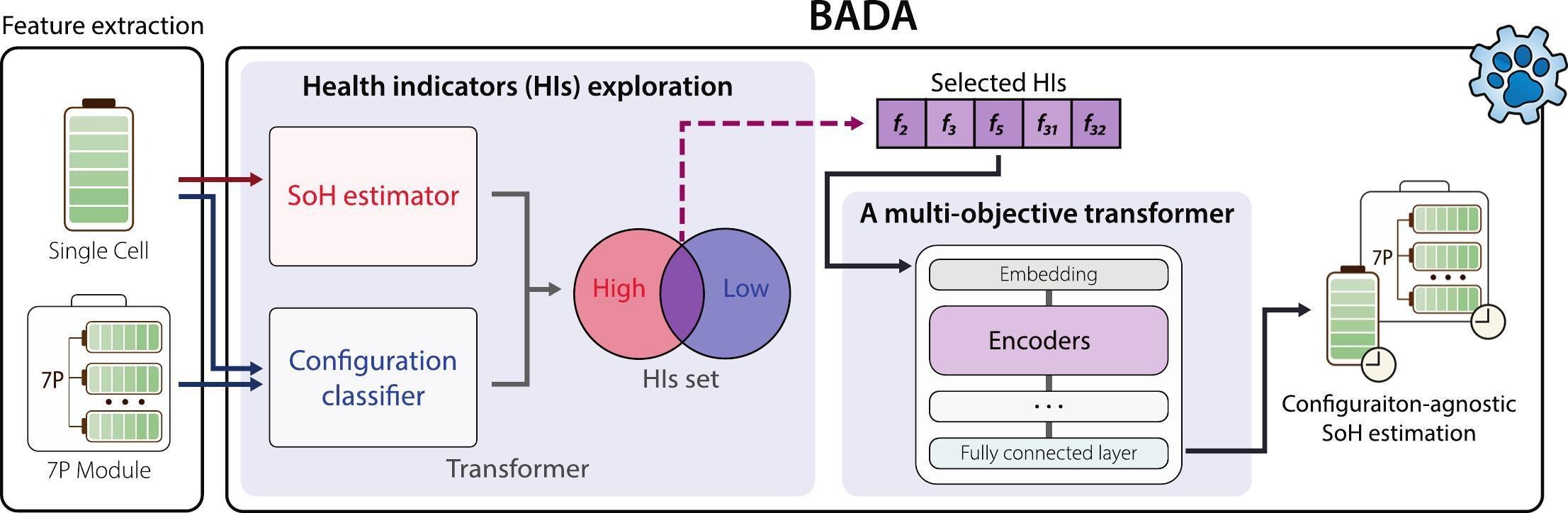 Figure 1. Schematic illustration of BADA (By capturing Attention in a transformer, assessing state of lithium-ion batteries with Distinguished health indicators Applicable to various configurations).
The model autonomously identifies five critical health indicators (HIs) from 62 data patterns derived from charge and discharge cycles. Importantly, these indicators are sensitive to the battery's remaining life while remaining unaffected by the connection type-whether series or parallel. This allows the system to accurately diagnose the health of not only individual cells but also larger modules composed of multiple cells.
Experimental results demonstrated that the AI trained solely on data from a single cell could reliably predict the lifespan of a module with seven parallel-connected cells. Compared to traditional models, which had a prediction error (RMSE) of 6.31×10⁻² due to configuration differences, the new approach achieved a much lower error of just 1.90×10⁻²-about one-third of previous methods.
Conventional AI diagnosis tools often struggle to apply across different configurations because internal resistance and voltage imbalances cause subtle shifts in data patterns. To address this, the team employed a transformer-based attention mechanism-an advanced AI architecture underlying models like ChatGPT. This allows the model to focus on the most relevant data features, effectively filtering out confounding factors related to various configurations.
Professor Kim explained, "We designed the AI to automatically identify genuine health signals unaffected by how the batteries are connected. This allows a single, versatile model to reliably diagnose different battery systems. Such technology holds great promise for EV battery management, large-scale energy storage, post-use battery assessment, and recycling."
The study was published online in the Chemical Engineering Journal, a leading international publication in the field of chemical engineering, on January 15 with support from the National Research Foundation of Korea (NRF).
Journal Reference
Seojoung Park, Yunseo Kim, Raehyeong Yoo, et al., "Transformer-based framework for configuration-agnostic Li-ion battery SoH estimation by exploring novel health indicators," Chem. Eng. J., (2026).


