
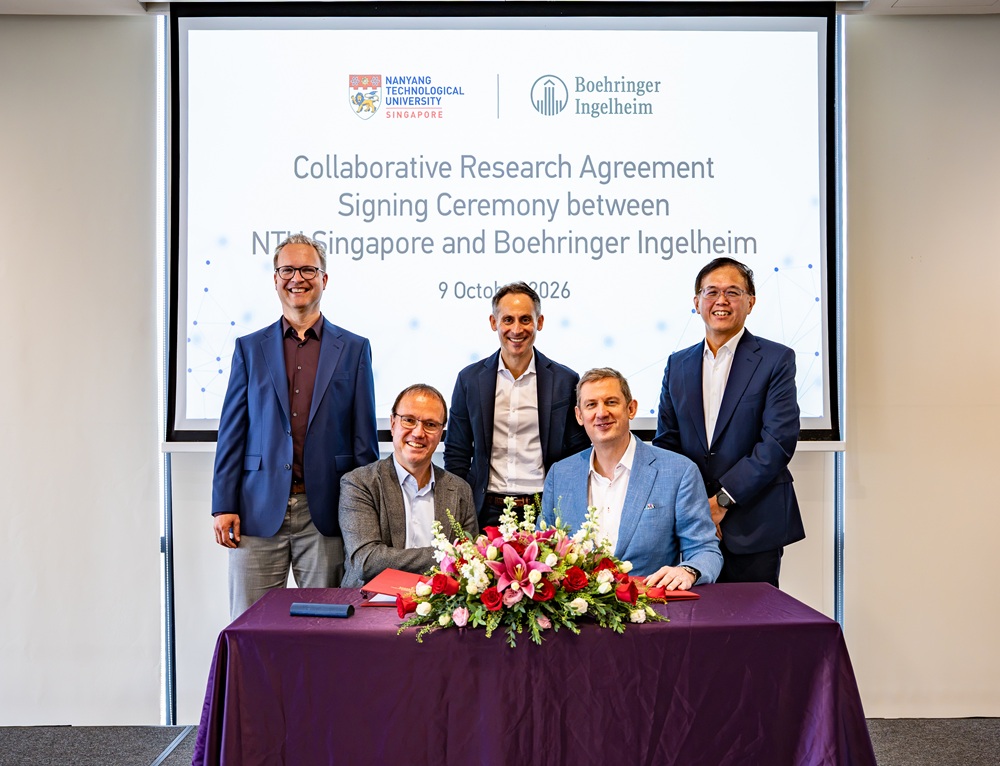
Image: (Front row from left) Dr. Søren Tullin, Senior Vice President and Global Head of Cardio-Renal-Metabolic Diseases Research, and NTU Deputy President and Provost Professor Christian Wolfrum. (Back row from left) Dr. Stefan Kauschke, Senior Principal Scientist, External Innovation group, Cardio-Renal-Metabolic Diseases Research, Dr. Anton Pekcec, Director Cardio-Renal-Metabolic Diseases Research, and Professor Andrew Tan Nguan Soon, LKCMedicine Vice Dean (Innovation and Enterprise)
Nanyang Technological University, Singapore (NTU Singapore) and global biopharmaceutical company Boehringer Ingelheim will be investigating new approaches to treating obesity, following a new research collaboration agreement between both organisations.
Under the collaboration, researchers from both partners will undertake two projects exploring different biological mechanisms that could potentially be targeted to develop new anti-obesity therapies.
The agreement was officially announced at a ceremony held at NTU's Lee Kong Chian School of Medicine (LKCMedicine) on Friday (9 Oct), with NTU Deputy President and Provost Professor Christian Wolfrum representing NTU and Dr Søren Tullin, Senior Vice President and global head of Cardio-Renal-Metabolic Diseases Research, representing Boehringer Ingelheim.
Obesity is a complex chronic disease involving multiple biological systems, affecting about one in eight people worldwide and a similar, rising share of adults in Singapore. It increases the risk of type 2 diabetes, cardiovascular disease and some cancers, and keeping weight off remains a challenge for many. Developing new treatments requires a deeper understanding of the mechanisms that regulate body weight and metabolism.
The first project will investigate whether long-lasting obesity-related changes in fat tissue can be reversed to restore its ability to regulate energy balance effectively.
Research suggests that weight loss alone may not fully reset obesity-induced alterations in fat tissue, leaving behind a biological memory that can compromise metabolic flexibility and make it more difficult to maintain long-term metabolic health.
The second project will examine the therapeutic potential of mitochondrial-derived peptides, a relatively new class of signalling molecules produced by mitochondria, the structures within cells that generate energy - and how they influence metabolic processes relevant to obesity.
Researchers will identify promising peptides, study their effects in relevant cellular models, and investigate whether they can act beyond the cells in which they are produced.
Professor Christian Wolfrum, an internationally acclaimed expert in metabolic research, and Dr Anton Pekcec, Director of Cardio-Renal-Metabolic Diseases Research at Boehringer Ingelheim, will co-lead the collaboration as project directors.
"We are learning that weight loss alone does not fully undo the changes obesity leaves behind in fat tissue. By understanding how fat cells age and how mitochondria signal to the rest of the body, we hope to uncover new ways to restore healthy metabolism. Working with Boehringer Ingelheim gives our discoveries a clear path from the lab towards potential new options for patients," said Prof Wolfrum.
The collaboration brings together NTU's research expertise in metabolism, ageing and molecular biology with Boehringer Ingelheim's expertise in drug discovery and development, and its long-standing leadership in researching, developing and providing treatments for cardiovascular, renal and metabolic conditions.
"Despite recent advances in obesity treatment, many people living with obesity still cannot access or stay on current therapies, and more options are needed. NTU's outstanding expertise in fat tissue biology complements our own research in cardiovascular, renal and metabolic diseases. Together, we hope to uncover biological mechanisms that could open doors to potential new treatments," said Dr Tullin.


