
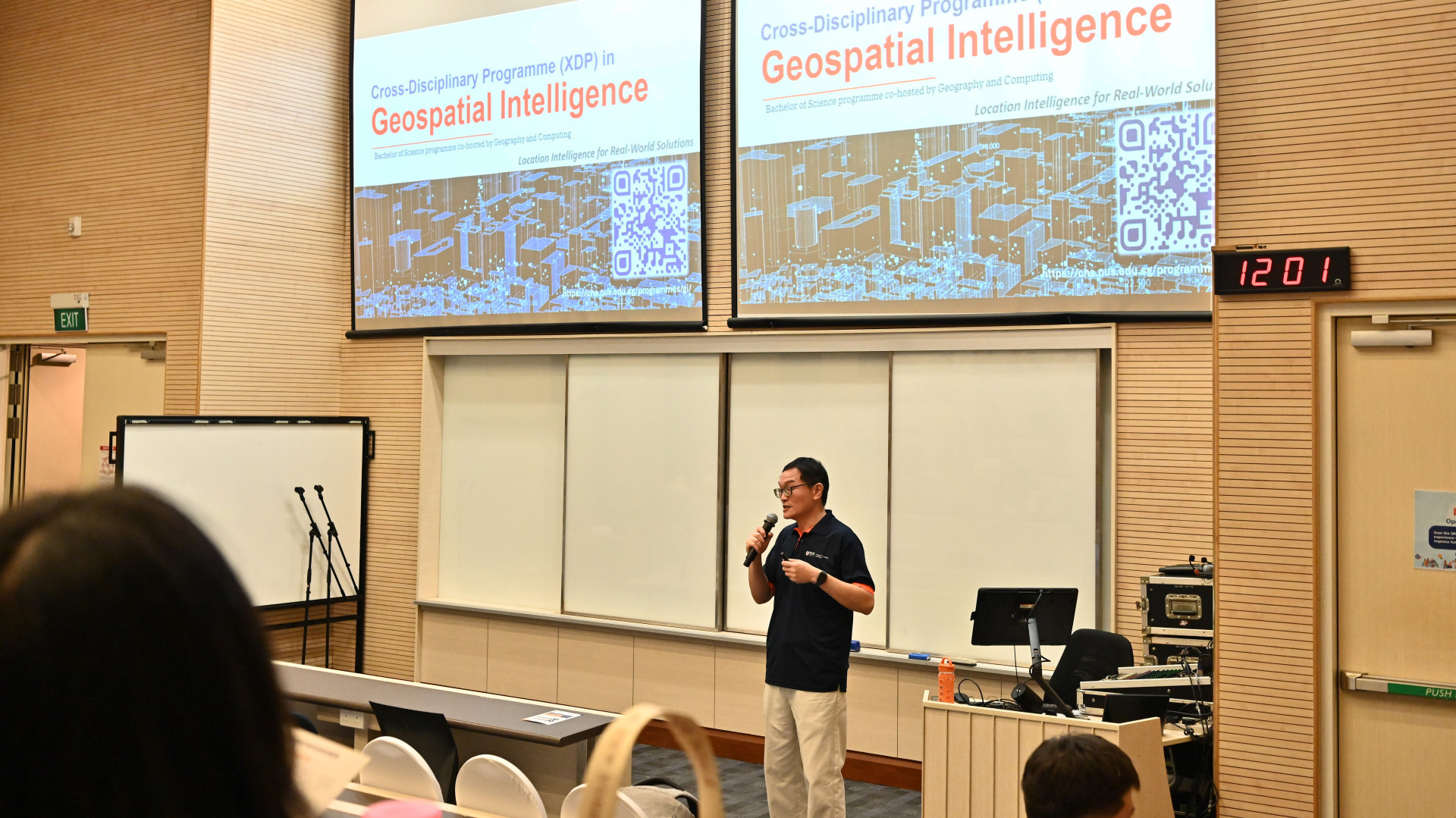
The National University of Singapore (NUS) will offer a new major in geospatial intelligence that will train students to harness geospatial data and emerging technologies such as artificial intelligence (AI) to address complex problems in climate change mitigation, smart city design, business planning and more.
The study and use of geospatial or location data have evolved from a field focused on mapping and visualisation to one that supports prediction, assessment and decision-making. With the rapid growth of data from satellites, sensors and social activity, combined with advances in computing and AI, geospatial intelligence has become essential for policymakers and organisations to extract insights that emerge from spatial patterns, anticipate risks and drive change.
This has created strong demand for professionals who not only have foundational skills in Geographic Information Systems (GIS) to organise and visualise spatial data, but also expertise in geospatial data science and advanced tools that let them create digital twins of real-world environments, including cities, buildings, transport networks, natural landscapes, ecosystems and social spaces, to explore scenarios, test solutions and make better data-driven decisions.
Therefore, NUS' new Bachelor of Science (Honours) in Geospatial Intelligence Cross-Disciplinary Programme (GIX), the first bachelor's degree of its kind in Asia, meets this demand and builds a talent pipeline in geospatial intelligence.
The four-year programme is offered by the College of Humanities and Sciences (CHS), led by the Department of Geography at the Faculty of Arts and Social Sciences, in collaboration with the School of Computing (SOC), which contributes expertise in AI, data science and computational methods.
The joint programme leverages world-leading expertise from the Department of Geography and SOC, which are both ranked No.1 in Asia for their respective subjects and in the top ten globally, and the strategic positioning of NUS in Singapore where high-density land utilisations present unique sets of geospatial challenges.
GIX will be offered to students matriculating in Academic Year 2026/2027, which begins in August 2026.
Unlocking deeper insights for spatial decisions
In Singapore, policymakers have recognised the profound impact of geospatial information and technology on decision-making and societal development. To realise its vision of becoming "a leading global geospatial hub", the Singapore Geospatial Masterplan 2024-2033 emphasises greater geospatial adoption and the strengthening of core capabilities in this field.
Geospatial intelligence has many practical applications. Beyond urban planning, transport and connectivity, geospatial intelligence is also used in disaster preparedness and resilience, as well as business optimisation and supply chain strengthening. As AI enhances the analysis of large-scale spatial data for such purposes, demand for professionals who can integrate geospatial expertise with AI capabilities is growing rapidly.
"The introduction of this new degree programme is timely as demand for and interest in AI-powered jobs soar," said GIX Programme Director Associate Professor Feng Chen-Chieh.
"The new Geospatial Intelligence Cross-Disciplinary Programme gives undergraduates a strong foundation in geographic thinking, computational skills and AI, giving them a real edge across sectors such as smart urban systems, logistics, climate risk management and real estate analytics," added Assoc Prof Feng, who teaches GIS courses at the Department of Geography.
Associate Professor Kan Min-Yen, Vice Dean (Undergraduate Studies), School of Computing, who is also a programme convenor, said the programme will draw interest from students keen to work on real-world issues such as disaster response, urban planning or climate adaptation.
"The programme complements NUS' existing offerings for students who want to combine data, computing and domain knowledge to solve complex interdisciplinary problems. The offering greatly increases the spectrum of cross-disciplinary programmes available to prospective students," said Assoc Prof Kan.
A preview session for the new programme was held today at the NUS 2026 Open House. Close to 100 prospective students and parents turned up to learn more about this emerging growth field and potential career pathways for geospatial intelligence experts in government, tech, urban solutions and environmental sectors.
The Geospatial Intelligence Cross-Disciplinary Programme reflects NUS' commitment to preparing students for an AI-driven future, equipping them with the skills to analyse complex spatial data, uncover patterns and generate actionable insights across a range of industries and societal challenges.


