
A new award will enable researchers at Oregon Health & Science University to test an anti-inflammatory drug for patients at heightened risk of developing leukemia due to an inherited mutation in the RUNX1 gene.
The $1.89 million, four-year Leukemia Exploration and Prevention Grant comes from the American Cancer Society and the RUNX1 Research Program. It will enable scientists at the OHSU Knight Cancer Institute to evaluate whether an anti-inflammatory drug could help delay or reduce the risk of blood cancer in people with an inherited condition known as RUNX1 familial platelet disorder, or RUNX1-FPD.
The project will build on an ongoing clinical trial currently underway at MD Anderson Cancer Center at the University of Texas.
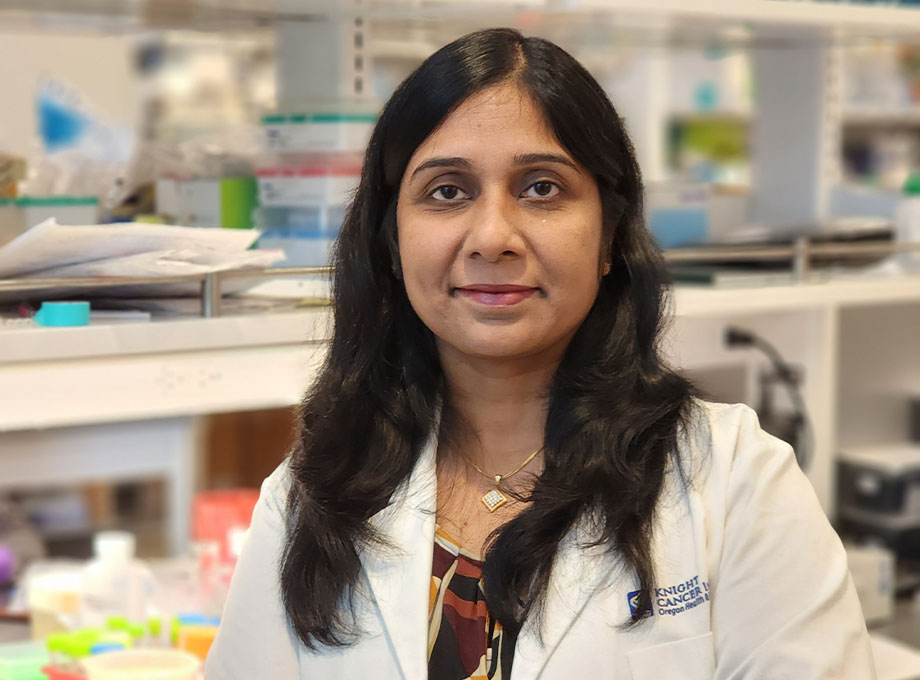
Between 10 and 12 participants with RUNX1-FPD will be recruited to the trial at OHSU and MD Anderson. Anupriya Agarwal, Ph.D., professor of medicine (hematology/medical oncology), cell and developmental and cancer biology, and molecular and medical genetics in the OHSU School of Medicine and OHSU Knight Cancer Institute, serves as the principal investigator at OHSU, and collaborates with Courtney DiNardo, M.D., MCSE, team principal at MD Anderson.
The RUNX1 gene plays a critical role in regulating blood production. People who inherit a RUNX1 mutation typically have low or dysfunctional platelets, placing them at increased risk of excessive or prolonged bleeding.
In addition, scientists estimate that 30% to 50% of patients with the condition could develop aggressive forms of blood cancer during their lifetime.
Researchers will test low-dose sirolimus, an FDA-approved drug with anti-inflammatory effects that is typically used as an immunosuppressant following organ transplants.
"The overarching goal is to intervene and potentially prevent the progression to leukemia," Agarwal said. "Considering RUNX1-FPD patients live in a pre-malignant state for many years, we see an opportunity to prevent or delay the development of leukemia."
If successful, the project could help advance the first targeted cancer-prevention strategy for this high-risk group, and serve as a model for people with inherited cancer risk more broadly.
The trial will evaluate the safety of a low daily dose of sirolimus taken over six months. Researchers will assess its effects on blood and bone marrow cell function, immune response and inflammation.
Importantly, researchers will assess whether the treatment affects cellular processes involved in the development of leukemia, with the goal of delaying or preventing it. Preclinical research in mice and in blood samples drawn from patients suggests sirolimus may inhibit cellular signaling pathways that contribute to inflammation and increased cancer risk.
"We will collect blood and bone marrow samples throughout the treatment to determine if the improvements we saw in the petri dish and in mice translate to people," Agarwal said.
Early observations in the first five patients treated at MD Anderson since 2024 are encouraging.
"We'll monitor each patient over the course of a year," Agarwal said. "We want to make sure they can take the medication over a long term while staying healthy and improving cellular function."
If shown to be safe, the next step would be a larger clinical trial to evaluate whether this approach can delay or reduce the risk of cancer.
Although RUNX1-FPD is considered rare, it's estimated that as many as 18,000 people in the United States may carry the mutation — the vast majority are not diagnosed. Agarwal said the findings from this project could have broader implications for other types of platelet disorders.
"Conceptually, the framework of early detection and intervention should have broader applicability," she said.
Co-investigators include Curtis Lachowiez, M.D., and Olivia Lucero, M.D., at OHSU; Kelly Bolton, M.D., Ph.D., at Washington University in St. Louis; and Andrew Frelinger, Ph.D., and Alan Cantor, M.D., Ph.D., at Boston Children's Hospital.


