
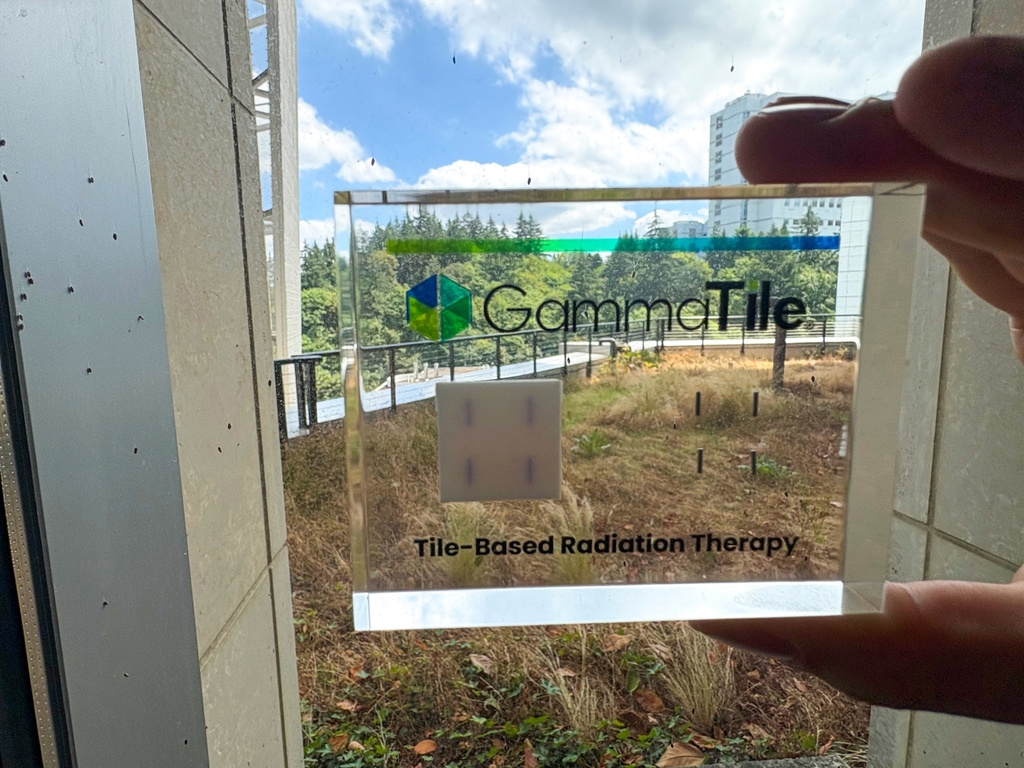
A team at Oregon Health & Science University this month became the first in Oregon to implant a new type of radioactive tile roughly the size of a postage stamp to improve the outcome for patients with brain tumors.

"It's a way of delivering radiation immediately after surgery and increases the effectiveness of surgeries to remove these tumors in many cases," said Stephen Bowden, M.D., assistant professor of neurological surgery in the OHSU School of Medicine.
Bowden performed the procedure in tandem with radiation oncologist Joshua Walker, M.D., Ph.D., associate professor of radiation medicine, and Joe Foy, Ph.D., a medical physicist and assistant professor of radiation medicine, both in the OHSU School of Medicine, as well as an anesthesiologist and surgical team.

The tile, called GammaTile, is a biodegradable collagen implant that encases a concentrated dose of radiation in the tissue directly surrounding the area after the surgeon has removed the tumor, a technique also known as brachytherapy.
Two groups of patients may benefit.
The first involves people with metastatic brain tumors who have previously received radiation, as was the case for OHSU's first patient on July 8. For those patients, the technique can improve the effectiveness of surgery in cases when another round of standard external beam radiation would be considered too toxic.

"It's a very good option for patients who have recurrent gliomas or recurrent metastasis," Walker said.
The second group involves patients undergoing surgical removal of metastatic brain tumors for the first time. For those patients, GammaTile delivers a safe dose of radiation where the tumor was removed, improving effectiveness of treatment while eliminating the need for external beam radiation treatment, as is standard a month after surgery.
Physicians cited promising clinical data reported during the American Society of Clinical Oncology annual meeting earlier this year.
"Once the results from that study at ASCO are published, I think we'll probably end up using it for a number of people with large tumors," Walker said.
Multidisciplinary expertise
OHSU has conducted two further surgeries using GammaTile since the first case on July 8, and physicians expect demand for the treatment will increase.
Learn more about OHSU innovation in neurological procedures and cancer treatment.
"We have a level of multidisciplinary expertise that allows OHSU to deliver specialty care for patients that doesn't exist anywhere else between Seattle and San Francisco," Walker said.
The first OHSU patient who underwent the procedure is recovering well and is pleased with the outcome.
Tom Farney, 71, of Happy Valley, is unusually knowledgeable about medical science following his own career as a general surgeon who practiced in Hermiston, Oregon. Now retired, he said he knew that Bowden trained with GammaTile during a fellowship at Memorial Sloan Kettering Cancer Center in New York and was comfortable with the procedure.
In his case, the tile enabled the surgical team to target a tumor growing against the part of his brain that controls his right, dominant hand. The tile improved safety by targeting cancerous cells spreading into a critical area for the function of his right hand.
"My handwriting seems like it even got better," he said with a smile.
Walker said he expects OHSU will implant the tile in a few patients per month, and initially only in cases similar to Farney's — the 5% to 15% of situations when cancer recurs following a previous course of surgical treatment and radiation.
Bowden said patients are beginning to ask him about the possibility of using GammaTile following news coverage of the results reported at ASCO.
"This could be a groundbreaking advance for the field," he said.


