
On 29 and 30 September 2026, the OSCE Programme Office in Dushanbe, in co-operation with the Action against Terrorism Unit of the OSCE Secretariat's Transnational Threats Department, conducted a two-day learning course in Dushanbe on the responsible and ethical use of artificial intelligence (AI). The course was for representatives of Tajikistan's law enforcement agencies and focused on the responsible and ethical use of AI, including in the context of countering terrorism.
Attended by 18 law enforcement officials, representing the Ministry of Internal Affairs, Prosecutor General's Office, State Committee for National Security, and Agency for State Financial Control and Combating Corruption of the Republic of Tajikistan, the course provided participants with practical knowledge on the opportunities, limitations and risks associated with the use of AI in law enforcement, including in the context of countering terrorism.
Particular attention was given to human oversight, accountability, transparency, data protection and the safe handling of sensitive information. The course also introduced participants to the INTERPOL-UNICRI Responsible AI Toolkit and discussed institutional readiness for the responsible adoption of AI technologies.
Opening the learning course, Ewan Todd, Head of the Politico-Military Department at the OSCE Programme Office in Dushanbe, emphasized the importance of maintaining professional judgement and human responsibility as new technologies become increasingly integrated into professional work.
"We are not here to suggest that AI has an answer to every problem. It does not. We are here to better understand where it can help, where we should be cautious, and where the human being must remain firmly in control," said Todd in his opening remarks.
H.E. York Schuegraf, Ambassador of the Federal Republic of Germany to Tajikistan, highlighted the importance of approaching innovation, security and the protection of fundamental rights together.
The programme combined discussions with hands-on exercises on the practical and responsible use of AI in law enforcement. Participants practised working with AI-generated outputs and explored key safeguards, including human oversight, data protection and institutional readiness.
The OSCE Secretariat's Transnational Threats Department's Project CLEAR (Critical Thinking, Information and Media Literacy, Ethical AI, and Resilience for Preventing and Countering Violent Extremism and Radicalization that Lead to Terrorism) supported the course. Project CLEAR is funded by Germany, Finland, Norway, and the United States.
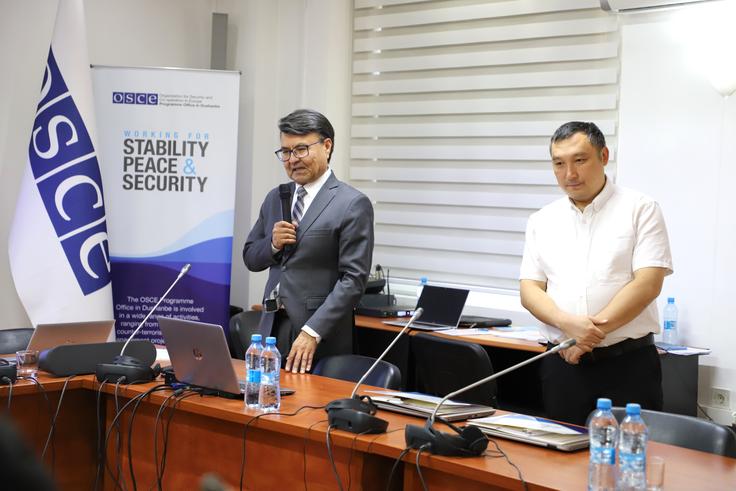
Otabek Rashidov, Associate Programme Officer with the Action Against Terrorism Unit of the OSCE Secretariat's Transnational Threats Department (left), introduces the course and outlines its objectives during a two-day learning event on the responsible and ethical use of artificial intelligence (AI), Dushanbe, 29 September 2026.
Project CLEAR supports participating States in strengthening comprehensive and human-rights-compliant approaches to preventing and countering violent extremism and radicalization that lead to terrorism that manifest in, and stem from, online environments and the misuse of the internet, emerging technologies, and AI for terrorist purposes across the OSCE area.


