
UConn School of Medicine offering innovative clinical trial testing novel pill's impact for reducing inflammation to treat Parkinson's disease

AdobeStock Image.
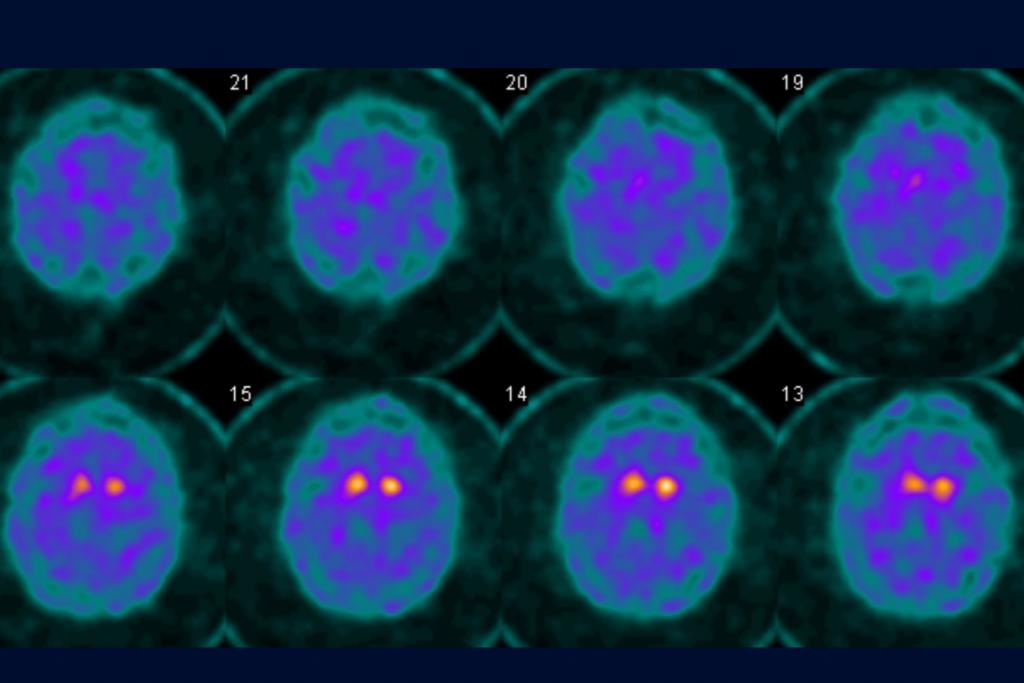
Bill is only in his fifties, but was diagnosed recently with Parkinson's disease at UConn Health's Brain and Spine Institute. The diagnosis was further supported through a DaTscan (dopamine transporter scan) using a radioactive tracer to confirm the disease's hallmark – low dopamine in the brain.
A couple of years ago, while rehabbing an injury, his physical therapist randomly asked, "Does your left thumb always twitch?"
"I actually had never noticed that twitch before," Bill reports. "My tremors in my left hand don't always happen, they come and go. But now they have gotten worse, and have started to spread to my right hand."
After experiencing these hand tremors, Bill wasn't surprised by his recent Parkinson's disease diagnosis.
"I knew something was wrong," says Bill, who has no family history of the disease that is the second most common neurodegenerative disease worldwide after Alzheimer's. Globally, PD afflicts more than 10 million people.
Besides hand tremors, the other three common Parkinson's symptoms are slowed movements, stiffness/rigidity, and balance changes known as postural instability.
Early Action
Bill is taking early action to stay ahead of his new Parkinson's diagnosis.
"I keep moving!," he says.
He is staying active. He is a runner, and exercises a lot. He has started yoga to help him maintain his balance, and is even thinking of trying Tai Chi next.
Also, he chose to enter the national Parkinson's Foundation PD GENEration registry collecting blood samples from volunteering patients across the country to collect and test their individual genetic predisposition for the disease. About 10-15% of PD cases are associated with an identifiable genetic cause. It also is pooling together more patient data to help advance research and try to find answers for a future cure. The registry already has 30,000 PD patients enrolled.
"We believe that genetic and environmental factors are at the core of the cause of Parkinson's disease. This registry can help us learn more about the genetic make-up of a family, and also of the disease itself. If you participate, you are helping patients across the country," says Dr. Bernardo Rodrigues, director of the Parkinson's disease Clinic at UConn Health.
Interestingly, while Bill was visiting the Clinical Research Center at UConn School of Medicine located in the lobby of UConn Health to have his blood drawn for this PD GENE registry, with available free genetic counseling offered by Indiana University, his wife saw a flyer. She then asked about a brand-new clinical trial (BHV8000-301) launching at UConn School of Medicine. This trial, sponsored by Connecticut-based Biohaven Pharmaceuticals, Inc. is testing the ability of their experimental new medication, BHV-8000, to slow disease progression in people like Bill who are living with early-stage PD.
Central to Bill's Clinical Research Center experience was Sheila Thurlow, MSN, RN, the study coordinator whose expertise and coordination are critical to both studies. Thurlow drew Bill's blood for the PD GENEration study while also answering his and his wife's questions about the Biohaven study. She oversees both studies, serving as a vital link between patients, investigators, and study sponsors. Her coordination of logistics, regulatory requirements, and patient education efficiently allowed Bill to move quickly from learning about the study to enrollment.
First Connecticut Patient in Clinical Trial
Bill became the first patient in Connecticut to be enrolled in the Biohaven clinical trial - an important milestone for both the study and Parkinson's research in the state.
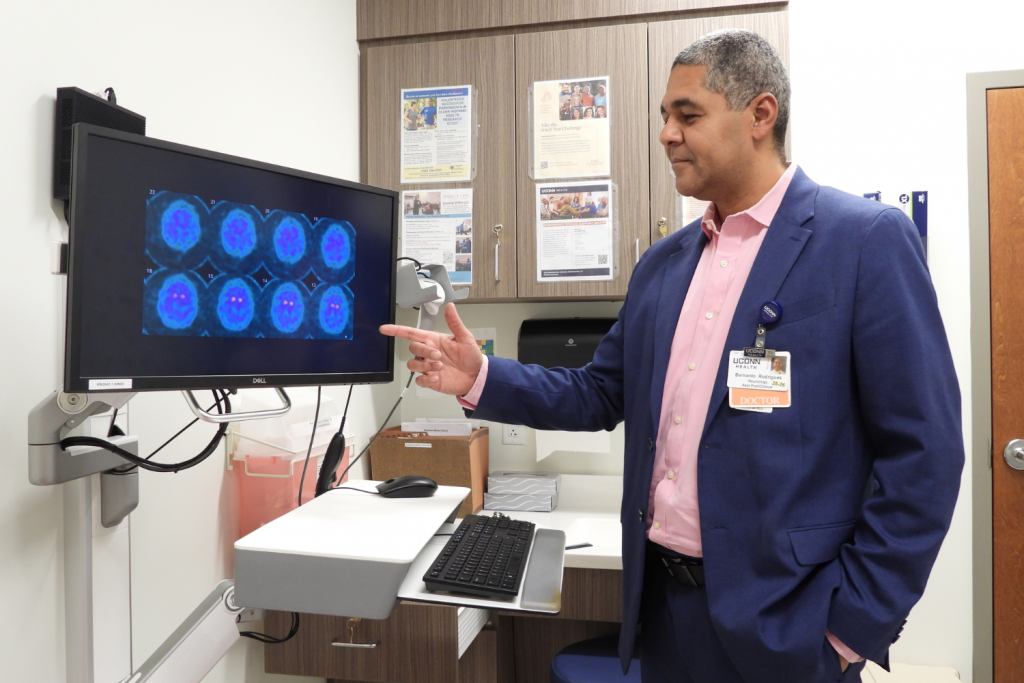
"Through this novel clinical trial Bill and other patients will be helping us find out if this new medication will change the world for Parkinson's disease patients - and we think it could," Rodrigues, whose team at UConn Health treats over 300 Parkinson's disease patients annually, says. "If proven effective, this would be a first of its kind in Parkinson's disease medication.
"This clinical trial is big. We are super excited about its potential."
BHV-8000-301 explores a different frontier to treat the underlying inflammation, including inflammation in the brain, that causes the disease to worsen. The drug (BHV-8000) works by targeting inflammation messengers to prevent and stifle two proteins TYK2/JAK1 from transmitting inflammatory signals between cells and spreading throughout the brain and the rest of the body.
"This medication works by blocking the transmission of inflammatory signals closely associated with PD. By inhibiting inflammation, the body's immune response calms, and allows for the body to begin to heal itself on the molecular level – and the hope is that we will be able to slow down Parkinson's disease progression," says Rodrigues. "This could be revolutionary."
"I'm a big believer in JAK inhibitors," shares Bill.
"I just took my first pill yesterday," Bill shared with excitement on February 3, 2026 about his participation in the double-blind, multi-center clinical trial BHV8000-301, sponsored by Biohaven Pharmaceuticals. Neither he nor his doctor or study team know if he is receiving the real medication or a placebo pill. But Bill is hopeful and is keeping a daily log of all his symptoms, food, medications, and supplements.
"My hope is that this new medication slows my Parkinson's disease progression," says Bill. "But even if participating in the clinical trial doesn't help me, I hope it helps others now or down the road. Participating in a clinical trial is a time commitment but it's worth it to help others."
Bill's participation in both research initiatives was made possible through the UConn School of Medicine's Clinical Research Center (CRC), a dedicated hub designed to support innovative research safely, efficiently, and effectively. The CRC provides specialized space, infrastructure, and highly trained expert staff to ensure that studies are conducted with the highest scientific, regulatory, and ethical standards.
"The CRC allows investigators to launch complex trials quickly while providing patients a seamless, supportive experience. This dedicated environment is essential for translating scientific discoveries into real world treatments and offering Connecticut patients access to innovative therapies," says Elizabeth Laska BSN, RN, CCRC, nurse manager of the Clinical Research Center.
Advice to Others with Parkinson's
Bill urges others to consider participating in the national PD GENEration registry powered by the Parkinson's Foundation.
He recommends working with a social worker like the ones he's benefitted from being connected with at UConn Health, and also to take advantage of informative webinars and support groups for Parkinson's disease patients like the ones UConn Health and other organizations offer.
He also recommends "keep moving!," as he says it does his body a lot of good as he embarks on his Parkinson's disease journey.
Rodrigues agrees and urges all Parkinson's disease patients to stay active and stay involved in the PD community and its resources such as the American Parkinson's Disease Association (APDA) programs, wellness support, and research opportunities. Also, participate in the national PD GENE registry to help establish your genetic risk for free, but also your family members. The Michael J. Fox Foundation is also dedicated to advancing PD research, access to clinical trials, and offers a lot of information.
In addition to offering the latest in diagnostics, treatments, and research clinical trials, UConn Health is also hard at work training the next generation of Parkinson's disease experts through UConn School of Medicine.
UConn Health, in collaboration with Hartford HealthCare and the support of the Chase Family Foundation, has a Movement Disorders fellowship training program that educates one new neurologist in the sub-specialty each year. This program is vital, as the U.S. and Connecticut are both dealing with aging populations, and there is a shortage of experts able to care for age-associated diseases like Parkinson's.
UConn Health's Parkinson's disease team, with the help of the Clinical Research Center, are proud of their clinical trials.
"Our patients are asked each time they come to our clinic if they would like to participate in clinical trials, and patients come to us from all over the state as they are excited to see what new trials we have to offer," says Dr. Chindhuri Selvadurai, division chief of Parkinson's disease and Movement Disorders program at UConn Health. She also directs the training of UConn medical students in the Neurology Clerkship. "Our research is open to our patients as well as anyone in the community who wishes to participate. Patients in Connecticut don't have to travel far to get this groundbreaking care that is available only in certain centers across the country and world. We are thankful to patients who contribute to science not only to help themselves, but also their friends, neighbors, children, and the general population."


