
As sea level rise pushes saltwater farther into the Florida Keys, it is not only roads and neighborhoods that are at risk; it is also the record of the region's earliest human history. For University of Miami archaeologist Traci Ardren, that urgency shapes the focus of her research.
Ardren, chair of the Department of Anthropology at the College of Arts and Sciences, has led archaeological work in the Keys since 2009, documenting ancestral Indigenous sites that are already experiencing erosion and tidal flooding. Her research challenges long-held assumptions that the Keys could not support permanent human habitation prior to European contact.
Most recently, Ardren conducted fieldwork on Key Largo during winter break at the request of John Pennekamp Coral Reef State Park, where park managers are grappling with the accelerating loss of cultural sites.
"These archaeological sites are now surrounded by mangroves in a way that they would not have been when Indigenous people lived there," Ardren said.
Building a new timeline for the Keys
For many years, archaeologists assumed that pottery found in the Florida Keys had been imported from the mainland, largely because suitable clay sources are scarce in South Florida. Ardren's research challenges that assumption by examining ceramic vessels using geochemical analysis to determine where they were made. The results show that ancestral Indigenous communities in the Keys were producing their own pottery locally while still sharing stylistic traditions with mainland groups.
"Ancestral people across the whole region of South Florida shared ideas about what designs were cool, or meaningful, to them," Ardren said. Those shared designs suggest that people were moving between regions, she added, and that ancestral communities in the Keys played an active role in regional social networks that extended across South Florida. "They were probably going into the Everglades, up to Lake Okeechobee, and over to the southwest coast on ceremonial occasions, to see relatives, or for trade and exchange."
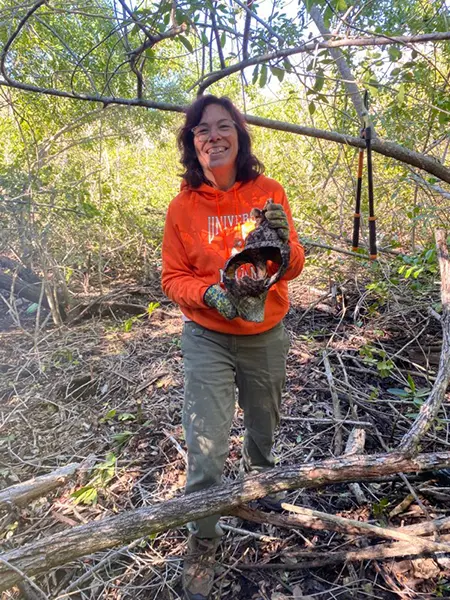
Ardren's findings, recently published in the Journal of Archaeological Science, also amend a long-standing limitation in archaeological studies of the Florida Keys.
For decades, scholars relied almost entirely on ceramic typologies developed in the 1940s to estimate when Indigenous communities lived in the Keys. Those early systems were created before radiocarbon dating was available and were based on limited samples. As a result, the Keys were often left out of broader histories of Indigenous life in the southeastern United States and were frequently described as places people passed through rather than places where communities formed and endured.
"The typologies were created without the advantage of using carbon-14," Ardren said.
In a recent study published in Southeastern Archaeology, Ardren and her team used modern radiocarbon dating to build the first accurate timeline for ancestral Indigenous sites in the Keys. By analyzing organic material with accelerator mass spectrometry and combining those results with advanced statistical modeling, the researchers were able to determine when people lived at specific locations with far greater accuracy than ever before.
The study focused on two large settlement sites, one on Upper Matecumbe Key and another on Key Largo. Ardren and her team found that ancestral communities lived in the Keys intensively between about A.D. 750 and 1150.
Taken together, the new chronology and pottery evidence point to sustained occupation in the Keys rather than temporary visits. That conclusion raises another long-standing assumption Ardren's work confronts: the idea that the Keys lacked sufficient freshwater to support permanent settlement.
Ardren pointed to earlier research by Abess Center for Ecosystem Science and Policy Ph.D. graduate M. Jesse Schneider, who demonstrated that freshwater sources were available year-round in the Keys. Combined with archaeological evidence of sustained occupation, this research reframes the Keys as a place where ancestral communities lived, adapted, and thrived.
Schneider's work also reflects a key aspect of Ardren's research: students are not simply contributors, but drivers of discovery.
Students at the center of discovery
Students have played a central role in studying ancestral Indigenous sites in the Keys, reflecting the college's emphasis on providing students with meaningful research opportunities. Undergraduate and graduate students have participated in excavations, laboratory analysis, and conference presentations, and even co-authored publications with Ardren.
One of those students is Elizabeth Perez, a Ph.D. student at the Abess Center, who is analyzing fish bones recovered during the Key Largo fieldwork to study how ancestral communities interacted with marine ecosystems. Perez is examining whether sustained fishing pressure was reflected in changes in fish body size over time, a method used elsewhere but never before applied in the Florida Keys.
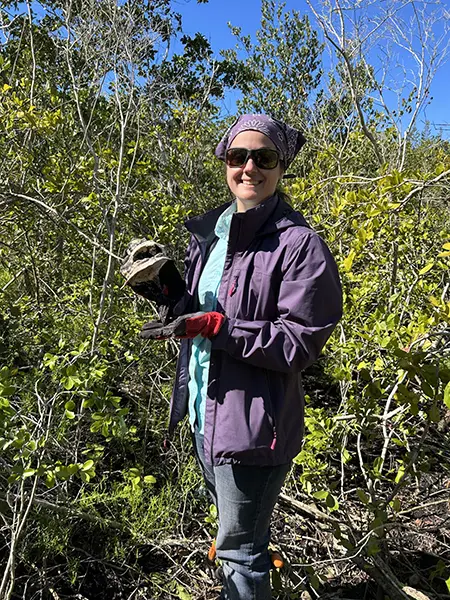
"Fish bones indicate what kind of relationships the population has with their immediate environment," Perez said. "They help us understand availability, biodiversity, and whether there are signs of overexploitation."
For Perez, the research is also deeply personal. She grew up in South Florida, fishing and snorkeling in the same waters she now studies.
"I would listen to my parents and their friends talk about what they noticed growing up here," she recalled. "The reef that they grew up snorkeling in is very different from the reef we see now."
Understanding long-term human and environmental interactions is essential to informing modern conservation and management decisions, Perez explained. "What people do not always realize is that you have to understand the history of a location before you can secure its future."
Research across disciplines
Ardren's research reflects the interdisciplinary nature of scholarship at the University.
"Archaeology spans everything the college wants to do," Ardren said. "If you are a hard scientist looking at bone isotopes, you have a place here. If you are a humanist looking at Indigenous literature about the environment, we want that, too. We need all of those perspectives to understand how humans and the environment interact."
For Perez, that interdisciplinary environment has been central to her academic path.
"What makes the U such a great institution is the opportunity to choose any path, and succeed," she said.


