
A team of geophysicists from Cornell, Cameroon and South Africa is using machine learning tools to unearth new information from earthquake data collected by Cornell 15 years ago - providing a lifeline for a scholar whose career was upended by conflict.
The team's cross-border collaboration is part of Global Cornell's support for Scholars Under Threat and long-standing partnership with the Institute of International Education's Scholar Rescue Fund (IIE-SRF). Cameroonian Ndikum "Eric" Ndoh is one of four virtual IIE-SRF fellows currently supported by Global Cornell, with two more expected by July.
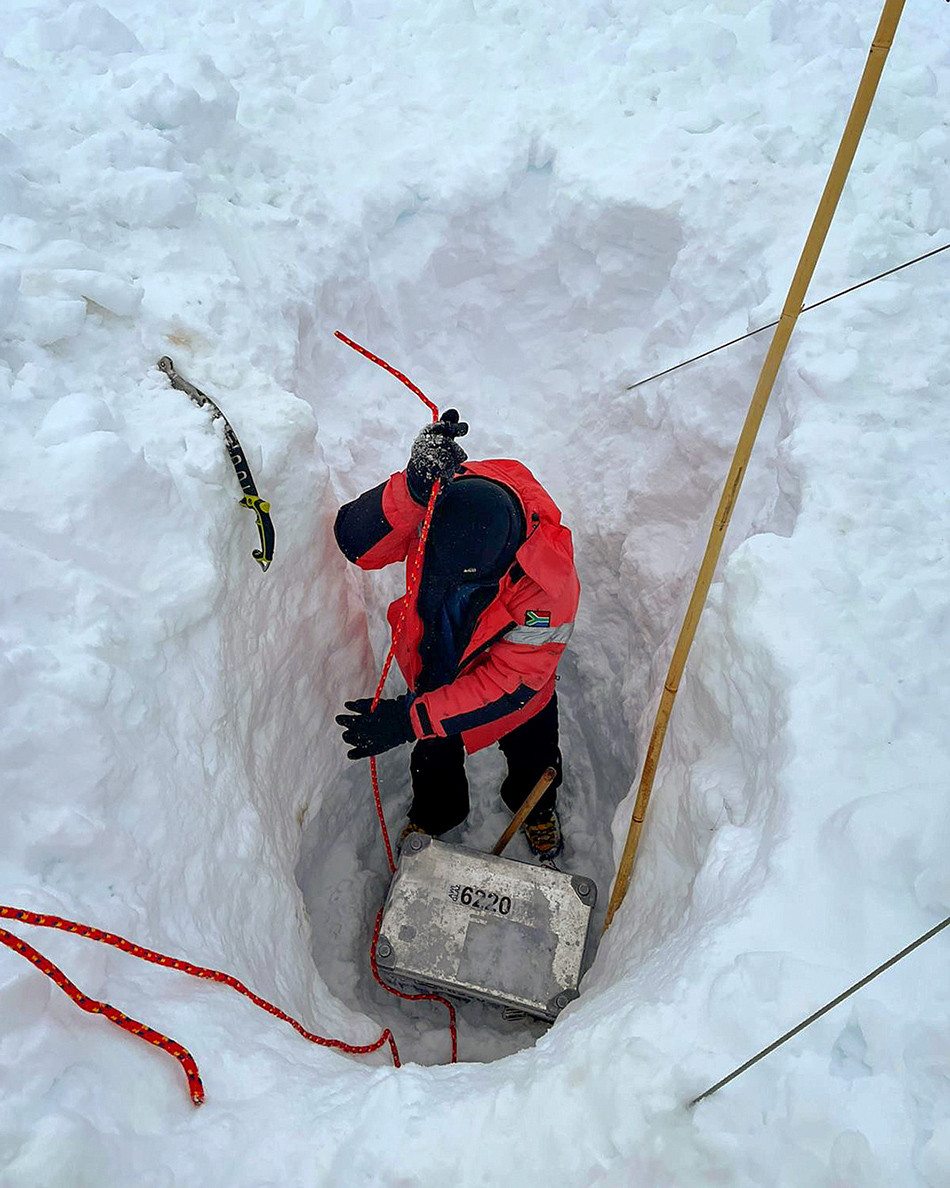
Diego Quiros, Ph.D. '17, conducted research on the Fimbul Ice Shelf in Antarctica in February.
Ndoh was head of the physics department at the University of Bamenda in the Northwest region of Cameroon when conflict erupted among Anglophone separatists and the Francophone government's security forces. His seismic research ground to a halt.
"You can't carry out any fieldwork," he said, "because only a corridor between the city and university was under some security by the government. There were also moments when our internet had to be cut."
In this atmosphere of increasing uncertainty and risk, Ndoh applied for and received an IIE-SRF fellowship. Seeking a placement, he worked with IIE-SRF to put the word out to colleagues and research programs around the world.
In Cape Town, South Africa, Diego Quiros, Ph.D. '17, saw his appeal.
Quiros, who is from Costa Rica, contributed as a doctoral student to the campus effort to record an August 2011 Virginia earthquake felt in Ithaca - and then chased the aftershocks to their source, capturing an exceptionally detailed seismic dataset of the rare magnitude 5.8 East Coast earthquake.
He moved on to other projects - including research this spring on the Fimbul Ice Shelf in Antarctica - but when he saw Ndoh's expertise in Earth science and machine learning, he wondered if together they might dive back into the earthquake data.
Quiros' department at the University of Cape Town agreed to host Ndoh and sponsor his visa, and Global Cornell stepped up to connect the pair to Geoffrey Abers, the William and Katherine Snee Professor in Geological Sciences in the Cornell Duffield College of Engineering. Abers remembered Quiros: They overlapped briefly at Cornell.
"When we heard about Eric and what he does - and then heard about Diego's involvement - this was a very easy decision," Abers said.
Thanks to Quiros' meticulous data collection as a doctoral student, Abers said, the Virginia earthquake is "probably one of the best recorded." He said for the last few years, seismologists have been reanalyzing old datasets with AI and finding that "there's a ton more in the data than we thought."
Ndoh arrived in Cape Town in August 2025 and became a Cornell virtual IIE-SRF fellow in October. Since then, the virtual team led by Ndoh has confirmed the researchers' shared suspicion that there was more to discover in the original earthquake catalog. While it is too early to report results, Ndoh said, preliminary findings suggest there may have been six times as many seismic events in the 2011 earthquake as were previously detected.
"We are building initial learning pipelines that allow us to quickly process the large dataset and identify events that hardly registered when analyzed manually," Ndoh said. "We're seeing obvious signs of many other events that were not located by previous researchers, so it's quite exciting."
The Virginia quake originated far from the edge of a tectonic plate. Such intraplate earthquakes are rare, Abers said, but "they tend to do much greater damage for their size." Learning more about them is helpful both for disaster preparedness and for understanding the geology and seismology of stable continental regions - like the eastern U.S. and South Africa.
"We have a good conceptual model for what drives earthquakes near plate boundaries," Abers said, "but we don't really have a model for why intraplate earthquakes occur and what makes them end. Case studies like this one become foundational to building up this kind of model."
The project continues, and Ndoh is applying to extend his IIE-SRF fellowship to August 2027.
"It's been a wonderful experience so far," Ndoh said. "I have everything I need for my work, and the people in Cape Town and Cornell have been very helpful."
The collaboration introduced Ndoh to advanced machine learning tools that he hopes to bring back to Cameroon when the situation allows. Although South Africa is still a long way from home, and his wife and children remain in Cameroon, Ndoh said being based in Africa is less disruptive than a U.S. placement.
Cornell has been partnering with IIE-SRF on virtual fellowships since 2023, initially focusing on displaced Ukrainian academics hosted in Latvia and Poland. The demand for virtual fellowships has grown rapidly following federal immigration changes since January 2025.
"Cornell is more committed than ever to supporting our international colleagues who can no longer work in safety," said Vice Provost for International Affairs Wendy Wolford.
Other Cornell virtual IIE-SRF fellows include Ayat Abdalrahman, a Sudanese biochemist currently hosted at the American University in Cairo, Egypt; Rania Mohamed Hassan Baleela, a Sudanese public health specialist hosted at the University of KwaZulu-Natal in South Africa; and Svitlana Turlakova, a Ukrainian industrial economist hosted at Sofia University in Bulgaria. Cornell is also supporting four IIE-SRF fellows on campus. Find out how to serve as a faculty host or apply to become a fellow.
Jonathan Miller is a freelance writer for Global Cornell.


