To encourage new investments in more effective reef restoration activities, Australian scientists are recommending a new way of measuring biodiversity on coral reefs.
A team of Australian environmental scientists led by James Cook University's Distinguished Professor Morgan Pratchett have published new research in the prestigious One Earth Journal – proposing a more rigorous and transparent framework for measuring improvements in biodiversity on coral reefs.
Biodiversity credits, such as those associated with the NSW Government's Biodiversity Offsets Scheme, are intended to facilitate investment into environmental restoration projects that deliver improvements in biodiversity.
"There's a massive shortfall in conservation funding, but there is also a clear demand for biodiversity credits … to allow for nature positive investment by a range of organisations," Prof Pratchett said.
Professor Pratchett explained that it was critical to ensure biodiversity credits were of high integrity, because there had been examples of low integrity carbon credits which had not resulted in reduced or avoided emissions – fostering scepticism about the effectiveness of such credit schemes.
"There are already coral reef biodiversity credits being issued, but there's no overarching framework. We're laying the foundations to ensure high-integrity biodiversity credits," Prof Pratchett said.
"We need the right metrics and a robust ecosystem-accounting method to quantify longer-term impacts of reef restoration and other activities, such as crown of thorn starfish control," Dr Ken Anthony, Director of Nature Assets and one of the research paper's co-authors said.
"This set of metrics collectively gives us good insight as to whether you've delivered some meaningful ecosystem benefit following a reef management intervention."
With hundreds of different metrics being previously used to define land-based biodiversity, the researchers established an optimal set of biodiversity metrics suitable for coral reef ecosystems.
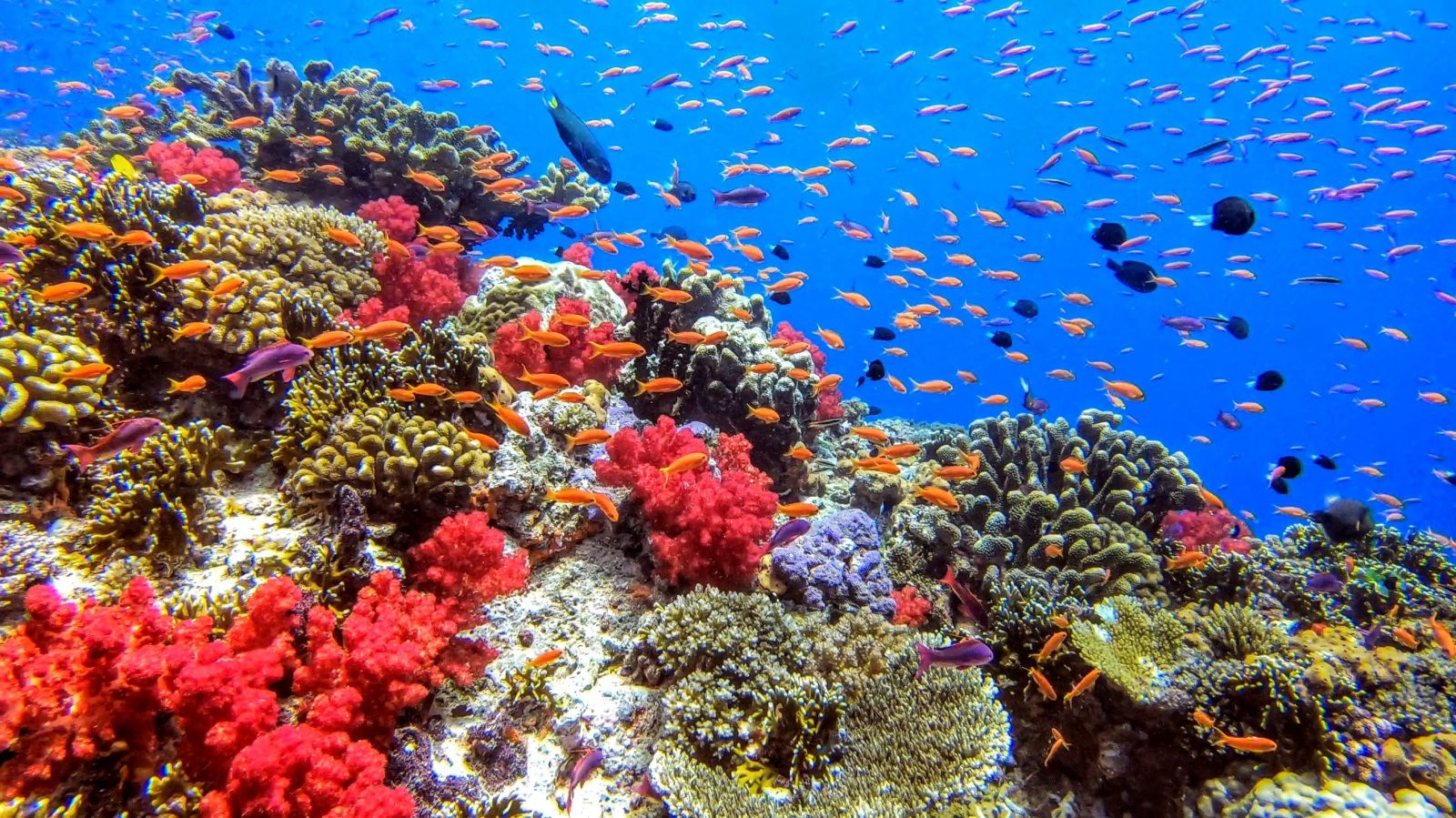
The researchers propose six metrics that more fully describe the structure and effective 'function' of reef ecosystems: hard coral cover; functional diversity; structural complexity; algal composition, fish biomass; and fish feeding diversity.
"Existing biodiversity credits are largely based on input-based activities – such as planting a coral – but there is no guarantee that this will deliver meaningful ecosystem benefits," Prof Pratchett said.
"What we're pushing for is an outcome or output-based credit – where you can demonstratively prove that you've improved the ecosystem's health.
"We chose reef biodiversity metrics that are already widely measured – things that you can extract from most well-established monitoring programs."
Professor Pratchett said using more rigorous biodiversity credits – based on the six metrics they propose – will help drive the private investment needed to address the biodiversity crisis facing the Great Barrier Reef.
Kristina Koenig, Conservation Finance Lead at the Great Barrier Reef Foundation – which was a strategic project partner in the research – said the research helps by developing more credible ways to measure improvements in reef health.
"This is part of a broader initiative developed by the Great Barrier Reef Foundation (GBRF) to explore high-integrity biodiversity credits for our reefs," she said.
"We want to build the confidence needed to unlock new sources of funding and take reef restoration to a whole new scale."
Reef restoration efforts based on rigorous and measurable biodiversity metrics can help maintain healthy reefs while the necessary action is taken to reduce carbon emissions – the primary threat to coral reefs.
"Reef restoration activities are trying to prevent ecosystem collapse. If we allow ecosystems such as coral reefs to collapse, there's going to be a whole bunch of other ecosystems that follow – things like mangroves, seagrasses, all these highly productive marine and coastal ecosystems," Prof Pratchett explained.
"Those impacts are going to be greater in developing tropical nations. It's going to affect the food security and livelihoods of all those people.
"With an estimated half-a-billion people around the world obtaining their daily protein from coral reefs, protecting reef biodiversity has never been more critical."
This work was supported by the Reef Restoration and Adaptation Program (RRAP) and the L'Oréal Fund for Nature Regeneration. RRAP is funded by a partnership between the Australian Government's Reef Trust and the Great Barrier Reef Foundation.