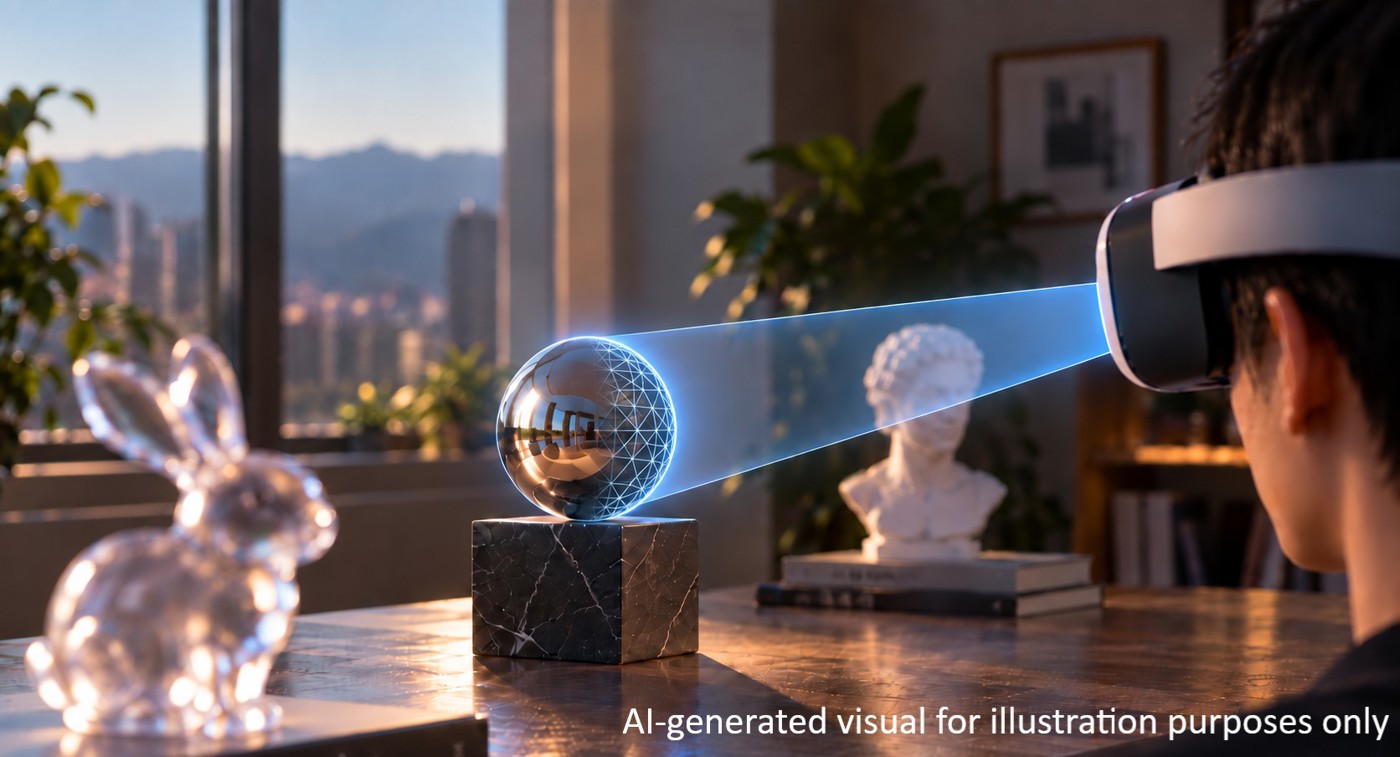
Holograms take a step closer to real life
Combining computer graphics, wave optics, and AI-based calibration, researchers at The University of Hong Kong (HKU) have developed two techniques that help holographic displays reproduce more natural changes in focus, perspective and material appearance.
Led by Professor Yifan Evan Peng from Department of Electrical and Computer Engineering of the Faculty of Engineering at HKU, the team connects 3D computer models with calculations of how light travels and interferes. One technique preserves a scene's geometry and depth as it becomes a hologram; the other follows light as it reflects, bends and scatters through the scene.
Demonstrated through computer simulations and laboratory display prototypes, the methods address a key challenge for future virtual and augmented reality (VR/AR): turning detailed digital worlds into convincing three-dimensional visual experiences.
More than a 3D picture
When people look around a room, nearby and distant objects come into focus at different distances. Surfaces hidden from one angle appear from another, and highlights shift across glossy materials. Holographic displays aim to reproduce these familiar cues by reconstructing light waves, rather than simply presenting a flat image.
But calculating those waves is difficult. Many existing methods first describe a scene using images at selected depths or viewpoints, then convert those images into a hologram. Important information can be lost between the two stages, producing unnatural changes in blur, incorrect visibility or visual effects that work only from certain viewing positions.
Keeping the scene intact
In one study, published in Nature Communications, the researchers begin with polygon meshes: the connected patches of surface used to build 3D models in animation, engineering and scientific visualisation. This gives the hologram calculation a description of the scene's surfaces and depth, rather than only a collection of flat images.
"Using meshes allows us to retain the 3D structure of a scene throughout hologram generation," said Mr. Xiangyu Meng, co-first author of both studies.
The team also looks beyond image brightness. Its optimisation preserves both the amplitude of the light wave, which relates to its strength, and its phase, which describes its position within an oscillation cycle. Together, these help determine how light propagates and forms an image at different depths.
AI-based calibration helps bridge the gap between the calculation and a real display. Using camera measurements, a learned model accounts for imperfections in the optical system. In laboratory tests, the approach produced smoother changes in focus and clearer image detail, while allowing objects hidden from one viewing position to become visible from another.
Following the light
The second study, HoloPathTracer, tackles another challenge: how light interacts with materials. A mirror reflects the scene around it, glass bends light passing through it, and a glossy surface sends different amounts of light in different directions.
To capture these effects, the researchers combine path tracing-a computer graphics technique that follows light through a virtual scene-with wave optics. Instead of calculating only the brightness of an image, the method also retains the phase information needed to form a hologram.
"HoloPathTracer further models how light physically interacts with scene geometry and materials," said Wenbin Zhou, the co-first author of both studies.
The resulting holograms reproduce effects including reflections, refractions, shifting highlights and indirect illumination, alongside natural changes in focus and viewpoint. The team also reduces repeated computation by reusing light paths when generating multiple holograms for display in rapid succession, and by caching parts of the scene's lighting.
Toward everyday displays
The two studies address different parts of the same goal. The mesh-based approach provides a calibrated route from familiar 3D models to holographic images, while HoloPathTracer extends what those images can show by modelling more complex interactions between light and materials.
The work remains at the research-prototype stage. Real-time consumer applications will require faster computation and further advances in spatial light modulators-the devices that shape light in a holographic display-and the surrounding optics.
"We believe this direction could help enable more natural and visually realistic holographic experiences for future VR and AR systems," said Peng.
The first research article, "Mesh-represented and learning-empowered hologram synthesis for full 3D holographic displays," was published in Nature Communications on 24 June 2026.
Project link: https://urimoo.github.io/Meshholography/
The second research article, "HoloPathTracer: Fast and Accurate Wave Path Tracing for Holography," was published in ACM Transactions on Graphics and presented at ACM SIGGRAPH 2026.
Project link: https://zhou-wb.github.io/holopathtracer/
About Professor Yifan Evan Peng
Professor Yifan Evan Peng is an Assistant Professor at HKU Electrical and Computer Engineering and Computer Science, leading the Computational Imaging & Mixed Representation Laboratory. He was a Postdoctoral Research Scholar at Stanford University. He received his PhD in Computer Science the University of British Columbia, and both his MS and BS in Optical Science and Engineering from the State Key Lab of Modern Optical Instrumentation, Zhejiang University. Professor Peng's research interest lies in the interdisciplinary field of Optics, Graphics, Vision, and Artificial Intelligence, particularly with the focus of: Computational Optics, Imager, Sensor, and Display; Holography & VR/AR/MR; Human-centered Visual & Sensory Systems.
Remarks:
Figures 1 & 2 are illustrative images generated by AI.
Figures 3 & 4 are produced by the research team.