
Rainforest cleared for agriculture can regenerate: trees and animals return. This is shown by a new study published in "Nature"; researchers from the Würzburg Biocentre are involved.
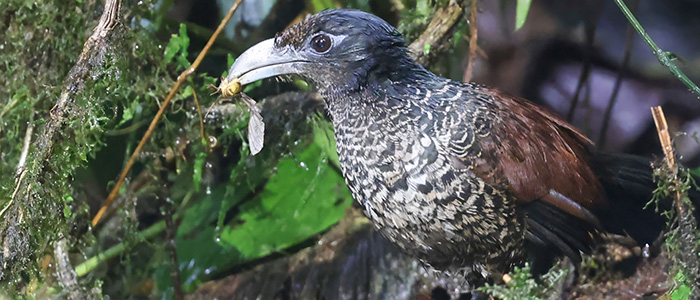
Tropical rainforests are home to almost two-thirds of all vertebrate species and three-quarters of all tree species: they are the most species-rich terrestrial ecosystem on Earth.
However, over half of these diverse rainforests have already been cleared, and their area continues to decline drastically, primarily for agricultural purposes. Is there a chance of regeneration, and can not only trees but also the unique diversity of thousands of animal species return to cleared areas?
The answer is surprisingly clear-cut and encouragingly positive: trees regrow rapidly on agricultural land as soon as land use ceases. A diverse range of animal species also re-establish themselves.
Biodiversity recovered to over 90% of its original level within 30 years. During this period, as many as three-quarters of the animal and plant species typical of primary forest returned.
This is reported by the Reassembly research group, which was funded by the German Research Foundation (DFG) ( www.reassembly.de ), in the leading journal Nature. Teams led by Professors Thomas Schmitt and Jörg Müller from the University of Würzburg's Biocentre contributed to the publication.
The study was conducted in north-western Ecuador
The group's findings apply, at least, to the study area in Chocó, in north-western Ecuador. In this region, there are still a few patches of undisturbed primary forest and larger areas of secondary forest. These form the reservoir for the many returning animal and plant species.
Researchers from over 30 universities and institutions have, for the first time, conducted a detailed study of the natural regeneration of 16 different groups of organisms (animal, plant and bacterial species) along a regeneration gradient.
A total of 62 sites were compared, all of which have been protected for several decades by the conservation organisation Jocotoco and integrated into a large nature reserve: actively used pastures and cocoa plantations, secondary forests of varying ages that were formerly used as pastures and plantations, and untouched primary forests.
Rainforest resilience proven empirically for the first time
Lead author Timo Metz carried out and summarised the extensive analyses as part of his PhD at Darmstadt Technical University.
He emphasises: "Rainforests, as complex ecosystems and species-rich communities, demonstrate remarkable resilience and the ability to return to their original state. This stability has often been modelled theoretically, but until now could not be demonstrated on the basis of such extensive empirical data."
Senior author Nico Blüthgen is Professor of Ecology at TU Darmstadt, spokesperson for the Reassembly research group and alumnus of the University of Würzburg. He initiated the studies together with Dr Martin Schaefer, director of the Ecuadorian conservation organisation "Jocotoco".
Nico Blüthgen emphasises: "The many rapidly returning animal species are not only beneficiaries of forest regeneration, but are also its key agents: bats, monkeys and other mammals, as well as birds, bring tree seeds back to the cleared areas; dung beetles bury the seeds in the soil; and hundreds of other animal species ensure pollination."
Martin Schaefer adds: "Our findings that 75% of species composition and 90% of species diversity return under their own steam within a single human generation show just how effectively we can protect nature. By purchasing and protecting land, we can preserve the diversity of life and the foundations of our societies - soil, water, and the pollination of the plants that form the basis of our food supply."
Contributions from the University of Würzburg's Biocentre
A total of 41 colleagues, mainly from Germany and Ecuador, were able to contribute their expertise to a study of over 8,500 species that is unique to date.
Professor Thomas Schmitt of the Chair of Animal Ecology and Tropical Biology at the University of Würzburg and his team have contributed to the assessment of dung beetles using dung and scent traps.
Another team around Professor Jörg Müller of the Würzburg Chair of Conservation Biology and Forest Ecology contributed to this research using acoustic methods, camera traps, artificial intelligence, and the identification of insect communities through genetic species scans. "With these new methods, we can assess promptly biodiversity of birds, mammals, frogs, and insects-as well as their recovery-even in the hyper diverse tropical forest, at an entirely new level," explains Jörg Müller.
"We will continue to develop this research over the next four years, thereby supporting Jocotoco in its conservation efforts throughout Ecuador. The application of artificial intelligence helps us scale up effective conservation", said Müller.
Mobile animals return relatively quickly
To date, various studies in Central and South America have clearly documented that the original diversity and biomass of trees require over 100 years to fully regenerate.
For most animal species, however, it was previously largely unknown whether and how quickly they could recover. The new study revealed clear differences between species groups: whilst some mobile animal groups regenerated within just a few years, communities of invertebrates in the leaf litter or bacteria in the soil take much longer than tree species.
A comparison of pastures and cocoa plantations revealed shorter regeneration times for the latter. Because the plantation trees are left in situ, shade-providing trees and foliage are already present in the early stages, rather than the highly competitive pasture grasses.
Protecting intact ecosystems remains important
Efforts to restore ecosystems are underway all over the world. The study impressively demonstrates that natural regeneration is worthwhile and can therefore help to motivate such conservation projects.
Nico Blüthgen, however, stresses how important the protection of intact ecosystems also is: "The rate of deforestation of tropical forests is currently much higher than the measures taken to protect them - almost 4-6 million hectares are lost worldwide every year. These annual losses are thus almost as high as the total area covered by all long-term restoration measures combined."
In addition to restoration, which should be massively expanded, the deforestation of virgin forests still untouched by humans must also stop, as promised in international agreements for this decade but not yet implemented.
"Furthermore, rapid natural regeneration only works as long as there are still sufficient intact forests in the landscape to act as seed sources," adds Blüthgen. There is therefore little time left for the urgently needed turnaround in the climate and biodiversity crisis.
Publication
Timo Metz et al.: "Biodiversity resilience in a tropical rainforest", Nature, 8 April 2026, DOI 10.1038/s41586-026-10365-2


