
By Tina Meketa, University Communications and Marketing
The University of South Florida increased its research activity to $531 million in fiscal year 2025 - a rise from last year and a 15% jump over the last two years - reinforcing the university's upward trajectory in an increasingly competitive national funding environment.
Research expenditures grew from $461 million in fiscal year 2023, reflecting sustained momentum and USF's ability to compete successfully for major federal awards and funding from other sources.
"The research environment is incredibly competitive and undergoing a dramatic reset. Sustained growth like this does not happen by accident. It reflects the reputation of USF's scholars who push the boundaries of discovery. They are helping delay the onset of dementia and advancing ways to use AI in disciplines from social work to health care to business. Our researchers are developing solutions that improve lives and strengthen the economy."
USF President Moez Limayem
The latest figures are reported in USF's submission to the National Science Foundation's Higher Education Research and Development (HERD) survey - the federal government's authoritative benchmark for measuring research activity at U.S. colleges and universities, which is typically released near the end of the calendar year.
In the most recent HERD ranking, USF is No. 47 nationally among public universities and No. 2 among Florida's public universities. Those rankings are based on USF's $522 million in research activity for fiscal year 2024.
"USF's continued rise in national research rankings reflects a focused commitment to advancing our research and teaching mission," said USF Provost and Executive Vice President Prasant Mohapatra. "At its core, USF's role is to translate discovery into meaningful outcomes that serve our communities."
The majority of USF's expenditures for fiscal year 2025 were derived from highly competitive federal awards from agencies such as the National Science Foundation, National Institutes of Health and the Department of Defense.
Expenditures from corporate sponsors increased 25% to $18 million last year - largely driven by an increase in clinical research for diseases such as Type 1 diabetes, Parkinson's disease and multiple sclerosis. Some of the top corporate sponsors included pharmaceutical companies Pfizer and Novo Nordisk, Abbott Diabetes Care and biotechnology company Genetech.
Here are some additional projects that reflect USF's strength across health innovation, workforce development and national security:
Advancing Alzheimer's prevention
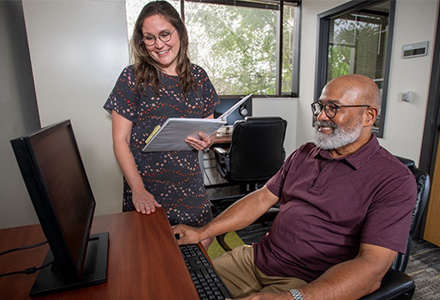
The PACT study is the largest study of its kind [Photo by Cliff McBride, University Communications and Marketing]
Jennifer O'Brien, associate professor of psychology in the College of Arts and Sciences, is leading an NIH-funded study exploring whether computerized brain training exercises can reduce the risk of cognitive impairment and dementia, including Alzheimer's disease.
"The PACT trial is the largest of its kind, both in amount of NIH funding ($44.5 million) and in its sample of 7,600 participants. If we find significant benefit of training to reduce dementia risk, the delay of dementia onset by even one year could result in approximately 9.2 million fewer cases over 30 years."
Strengthening the nursing workforce
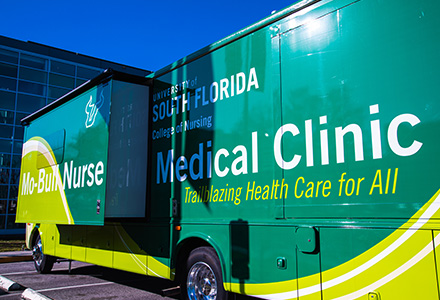
Mo-Bull Nurse Medical Clinic [Photo courtesy of the USF College of Nursing]
Usha Menon, dean of the College of Nursing, is spearheading a federally funded initiative supported by the U.S. Department of Health and Human Services to address the critical shortage of nurses, particularly those trained to care for medically underserved patients and individuals in primary care and community settings.
"Through a workforce development federal grant, we have the opportunity to scale up mobile health care by providing free primary care services to those most in need in the Tampa Bay area, while also training nurse practitioners and nursing students. With over 2,500 patient visits and nearly 340 students trained, the Mo-Bull Nurse Medical Clinic reflects the university's commitment to our community."
Accelerating space exploration
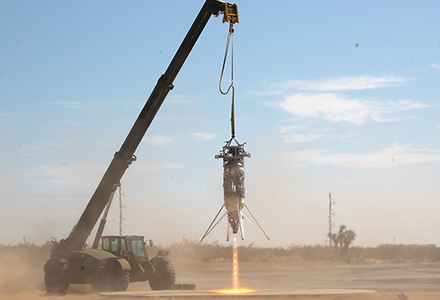
The technology was launched from the Mojave Air & Space Port in Mojave, California [Photo courtesy of Peter Jorgensen]
Peter Jorgensen, director of engineering for the USF Institute of Applied Engineering, and his team of staff members and USF students were selected by NASA to flight-test technology that could ultimately allow for low-cost, fully autonomous landing on the moon. Their Automated Lidar Scanning Topography technology collects data about surface features, such as rocks and craters, to generate an accurate topographical map for landing navigation and hazard avoidance.
"Leveraging our expertise in software, systems engineering and integration, the IAE team intends to dramatically reduce costs of precision landing technology, enabling increased potential for rapid lunar landings, further cementing U.S. leadership in space exploration and giving USF engineers incredible work to do."
Separate from research expenditures, USF also recently reached a record $750 million in total grants awarded in fiscal year 2025 - further demonstrating the scale, competitiveness and continued growth of its research enterprise.
The next HERD ranking, reflecting USF's $531million in fiscal year 2025 research activity, will be released later this year.


