
A new department-level research cluster at Binghamton University is betting that the answer to combating fake images and video generated by artificial intelligence is not better detectors, but real-world physics.
On Thursday, the Department of Electrical and Computer Engineering at the Thomas J. Watson College of Engineering and Applied Science launched the Cyber-Physical AI Trust and Integrity (CAITI) research cluster.
"Trust is becoming one of the defining challenges of the digital age, and the Department of Electrical and Computer Engineering at Binghamton University has been working on its physical foundations for decades, from sensor forensics and hardware security to quantum sensing," said Professor and ECE Chair Indranil Bhattacharya. "CAITI brings these efforts together under one vision: advancing our ability to understand, protect, and trust the digital evidence on which society increasingly depends."
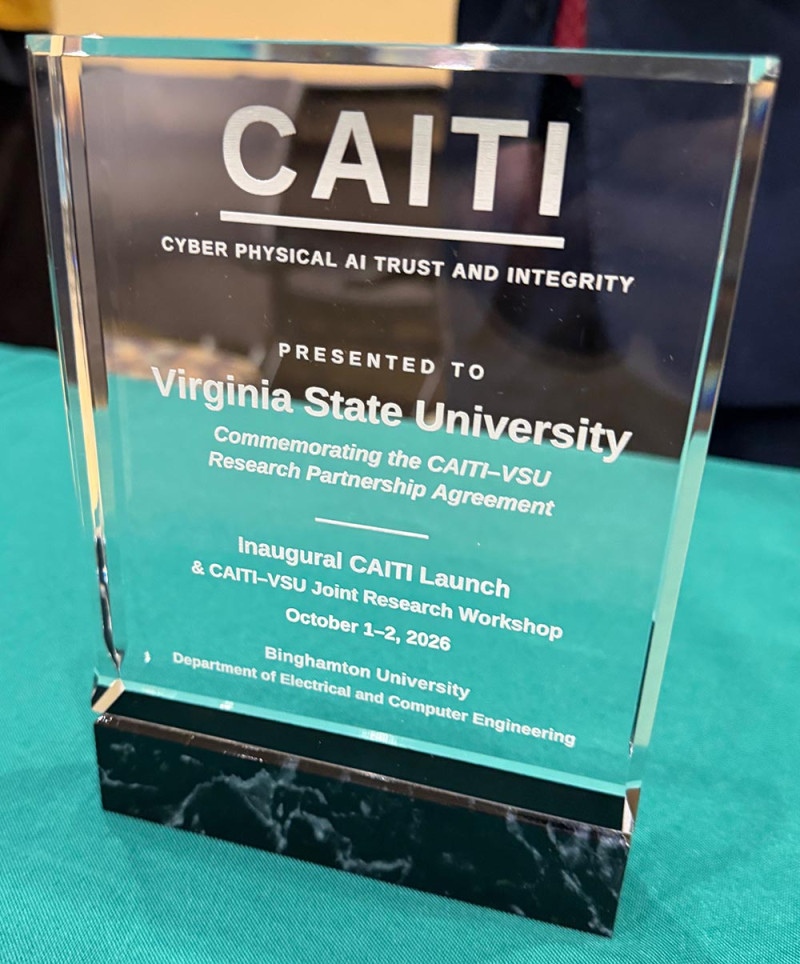
The researchers at CAITI will take a different angle than other AI detection methods, focusing on "physical anchors" that can offer clues about how content is produced.
All recordings made by real devices reflect the real world. A camera sensor has manufacturing imperfections unique to that sensor, and they appear faintly in every photo it takes. Audio and video recorded on mains electricity pick up fluctuations in the electrical grid's frequency. A microphone responds to real sound in ways governed by physics.
Generative models do not produce these markers, because their output never passed through those physical conditions.
The practical difference is in which question you ask. Detection asks whether something looks fake, and that question gets harder every time the generators improve. Anchoring asks whether the physical world left its signature, and that question keeps its answer.
"As AI gets better at synthesizing text, images, signals, and behavior, the trust that rests on software alone degrades, and physical anchors have to become first-class roots of trust," said Yu Chen, professor of electrical and computer engineering and leader of the CAITI cluster.
As part of the CAITI launch, the ECE Department also signed a research partnership statement with Virginia State University (a historically Black university) that names faculty for collaborations and commits the partners to joint research.
"Our faculty and students gain valuable opportunities for research collaboration and doctoral mentorship, while Binghamton gains a partner that can provide its doctoral students with meaningful teaching and professional experience," said Professor Joon Suk Lee, chair of VSU's Department of Computer Science.
"Over the years, Virginia State has hired Binghamton doctoral students and graduates as faculty members, helping them build teaching experience while strengthening our own academic programs. This partnership formalizes that longstanding relationship and creates new opportunities for our faculty and students to collaborate in research, graduate education, and other areas of shared interest."
Two of those hires attended the CAITI launch. Qian Qu and Nihal Poredi earned their doctorates in Chen's lab at Binghamton and are now VSU faculty members. Both presented their research Thursday morning.
The stronger ties to VSU are part of Binghamton University and Watson College's partnership with six historically Black colleges and universities around the country. In 2023, Thurgood Marshall College Fund established the New Educational and Research Alliance (newERA) to encourage research collaborations among faculty and students across the participating institutions.
"Watson College is proud of our partnership with universities in newERA," Dean Atul Kelkar said. "By bringing together our collective resources, knowledge, and expertise, these partnerships give us the strength and insight needed to meaningfully tackle today's most pressing societal challenges."
"Partnerships work best when they are grounded in mutual respect, complementary strengths, and shared benefit," said Dean Dawit Haile from VSU's College of Engineering and Technology. "Virginia State and Binghamton have built that kind of partnership - one with strong potential to expand student pathways, strengthen education, advance research, and create opportunities for broader economic impact. I am proud to witness that on behalf of Virginia State University."
As part of the CAITI launch, Professor Kevin Fu of Northeastern University gives the ECE Department's first-ever Distinguished Lecture on Friday. He is a fellow of the Institute of Electrical and Electronics Engineers (IEEE), the Association for Computing Machinery (ACM) and the American Association for the Advancement of Science (AAAS) who served as the federal Food and Drug Administration's first acting director of medical device cybersecurity. Fu's topic is "Not AI: Wicked Bizarre Semiconductor Physics of Sensor Security. Lies, AI."
SUNY Distinguished Professor Jessica Fridrich, an ECE faculty member, discusses her research at a talk titled "Sensor Fingerprint for Digital Forensics." A pioneer of camera-sensor fingerprint detection, she is a fellow of the IEEE and the National Academy of Inventors.
Other speakers include Michael Hayduk, associate director of the Information and Spectrum Warfare Directorate at the U.S. Air Force Research Laboratory, and two other AFRL researchers.
The event also features roundtable discussions and networking opportunities. Sponsoring the launch activities are Watson College, the IEEE Binghamton Section, the Institute for AI and Society, and the Griffiss Institute.
"We intentionally launched the cluster alongside our first Distinguished Lecture and our agreement with Virginia State University because meaningful research is built through people, ideas, and partnerships," Bhattacharya said. "CAITI is not simply bringing existing work together - it is creating a platform for new collaborations, new discoveries, and a broader community working together to shape the future of trustworthy technology."


