
UConn researcher Sukhmani Singh's new report to the Connecticut Sentencing Commission shows that people released under the state's juvenile parole law have low recidivism rates and face significant reentry challenges, informing ongoing debates about sentencing reform
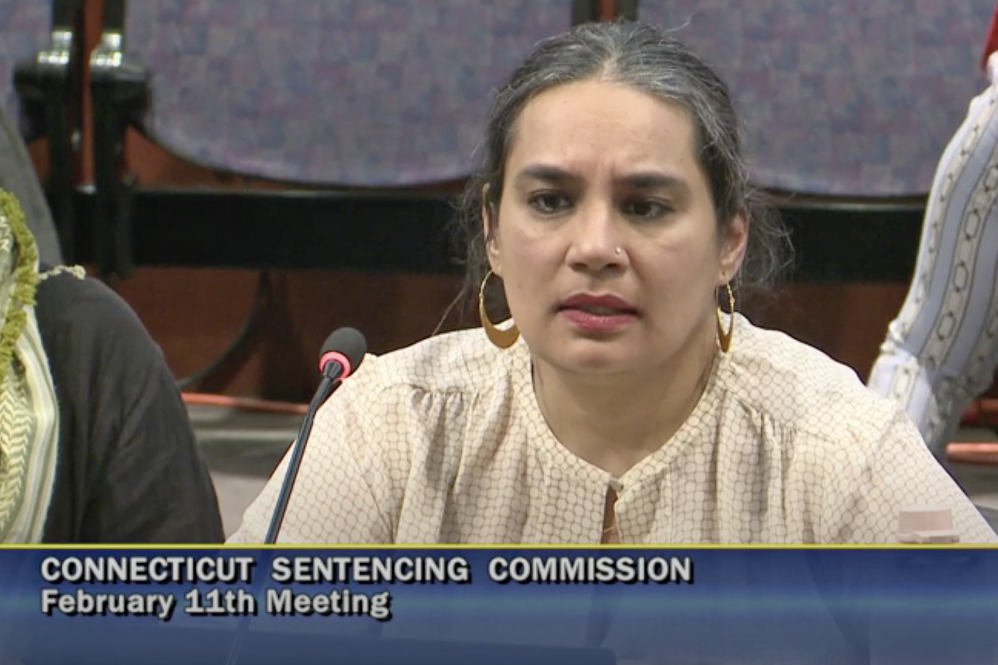
Sukhmani Singh, assistant professor in the UConn School of Social Work, presents findings from her participatory, mixed-methods study on juvenile parole beneficiaries to the Connecticut Sentencing Commission on Feb. 11.
More than a decade after Miller v. Alabama, 2012, when the U.S. Supreme Court ruled mandatory life-without-parole sentences for juveniles are unconstitutional, Connecticut is once again examining how it sentences young people.
Sukhmani Singh, assistant professor at the UConn School of Social Work, lead a participatory, multi-method research project and her work is helping shape this timely conversation.
On Feb. 11, Singh, along with UConn research affiliate and incoming doctoral student Fernando Valenzuela, and their community co-researcher, James Jeter, presented their findings to the Connecticut Sentencing Commission. Specifically, their study was an examination of the experiences of beneficiaries of Public Act No. 15-84, the state's 2015 law that created parole eligibility opportunities for individuals serving lengthy sentences for crimes committed as minors. Data included both qualitative interviews that Singh and Valenzuela conducted, as well as secondary, administrative data provided by the Board of Pardons and Parole on people released through 15-84.
"We should note that internationally, the United States is the only nation in the world that still says it's OK to sentence children to life in prison." -Sukhmani Singh
Singh, who is also affiliate faculty with the Center on Community Safety, Policing and Inequality at the UConn School of Law, served as principal investigator of the two-year study, which was funded by the Connecticut Sentencing Commission.
Their 83-page report, "Reentry After a Life Behind Bars: A Participatory, Mixed-Methods Approach to Understanding the Experiences of PA 15-84 Beneficiaries in Connecticut after Miller v. Alabama" sheds light on the experiences of people who received long or life sentences for crimes committed before age 18 and later became eligible for parole under 15-84.
"We should note that internationally, the United States is the only nation in the world that still says it's OK to sentence children to life in prison," Singh told the Commission.
As of January 2025, 123 individuals in Connecticut had been released from prison under Public Act 15-84. At the time of their offenses, they were approximately 17 years old on average, 99.2% male, and 96.7% people of color. Most had received total effective sentences of about 30 years for offenses including murder, manslaughter, or felony murder.
The quantitative findings show positive reentry outcomes:
- 75% are currently employed
- About 60% live with family members or romantic partners
- Individuals have spent an average of five years in the community
- 41% remain under Department of Correction supervision
- Approximately 11% returned to prison. By comparison, Connecticut's overall recidivism rate is about 49%.
Singh also placed Connecticut's data in a broader national context. Prior to the Supreme Court's Miller ruling, roughly 12,000 individuals across 44 states were serving juvenile life-without-parole or de facto life sentences. Since then, many states have expanded parole eligibility.
Research from states including California, Michigan, and Pennsylvania similarly shows low recidivism rates among individuals released after lengthy sentences for crimes committed as youth-all in the single digits.
"A lot of our national decarceration efforts have focused on low-level, nonviolent offenses," Singh said. "This population gives us a de facto test of safe and equitable decarceration, even for people who committed violent offenses."
Criminological research consistently shows that individuals age out of risky behavior, she added, raising questions about the public safety value of incarcerating people decades beyond adolescence.
"What the developmental science has shown us over the last 25 years is that young people are different from adults," Singh said. "The prefrontal cortex and limbic structures of the brain go through incredible transformation during adolescence and into early adulthood."
Life During Incarceration and Reentry Challenges
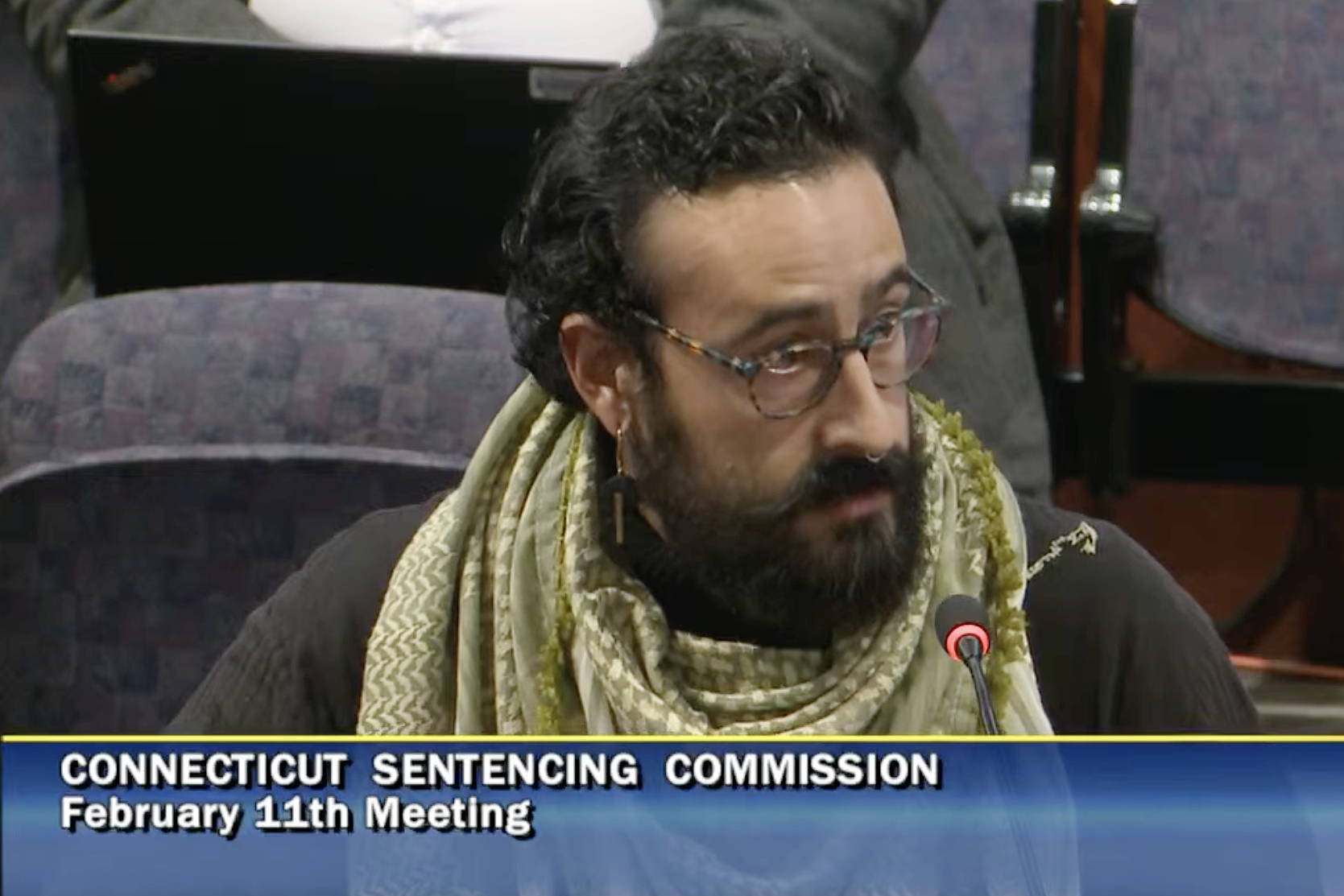
Beyond the quantitative findings, interviews conducted by Valenzuela and Singh revealed that reentry to society is complex after decades behind bars. Participants described challenges securing identification documents like state IDs and birth certificates which are necessary for moving around in society, adjusting to technological change, navigating employment discrimination and working hard labor jobs, and adjusting to being with family.
"All participants expressed living with remorse, many expressed a strong desire for education, stability, and meaningful contribution to society," Singh said.
The 11 participants interviewed entered prison at an average age of 16 and spent an average of 21 years incarcerated. They were released at an average age of around 40. At the time of the interviews, none were living in court-mandated housing, and most were renting independently.
Valenzuela said participants described the challenges of growing up in prison environments shaped by violence and long-term incarceration.
"They talked about having to mature very quickly," they said. "About navigating a culture where one participant described violence as the currency of prison."
At the same time, many expressed a deep desire for education and self-improvement but reported barriers to accessing programs within prisons because of their long sentences.
"If you had a long sentence, you were invisible," one participant said.
The researchers examined eight key areas of reentry and presented on the following four: documentation procurement, housing, employment, and reentry services.
They found that 73% of participants experienced problems obtaining essential identification documents such as Social Security cards, state IDs, or birth certificates upon release-barriers that delayed access to employment and healthcare.
Housing outcomes varied. Most participants initially lived with family members, which they described as critical to stability. Others entered halfway houses, sometimes by choice to save money before securing permanent housing.
Employment rates were high, with 82% of participants finding jobs through personal networks. Still, participants described financial strain and low wages in labor-intensive positions.
"If you find employment, they'll pay you pennies just enough so that you can survive," noted one interviewee. "You'll be eating cereal again for dinner for like two weeks because they're living paycheck to paycheck… people are doing the craziest -. They're just trying to make ends meet. I've seen a guy take toilet paper. It doesn't make sense to me. You're working full time and you need to steal toilet paper?"
"This is how much they're struggling," Valenzuela said. "People are working hard and not getting paid enough to meet their basic needs."
Experiences with reentry programs were mixed. Some participants benefited from trauma therapy or financial assistance programs. Others described receiving informational pamphlets but little tangible support.
"One participant emphasizes that they're given a Burlington Coat Factory voucher, but they don't have the means to actually go there," Valenzuela says.
Policy Recommendations
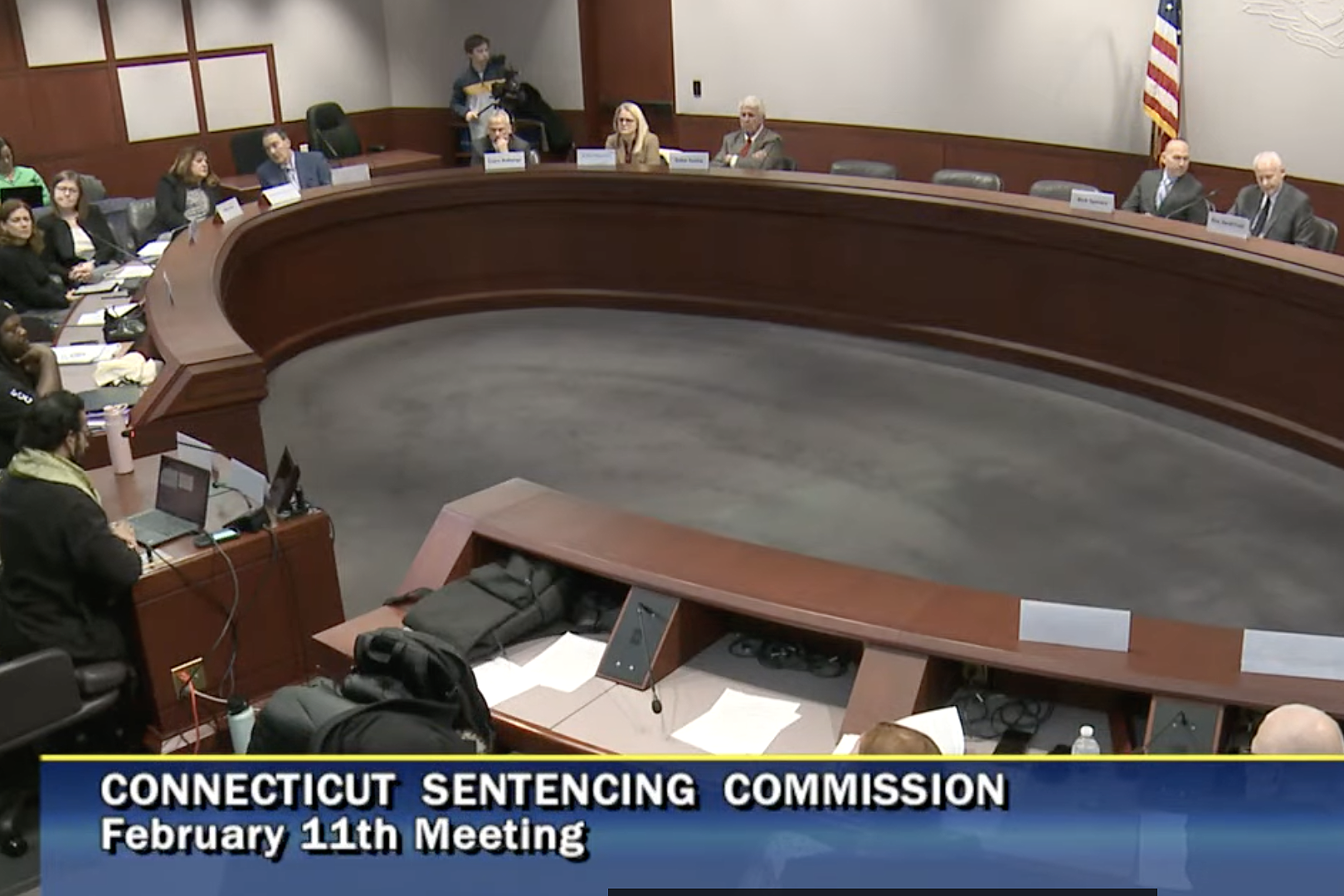
The researchers concluded with recommendations at legislative and community levels.
"As this legislative session moves forward, all eyes should be on how Connecticut addresses parole eligibility," Singh stated. "The evidence is clear. The question now is whether we are willing to align our policies with what the research shows."
Singh noted that it costs approximately $60,000 per year to incarcerate someone in Connecticut; a "conservative estimate" from a 2015 Vera Institute of Justice report. She urged lawmakers to determine parole eligibility based on age at the time of the offense rather than arbitrary sentencing dates (Public Act No. 23-169) and to consider expanding parole eligibility to individuals who committed crimes under age 26.
She also emphasized the importance of ensuring accurate release documentation, expanding access to prison education and rehabilitative programming regardless of sentence length, and supporting family connections during the period incarceration.
More broadly, she pointed to much needed investments in affordable housing, employment opportunities, healthcare access, education, and historically divested communities as central to long-term public safety.
"Nationally, the pre-incarceration experiences of people we label 'juvenile lifers' show that fewer than half were attending school at the time of their offense, and 85% had been suspended or expelled," Singh said. "We should be increasing investments in early childhood, in our schools, in education."
The presentation comes as Connecticut lawmakers consider proposals to expand early parole eligibility to additional individuals who committed crimes as young adults-potentially affecting hundreds of incarcerated people statewide.
"We need to remember, this is a population of people that have almost invariably experienced childhood trauma, violence and victimization pre-incarceration," Singh explained. "We know that when these young people who are incarcerated, the research suggests that they reckoned with their crimes. They've experienced recognition of the harm they caused and want to contribute to society as they are being released."


