
When a Norfolk Southern freight train derailed in East Palestine, Ohio, in February 2023, it released more than 115,000 gallons of vinyl chloride into the surrounding community. Although much of the early attention focused on immediate health concerns, a quieter danger may be unfolding in the livers of residents who were exposed, and a team of University of Kentucky and University of Pittsburgh researchers is already working to understand the long-term impacts.
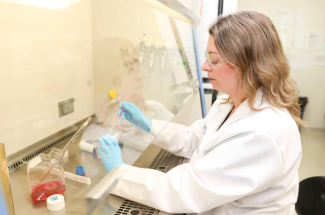
Lindsay C. Czuba, Ph.D., assistant professor in the UK College of Pharmacy Department of Pharmaceutical Sciences, has been awarded a pilot grant through the University of Kentucky Center for Appalachian Research in Environmental Sciences (UK-CARES) to investigate how chronic, low-level vinyl chloride exposure affects liver health and, importantly, how it alters the way the body processes medications.
Czuba's research builds on the East Palestine Train Derailment Health Research Program, funded by the National Institute of Environmental Health Sciences. Her work focuses on proteins that maintain bile acid regulation in the liver. Her goal is to translate these findings into new therapeutic targets for obesity and liver disease, while exploring molecular mechanisms underlying drug interaction-risk potential. The East Palestine pilot study is a natural extension of that work, applying her analytical expertise in bile acid biology to understand the liver health consequences of environmental vinyl chloride exposure.
Vinyl chloride is a known carcinogen linked to liver disease, including a condition called toxicant-associated steatohepatitis, or TASH, a form of liver inflammation and fat accumulation that can occur even at exposure levels not considered toxic, without typical warning signs on standard liver tests. What makes TASH particularly difficult to diagnose is that routine bloodwork may appear normal even as liver damage progresses.
Czuba's project, "Impact of Plasma Bile Acids in Vinyl Chloride-Induced Toxicant-Associated Steatohepatitis (TASH)," aims to change that. Her lab will analyze blood plasma samples from East Palestine community members to identify whether specific bile acids - natural cholesterol-derived molecules that regulate liver metabolism - can serve as early, noninvasive biomarkers for TASH.
"If we can establish that certain bile acid patterns in the blood correlate with liver disease severity in vinyl chloride-exposed individuals, we may be able to detect injury earlier and intervene sooner," said Czuba.
A critical concern for pharmacists and clinicians
The study carries particular significance for healthcare providers. Beyond detecting liver injury, Czuba's team will also measure biomarkers for two proteins central to liver drug processing: CYP3A4, an enzyme responsible for metabolizing more than half of all FDA-approved medications, and OATP1B1 and OATP1B3, transporters critical to the efficacy of commonly prescribed drugs, including statins. Disruption of these proteins can cause medications to accumulate to toxic levels or lose their effectiveness - a risk that may go entirely unrecognized in patients with vinyl chloride-induced TASH.
"This study could have real implications for how pharmacists and clinicians manage medications in patients who have been environmentally exposed to vinyl chloride," Czuba said. "If these detoxification pathways are compromised, standard drug dosing assumptions may not hold."
Building on an ongoing community health study
The pilot work builds on the existing "East Palestine Train Derailment Health Research Study," a larger ongoing investigation led by Erin N. Haynes, Dr.P.H., professor in the UK College of Public Health and UK-CARES director, in collaboration with researchers at the University of Pittsburgh, including Juliane I. Beier, Ph.D. Haynes serves as senior mentor on Czuba's pilot project and, along with Beier, coordinates recruitment, which will include paired plasma samples and liver FibroScan imaging from East Palestine community members.

"Partnering with the Czuba lab gives us the opportunity to expand our study's scope to include further exploration on the impact of the derailment on the hepatic health of this community," said Haynes. "Understanding how bile acid dysregulation relates to TASH severity will strengthen our overall picture of the long-term health impacts of this disaster."
The Czuba lab brings specialized analytical capabilities to the project, using advanced LC-MS/MS instrumentation to detect and quantify approximately 50 bile acid metabolites from small plasma samples - methods already validated in studies of drug metabolism during pregnancy. These techniques offer a level of precision that standard metabolomic screens cannot match.
The pilot study will include 60 to 100 participants across exposed and unexposed groups, with findings expected to support future grant applications and, potentially, a human drug interaction study.
The UK-CARES Pilot Program is funded by the National Institute of Environmental Health Sciences. It is designed to support early-career faculty pursuing innovative research at the intersection of environmental health and community impact.
Research reported in this publication was supported by the National Institute of Environmental Health Sciences of the National Institutes of Health under Award Number OT2ES038696. The content is solely the responsibility of the authors and does not necessarily represent the official views of the National Institutes of Health.


