Researchers map careers as rivers to show how independence evolves over time
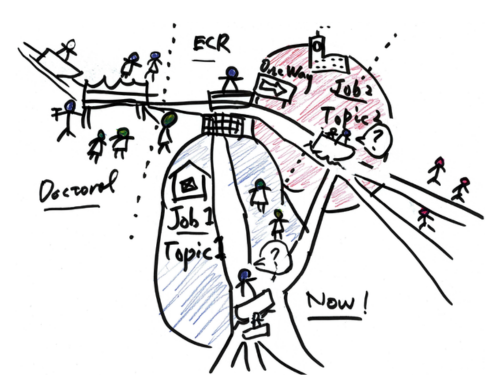
A new study shows that researcher independence is not a simple PhD milestone but rather an ongoing, uneven process. Lead author Associate Professor Yusuke Sakurai illustrates his academic journey as a "river of experience." (Illustration by Yusuke Sakurai, Hiroshima University, CC BY-NC-SA 4.0)
So you've finished your PhD - now what?
A PhD is often treated as the point where scholars become "independent." Yet, a new study by Hiroshima University shows that achieving independence is far less simple and tidy, unfolding instead as a long, uneven, river-like journey shaped by relationships, risks and resilience.
The study was published in Innovations in Education and Teaching International on May 18, 2026.
"Existing research often views researcher independence as a milestone or output of doctoral training, but this overlooks the complex developmental process that continues well beyond the PhD and arises from academic relationships and structures," said Yusuke Sakurai, associate professor from the Center for Academic Practice and Resources and the Research Institute for Higher Education at Hiroshima University and lead author of the study.
Using an innovative approach combining collaborative autoethnography with visually guided interviews, known as the "river of experience," the team drew on their own experience as six researchers in educational study across doctoral, early-career and mid-career stages, offering a rare, longitudinal perspective on how independence is actually experienced.
"Each participating researcher literally draws their career as a river, with bends, rapids, confluences, and calm stretches representing key moments in their development," Sakurai said.
The findings point to three core dimensions of researcher independence. First, it is a bumpy developmental process, marked by uncertainty, setbacks and gradual growth rather than a clear transition point. Second, it is an agentive, self-directed process in which researchers build skills, advance expertise, and navigate their careers through varied academic engagements. Third, it is created and affirmed through ongoing interactions between internal validation and external academic recognition.
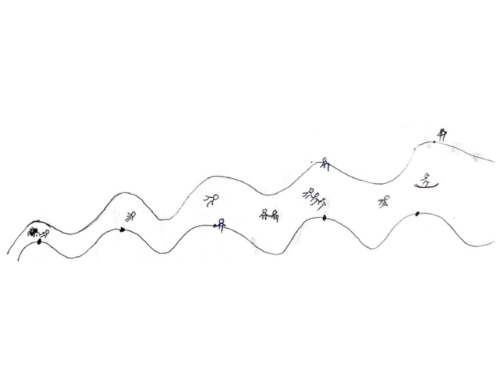
Illustrating co-author Wenjuan Cheng's academic journey. (Illustration by Wenjuan Cheng, Hiroshima University, CC BY-NC-SA 4.0)
"Rather than a simple transition from 'dependent doctoral student' to 'independent academic,' independence appears as a non‐linear, 'bumpy' process shaped by critical experiences such as conferences, job searches, rejections, supervision dynamics, and opportunities to review and mentor others," Sakurai said.
Importantly, the findings show that independence is fashioned as much by external conditions as by internal growth. Relationships with supervisors and peers, institutional expectations, and structural challenges - particularly precarious employment - can all enable or constrain a researcher's ability to act independently. Even experienced researchers may struggle to feel truly independent when they lack the freedom to choose their projects or roles.
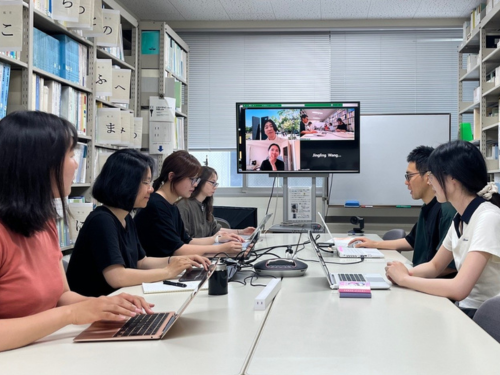
Associate Professor Yusuke Sakurai is pictured with students during class. (Yusuke Sakurai, Hiroshima University)
By moving beyond the narrow framing of independence as a one-time achievement, the study offers a more realistic understanding of it as a dynamic, lifelong process formed by both individuals and the systems they work within.
Looking ahead, the team aims to inform more sustainable and intentional approaches to researcher training, particularly as the global research community continues to grow.
"We hope future research will examine other disciplines and settings, using longitudinal designs to track how researchers negotiate independence across different stages and contexts," Sakurai said.
The research team also includes Jin Yu of the University of Glasgow, UK; Dangeni of Anglia Ruskin University, UK; Anding Shi and Kelsey Inouye of the University of Oxford, UK; and Wenjuan Cheng of Hiroshima University, Japan.
About the study
- Journal: Innovations in Education and Teaching International
- Title: How researchers across career stages experience researcher independence: A visual collaborative autoethnography
- Authors: Yusuke Sakurai, Jin Yu, Dangeni, Anding Shi, Wenjuan Cheng & Kelsey Inouye
- DOI: 10.1080/14703297.2026.2666368